Facts
The Petitioner, which operated “Magmus Bar and Restaurant” in Khar, Mumbai, held the requisite licences for its bar and restaurant business.
Source reference: no citationOn 16 May 2025, it applied for premises and performance licences under the Maharashtra Police Act, 1951 and the Rules for Licensing and Controlling Places of Public Amusements, 1960 (“Public Amusement Rules”) to conduct live music/orchestra performances at its premises.
Source reference: para. 3–4The Senior Police Inspector, Khar Police Station, after inspection, reported that the prescribed requirements were satisfied and raised no objection to the grant of the licences; the Assistant Commissioner of Police also issued a No Objection Certificate.
Source reference: para. 5, 36Nevertheless, the Deputy Commissioner of Police rejected the application on the general ground that granting the licence might cause a law-and-order problem and disturb social harmony, without identifying supporting reasons or material.
Source reference: para. 6, 34The Divisional Commissioner dismissed the Petitioner’s statutory appeal, referring generally to non-compliance with Rule 108 and affirming the rejection without independent reasoning.
Source reference: para. 7, 33During the writ proceedings, the State relied on earlier criminal cases, subsequent complaints, registration of CR No. 471 of 2026, and a Government Circular dated 27 July 2026 restraining the grant or renewal of orchestra licences.
Source reference: para. 9–11, 21–22Issues
Whether the Licensing Authority could refuse the premises and performance licences merely on an unsubstantiated apprehension that the proposed orchestra/live music performance might create a law-and-order problem.
Source reference: para. 28–38, 48, 54Whether the orders of the Licensing Authority and the Appellate Authority were arbitrary and unreasonable for failing to disclose the objective material and reasons supporting the refusal.
Source reference: para. 34–38, 42, 54Whether subsequent complaints, previously quashed criminal proceedings, and the Government Circular dated 27 July 2026 could retrospectively justify the original refusal.
Source reference: para. 39–42, 52–53Whether executive instructions could override or supplant the statutory scheme governing premises and performance licences under the Public Amusement Rules, 1960.
Source reference: para. 52–53Law Applied
The Court applied Sections 33(1)(w) and 33(1)(wa) of the Maharashtra Police Act, 1951, which empower regulation and licensing of places of public amusement in the interests of public order, safety and general welfare.
Source reference: para. 24Under Rules 107, 108, 108-A and 110 of the Public Amusement Rules, a premises licence is required, the application must satisfy prescribed conditions, and refusal under Rule 110 must be based on circumstances such as obstruction, inconvenience, danger, traffic problems, harm to national interest or an actual law-and-order problem.
Source reference: para. 27–29Rule 116 requires a separate performance licence, while Rule 120 permits refusal where the proposed performance is indecent, offensive, seditious, likely to cause breach of peace, or otherwise objectionable; reasons are required where refusal is under the residuary clause.
Source reference: para. 30–32The exercise of licensing discretion must therefore be reasonable, non-arbitrary and supported by objective material.
Source reference: para. 38The Court also applied Article 19(1)(g), read with Article 19(6), protecting the right to carry on an occupation or business subject only to reasonable restrictions in the public interest.
Source reference: para. 43–44Relying on Hotel Priya, A Proprietorship v. State of Maharashtra, 2022 SCC OnLine SC 204, Shivaji Sambu Waghralkar v. Commissioner of Police, Navi Mumbai, 2026 SCC OnLine Bom 2409, Indian Hotel and Restaurant Association (AHAR) v. State of Maharashtra, (2019) 3 SCC 429, and State of Punjab v. Devans Modern Breweries Ltd., (2004) 11 SCC 26, the Court held that regulated entertainment activities cannot be refused on stereotypical or unsubstantiated notions of morality or public disorder, and that executive instructions cannot override or supplant statutory rules.
Source reference: para. 45–53Reasoning
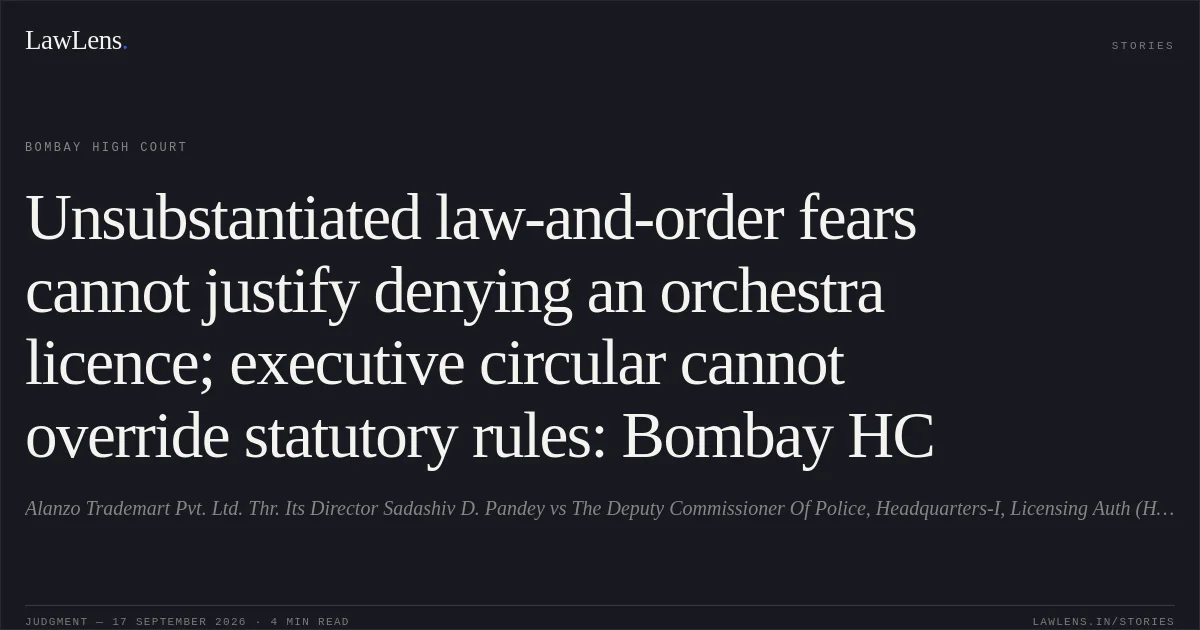
The Court found that the Licensing Authority’s order contained only the bare assertion that the proposed orchestra might create a law-and-order problem, without identifying any facts, evidence or objective material supporting that conclusion.
Source reference: para. 34This was particularly unsustainable because the jurisdictional police inspection found compliance with the applicable requirements, including the location, road width, absence of nearby sensitive establishments, parking facilities and soundproofing, and expressly raised no objection.
Source reference: para. 36–37Although the Licensing Authority possessed discretion under Rules 110 and 120, that discretion was neither unfettered nor immune from judicial review; an ipse dixit could not satisfy the requirement of reasonable and non-arbitrary decision-making.
Source reference: para. 38The earlier criminal cases relied upon by the authorities had already been quashed and therefore could not validly support the refusal.
Source reference: para. 39Complaints made after the impugned order could not be used to retrospectively supplement reasons absent from that order.
Source reference: para. 40–42The Court further held that live music/orchestra performance was not inherently dangerous, immoral or injurious to the public, and that the later Government Circular could not override the statutory licensing framework.
Source reference: para. 44, 48, 52–53Holding
The Court held that the refusal of the licences was arbitrary and unreasonable because it was based solely on an unsupported apprehension of a law-and-order problem, despite the Petitioner’s compliance with the prescribed requirements and favourable police reports.
The order dated 2 June 2026 passed by the Divisional Commissioner and the order dated 10 October 2025 passed by the Licensing Authority were quashed and set aside.
Source reference: para. 55The Licensing Authority was directed to grant the Petitioner a performance licence to operate an orchestra/live music performance within four weeks from communication of the judgment.
Source reference: para. 55The Petition was allowed, Rule was made absolute, and there was no order as to costs.
Source reference: para. 55Acts & Sections Cited
1 provisions across 1 statute referred to in this judgment. Each provision opens on LawLens.
Bharatiya Nyaya Sanhita, 20231
Original Court PDF
Alanzo Trademart Pvt. Ltd. Thr. Its Director Sadashiv D. PandeyvsThe Deputy Commissioner Of Police, Headquarters-I, Licensing Auth (Hotel Branch) And Anr
Click to open original judgment
Original judgment, available to read, download and summarize on LawLens.in