Facts
The petitioner No. 1, a registered cooperative society, obtained a work order from the West Bengal State Marketing Board for construction of a pucca stall with a two-storied foundation at Khochabari Hat under the R.K.V.Y. Scheme, pursuant to N.I.T. No. 39/2011–2012 and an agreement dated 14 May 2012.
Source reference: para. 8–9, p. 3The tender amount was ₹32,66,865.
Source reference: para. 8–9, p. 3The petitioners claimed that the work was completed on 16 August 2016 and the remaining electrical work on 15 February 2018, but ₹17,00,000 remained unpaid.
Source reference: para. 10–11, pp. 3–4The respondents contended that the work was completed beyond the stipulated and extended periods and that compensation was consequently imposed at 0.0182% per day of the tender amount.
Source reference: para. 12–13, pp. 4–6After deductions, ₹6,78,345 was paid as the final amount, which the respondents asserted was accepted in full and final settlement.
Source reference: para. 12–13, pp. 4–6The petitioners sought a writ of mandamus directing payment of ₹17,00,000 with interest.
Source reference: no citationThe writ petition was initially dismissed for default on 14 January 2025; the Court subsequently condoned the 51-day delay, recalled the dismissal order, and restored the writ petition.
Source reference: paras. 3–6, p. 2The agreement contained an arbitration clause referring contractual disputes to arbitration.
Source reference: para. 15, pp. 6–7Issues
Whether the petitioners were entitled to a writ of mandamus directing payment of ₹17,00,000 with interest, notwithstanding the respondents’ contention that the final payment had been made after deducting compensation.
Source reference: paras. 7, 11–14, pp. 2–6Whether the disputed question concerning the date and manner of completion of the contractual work could be adjudicated in writ jurisdiction.
Source reference: para. 17, p. 7Whether the existence of the contractual arbitration clause constituted an alternative remedy requiring the petitioners to pursue arbitration.
Source reference: paras. 15–16, pp. 6–7Law Applied
The Court applied the principle that writ jurisdiction under Article 226 of the Constitution is discretionary and is ordinarily not exercised where an efficacious alternative remedy is available, particularly where the dispute involves disputed questions of fact.
Source reference: para. 17, p. 7It relied on Whirlpool Corporation v. Registrar of Trade Marks, Mumbai, (1998) 8 SCC 1, which recognises that the High Court may nevertheless entertain a writ petition despite an alternative remedy in cases involving enforcement of fundamental rights, breach of natural justice, proceedings wholly without jurisdiction, or a challenge to the vires of legislation or subordinate rules.
Source reference: para. 16, p. 7The Court also applied the contractual arbitration clause, under which disputes relating to the contract, execution or failure to execute the work were referable to arbitration.
Source reference: para. 15, pp. 6–7Reasoning
The Court found that completion of the work within the stipulated or extended period was disputed.
Source reference: paras. 13–14, pp. 5–6The respondents asserted that the extension expired on 16 August 2016 and that electrical work continued until 15 February 2018, justifying compensation and payment of only ₹6,78,345; the petitioners disputed the applicability of that deduction.
Source reference: paras. 13–14, pp. 5–6Resolving this controversy required examination of contractual obligations, the extension of time, the completion dates, the compensation decision, and the alleged acceptance of final payment.
Source reference: para. 17, p. 7Such disputed factual and contractual matters could not appropriately be determined in writ proceedings.
Source reference: para. 17, p. 7Since the agreement expressly provided for arbitration and none of the exceptional circumstances identified in Whirlpool was established, the Court declined to exercise writ jurisdiction on the merits.
Source reference: paras. 15–17, pp. 6–7Holding
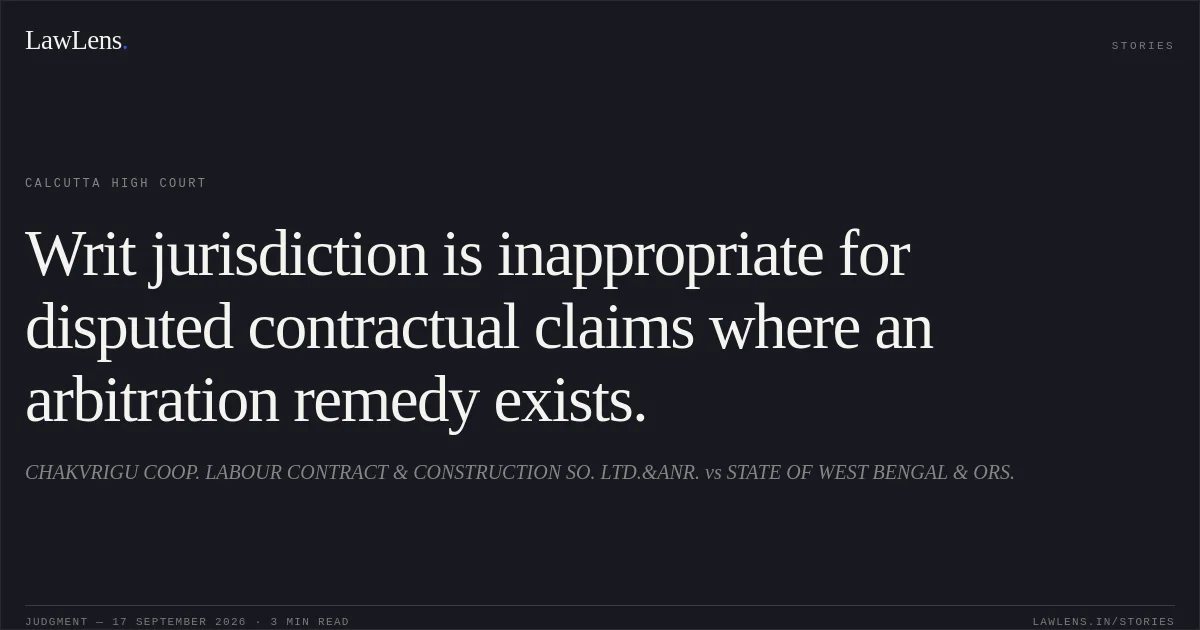
The Court dismissed WPA 19048 of 2019, holding that the claim for the alleged unpaid amount could not be adjudicated in writ jurisdiction because it involved disputed questions of fact and was covered by the contractual arbitration clause.
The dismissal did not preclude the petitioners from invoking arbitration; if arbitration was pursued and an arbitrator appointed, the dispute was to be decided on its merits without being influenced by the observations in the judgment.
Source reference: para. 19, p. 8Any interim order stood vacated.
Source reference: para. 20, p. 8Original Court PDF
CHAKVRIGU COOP. LABOUR CONTRACT & CONSTRUCTION SO. LTD.&ANR.vsSTATE OF WEST BENGAL & ORS.
Click to open original judgment
Original judgment, available to read, download and summarize on LawLens.in