Facts
The petitioner, a company incorporated under the Companies Act, 1956, operates an e-commerce-based direct-selling business through independent representatives, selling products such as water purifiers, nutritional products, jewellery and watches.
Source reference: p. 4–10It asserted that its receipts were consideration for genuine sales and that it neither accepted deposits nor charged fees from its representatives.
Source reference: p. 4–10The State issued a notification dated 29 June 2021 under Section 5(1) of the Karnataka Protection of Interests of Depositors in Financial Establishments Act, 2004 (“KPIDFE Act”), appointing the competent authority, and another notification under Section 3(2) directing ad interim attachment of the petitioner’s properties.
Source reference: p. 3–4, 15–16The notifications were published in the Official Gazette on 12 November 2021.
Source reference: p. 3–4, 15–16The petitioner initially challenged the constitutional validity of Sections 2(2), 2(4), 3, 6(2)(e) and 6(2)(f) of the KPIDFE Act, besides challenging the notifications.
Source reference: p. 2, 11–12During arguments, however, it did not press the constitutional challenge and confined its case to contending that it was not a “financial establishment,” that its receipts were not “deposits,” and that the notifications were issued in violation of natural justice.
Source reference: p. 2, 11–12The respondents contended that complaints had been received alleging inducement to invest money, promises of returns or commissions, failure to provide promised benefits and diversion of funds.
Source reference: p. 15–19They maintained that the Government had formed the statutory opinion required under Section 3(2) and that the petitioner had an effective remedy before the Special Court constituted under the Act.
Source reference: p. 15–19Issues
Whether the petitioner could be excluded from the operation of the KPIDFE Act merely because it described its activities as e-commerce or direct selling, and whether the amounts received by it were necessarily outside the definition of “deposits.”
Source reference: para. 12; p. 20–22Whether the impugned notifications under Sections 5(1) and 3(2) of the KPIDFE Act were liable to be quashed for want of jurisdiction, insufficient material or violation of natural justice.
Source reference: para. 5, 12–14; p. 11–12, 22–25Whether the disputed questions concerning the nature of the transactions, the source of funds and the alleged deposit-taking activity could be adjudicated in a writ petition under Articles 226 and 227, or were required to be decided by the statutory forum.
Source reference: para. 8–10, 14–15; p. 14–19, 23–25Law Applied
The Court applied the KPIDFE Act, particularly Sections 2(2), 2(4), 3(2), 3(3), 5(1) and 10.
Source reference: p. 16–18, 21–22The statutory definitions and scheme require the Court to examine the substance, rather than merely the label, of an arrangement to determine whether money was received as a “deposit” and whether the entity constituted a “financial establishment.”
Source reference: p. 16–18, 21–22However, ordinary sale consideration received in the normal course of business, where goods or services are supplied against payment, would not ordinarily constitute a deposit.
Source reference: p. 21Section 3(2) permits ad interim attachment where the Government has sufficient material to form the prescribed statutory opinion; a full trial is not required at the attachment stage, since the attachment is provisional and subject to adjudication by the Special Court.
Source reference: p. 22–24The Court also recognised the principle that statutory power with serious consequences cannot be exercised casually and must be founded on some relevant material, as reflected in The Government of Mysore v. J.V. Bhat, 1975 1 SCC 1110.
Source reference: p. 12–13The respondents also relied on State of Maharashtra v. MOONS Technology Ltd., (2022) 6 SCC 363, K.K. Baskaran v. State, (2011) 3 SCC 793, and New Horizons Sugar Mills Ltd. v. Government of Pondicherry, (2013) AIR SC 584, concerning the validity and operation of depositor-protection legislation.
Source reference: p. 18–19Reasoning
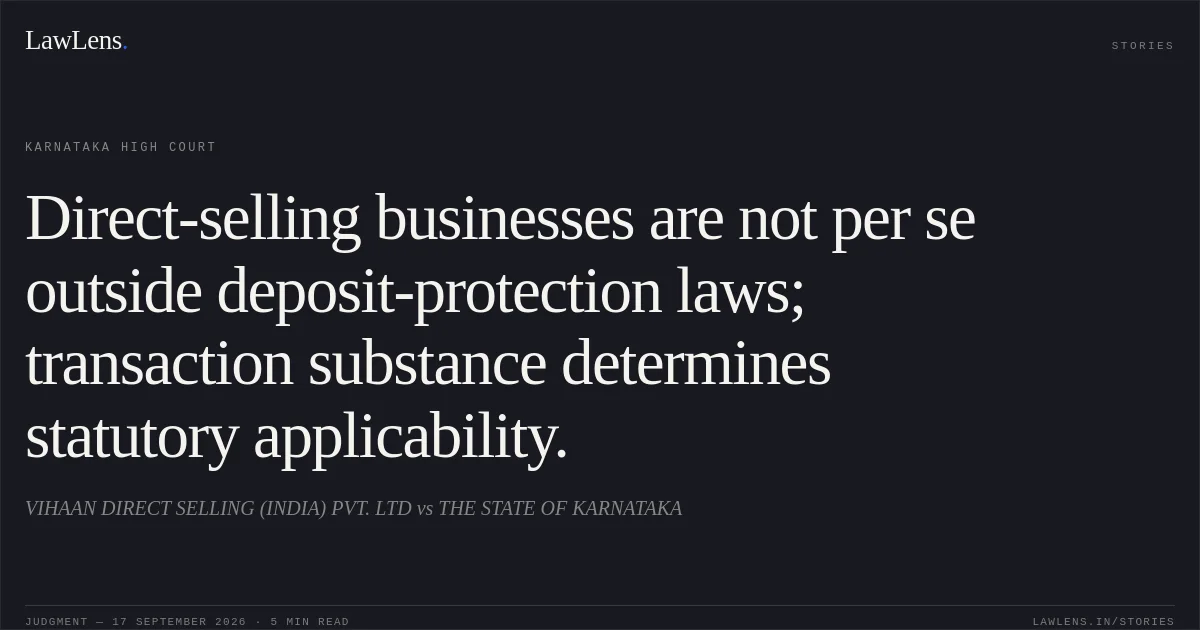
The Court rejected both extreme positions: the petitioner could not contend that e-commerce or direct selling could never fall within the KPIDFE Act, while the State could not treat every receipt by a direct-selling business as a deposit.
Source reference: p. 20–22The decisive consideration was the real nature of the transactions.
Source reference: p. 20–22A genuine purchase of goods followed by delivery in the ordinary course would ordinarily fall outside the Act; however, if product sales formed only part of a broader arrangement involving collection of money from the public in return for promised returns, benefits or income opportunities, the arrangement required substantive examination.
Source reference: p. 21The Court found that the impugned action was not shown to have been initiated merely because the petitioner conducted direct-selling activities.
Source reference: p. 23Complaints had been received, an investigation had been undertaken, and material was placed before the Government before the notifications were issued.
Source reference: p. 23Determining whether the petitioner’s receipts were genuine sale proceeds or deposits would require examination of individual transactions, payment structures, goods supplied, contractual terms, promised benefits and the flow of funds—issues unsuitable for final determination on affidavits in writ jurisdiction.
Source reference: p. 23–24Since the attachment was only an interim protective measure and the Special Court could determine whether the properties were traceable to depositor funds, the Court declined to substitute writ review for the statutory adjudicatory process.
Source reference: p. 23–25Nevertheless, it clarified that attachment could not continue indefinitely without the statutory proceedings being taken to their logical conclusion.
Source reference: p. 24Holding
The Court held that the petitioner could not be treated as outside the KPIDFE Act solely on the basis of its description as an e-commerce or direct-selling company.
Whether its receipts constituted genuine business revenue or “deposits” under the Act involved disputed factual and evidentiary questions that had to be determined by the competent statutory forum.
Source reference: para. 13–15; p. 20–25The writ petition was disposed of without quashing the impugned notifications.
Source reference: p. 25The petitioner was granted liberty to raise all its contentions, including that the amounts received represented genuine consideration for goods and services and were excluded from the definition of “deposit,” before the Special Court constituted under the Act.
Source reference: p. 25The Court expressly stated that it had not expressed any opinion on the merits, directed the Special Court to decide the matter independently and in accordance with law, and closed all pending interlocutory applications.
Source reference: p. 25Acts & Sections Cited
5 provisions across 1 statute referred to in this judgment. Each provision opens on LawLens.
KARNATAKA PROTECTION OF INTEREST OF DEPOSITORS IN FINANCIAL ESTABLISHMENTS ACT, 20045
Original Court PDF
VIHAAN DIRECT SELLING (INDIA) PVT. LTDvsTHE STATE OF KARNATAKA
Click to open original judgment
Original judgment, available to read, download and summarize on LawLens.in