Facts
The Respondent, an employee of the Department of Posts, had earlier received a minor penalty of censure under Rule 16 of the Central Civil Services (Classification, Control and Appeal) Rules, 1965 (“CCS (CCA) Rules”) for negligence and misconduct.
Source reference: p. 2, para. 4(a)On 21 June 2020, he was allegedly involved in the fraudulent transfer of government funds of Rs. 8,81,276/- by misusing Finacle credentials; a complaint was lodged by the Postmaster on 16 July 2020, and the employee allegedly admitted the misconduct in writing.
Source reference: p. 2, para. 4(b)-(c)In the context of an alleged larger misappropriation of approximately Rs. 1 crore, he deposited Rs. 10 lakhs into the Government account as an Unclassified Receipt.
Source reference: p. 3, para. 4(d)He was placed under suspension under Rule 10(1) of the CCS (CCA) Rules on 17 July 2020, and two FIRs were registered on 20 and 21 July 2020.
Source reference: p. 3, para. 4(e)-(f)A memorandum of charges under Rule 14 was issued on 1 June 2021 but withdrawn on 30 June 2021 owing to defects in the statement of imputations.
Source reference: p. 3, para. 4(g)-(i)A fresh charge memorandum was issued on 6 January 2025. An Enquiry Officer and Presenting Officer were appointed on 18 February 2025, and the departmental inquiry commenced through sittings held between 13 March and 25 July 2025.
Source reference: p. 3-4, para. 4(j)-(n)At the employee’s instance, the Central Administrative Tribunal, Kolkata Bench, stayed the departmental inquiry on 7 August 2025.
Source reference: p. 4, para. 4(o)-(q)On 5 January 2026, the Tribunal revoked the suspension and directed that specified periods of suspension be treated as duty, with entitlement to full salary.
Source reference: p. 4-5, paras. 5 and 11Issues
Whether the Tribunal was justified in revoking the employee’s suspension despite the seriousness of the allegations of financial misappropriation and the pendency of the departmental and criminal proceedings?
Source reference: p. 4-6, paras. 5-8, 11Whether the employee could seek revocation of suspension while simultaneously obtaining a stay of the departmental inquiry, thereby preventing the employer from concluding the disciplinary proceedings?
Source reference: p. 5-6, paras. 6-10Whether the Tribunal was justified in directing that the suspension period be treated as duty and granting salary for that period merely because of delay in reviewing the suspension?
Source reference: p. 7-8, para. 11Law Applied
The Court applied Rule 10(1) of the CCS (CCA) Rules, 1965, which empowers the disciplinary authority to place an employee under suspension where disciplinary or criminal proceedings are pending or contemplated, subject to payment of suspension allowance.
Source reference: p. 3, para. 4(e); p. 5, para. 6It also considered Rule 14, governing major-penalty disciplinary inquiries, and Rule 16, under which the employee had earlier received a minor penalty.
Source reference: p. 2-3, para. 4(a), (h)The Court reiterated that suspension is ordinarily within the employer’s discretion, that the employee is entitled to suspension allowance, and that prolonged inquiry may, depending on the employee’s conduct, justify reduction of that allowance rather than automatic reinstatement.
Source reference: p. 5, para. 6It further held that departmental proceedings and criminal prosecution are conceptually distinct: departmental charges are determined on the preponderance of probabilities, whereas criminal guilt must be proved beyond reasonable doubt; the pendency of a criminal case does not, by itself, prevent disciplinary proceedings from continuing.
Source reference: p. 6-7, para. 9The Court relied on Chairman, LIC v. A. Masilamani, Ajit Kumar Nag v. General Manager, Indian Oil Corporation Ltd., Ragunath Vishnu Patil v. R.N. Gavande, Lalit Popli v. Canara Bank, and the other authorities cited at page 6-7, paragraph 9.
Source reference: p. 6-7, para. 9Reasoning
The Court found that the allegations against the employee were grave, involving alleged misuse of official Finacle credentials and misappropriation of substantial government funds, and that the employee had deposited Rs. 10 lakhs in the Government account.
Source reference: p. 5, para. 6Given his alleged access to passwords and sensitive systems, the Court held that his reinstatement during the pendency of the proceedings could expose the establishment to further risk.
Source reference: p. 5-6, para. 7The employee had obtained a stay of the departmental inquiry while also seeking revocation of suspension.
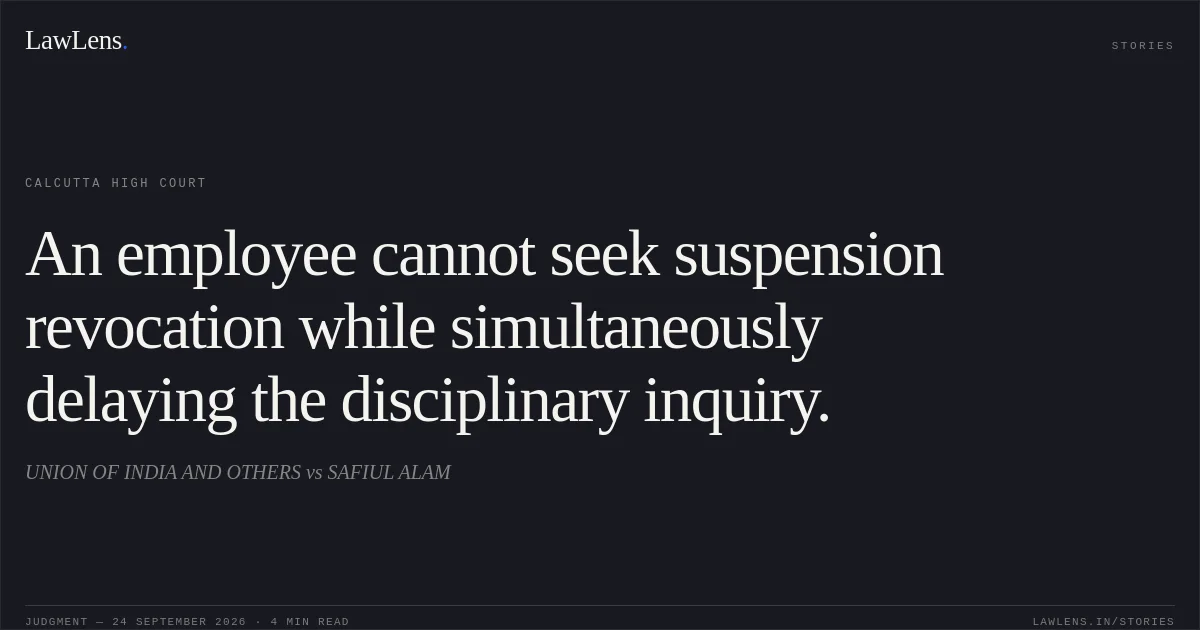
Source reference: p. 5-6, paras. 6-10The Court held that he could not claim both reliefs: suspension could not be revoked on the ground of delay when the employee himself had contributed to prolonging the inquiry by obtaining its stay.
Source reference: p. 5-7, paras. 7-10The employer nevertheless remained under a legal obligation to conclude the inquiry in accordance with law, and the Tribunal’s stay prevented that obligation from being fulfilled.
Source reference: p. 5-7, paras. 7-10The Court further held that delay in reviewing suspension, by itself, was insufficient to invalidate the suspension or justify treating the suspension period as duty, particularly in view of the serious charges and the continuing criminal and departmental proceedings.
Source reference: p. 7-8, para. 11Holding
The High Court allowed the writ petition and quashed the Tribunal’s order dated 5 January 2026 and the corrected order dated 9 January 2026, which had revoked the suspension and directed payment of salary by treating the relevant suspension periods as spent on duty.
The Court held that the employee could not simultaneously secure a stay of the departmental inquiry and seek revocation of suspension, especially where the charges involved serious alleged financial misconduct and access to official systems.
Source reference: p. 5-7, paras. 7-10The suspension was consequently restored, while the employee was held entitled to suspension allowance in accordance with the applicable Rules.
Source reference: p. 8, paras. 12-13Original Court PDF
UNION OF INDIA AND OTHERSvsSAFIUL ALAM
Click to open original judgment
Original judgment, available to read, download and summarize on LawLens.in