Facts
The petitioner, initially appointed as an Assistant Teacher in 1995 and promoted as a Physical Training Instructor in 2005, was assigned additional charge of Assistant Director (Sports/Physical Education) in the office of the Joint Director, Public Instruction, Gwalior, on 06.10.2023.
Source reference: para. 2After subsequent transfer-related litigation involving both employees, a Coordinate Bench directed the Commissioner, Public Instruction, to reconsider the assignment of charge of Assistant Director and pass an appropriate order. In compliance, the Commissioner passed the impugned order dated 17.07.2026, assigning the additional charge to respondent No. 4 and directing the petitioner to serve on his substantive post at Murar, District Gwalior.
Source reference: paras. 5–6Issues
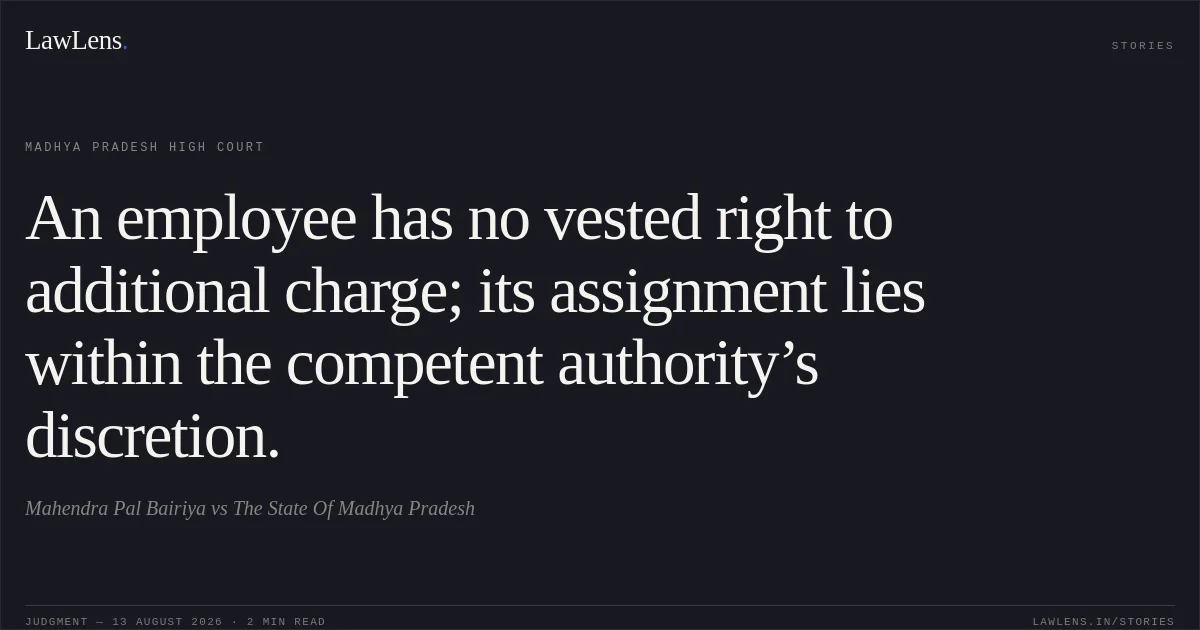
Whether the petitioner had a legal or vested right to continue holding the additional/current charge of Assistant Director (Sports Education/Physical Education).
Source reference: paras. 9–11Whether the Commissioner’s decision to assign the additional charge to respondent No. 4, on the basis of administrative discretion, suitability and seniority, was liable to be set aside.
Source reference: paras. 5–12Whether the respondents should be directed to appoint a regular Assistant Director instead of continuing an in-charge arrangement.
Source reference: para. 12Law Applied
The High Court exercised its jurisdiction under Article 226 of the Constitution.
Source reference: para. 1It applied the principle that assignment of an in-charge or additional charge is an administrative arrangement and does not confer a vested, enforceable or continuing right upon an employee; the competent authority retains discretion to select an eligible and suitable employee having regard to administrative requirements.
Source reference: paras. 9–11Relying on Ramakant Shripad Sinai Advalpalkar v. Union of India & Others, 1991 Supp (2) SCC 733, the Court reiterated that an in-charge arrangement is not necessarily based on seniority and cannot create rights, equities or legitimate expectations.
Source reference: para. 11Reasoning
The Court found that the impugned order had been passed by the competent Commissioner in compliance with the earlier judicial directions.
Source reference: para. 9Since the assignment was only an additional-charge arrangement, the petitioner could not claim its continuation as a matter of right. The competent authority was entitled to assess suitability and administrative requirements, and had considered respondent No. 4, who was stated to be senior to the petitioner, more suitable for the charge.
Source reference: paras. 9–10The petitioner’s contention that he had previously held the charge and had no adverse complaint did not establish any vested entitlement or demonstrate legally sustainable arbitrariness. Consequently, the Court declined to interfere with the administrative decision.
Source reference: paras. 10–12Holding
The petition was dismissed, and the impugned order dated 17.07.2026 assigning the additional charge to respondent No. 4 was upheld.
The Court held that no employee can claim an in-charge post as a matter of right. However, it directed the respondents to post a regular Assistant Director in the office of the Joint Director, Public Instruction, Gwalior, instead of continuing the charge arrangement, if possible and in accordance with law.
Source reference: para. 12Original Court PDF
Mahendra Pal BairiyavsThe State Of Madhya Pradesh
Click to open original judgment
Original judgment, available to read, download and summarize on LawLens.in