Facts
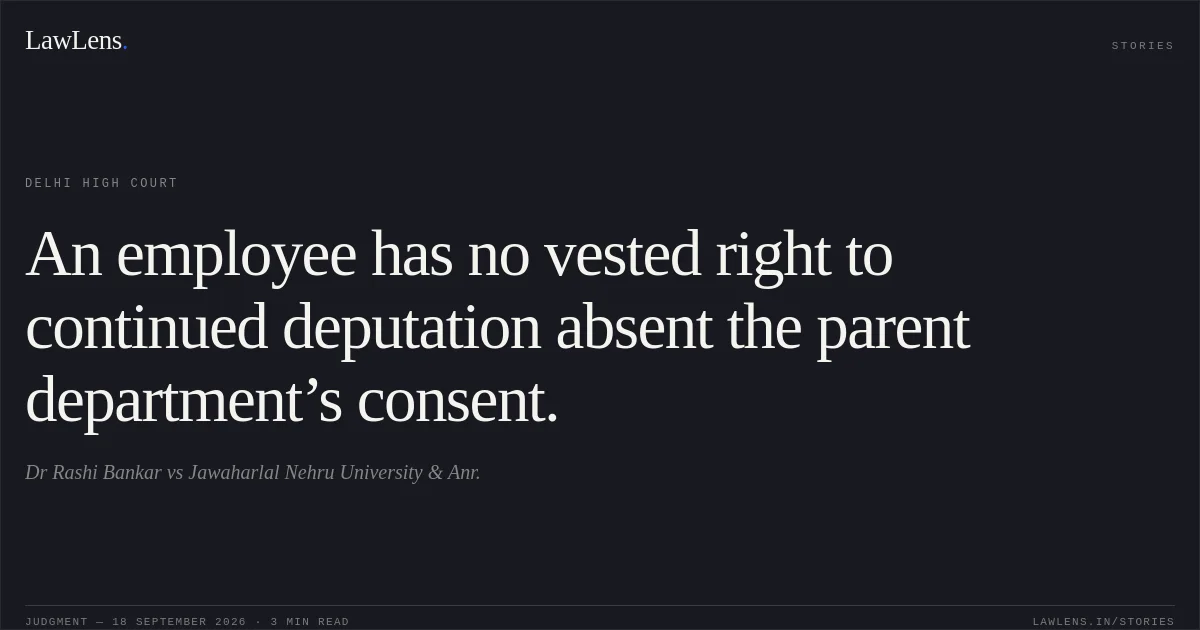
The appellant, a Senior Technical Assistant employed by Jawaharlal Nehru University (JNU), was appointed on deputation as Assistant Director (Technical) with the Food Safety and Standards Authority of India (FSSAI), after obtaining JNU’s No Objection Certificate.
Source reference: p.2, para. 2When JNU initially did not relieve her, this Court directed it to do so by order dated 27 July 2022; she thereafter joined FSSAI for a three-year deputation commencing on that date.
Source reference: p.2, para. 3JNU subsequently consented to a one-year extension, and FSSAI extended the deputation until 26 July 2026.
Source reference: p.2, para. 4Before expiry, FSSAI sought JNU’s consent for a further extension from 27 July 2026 to 26 July 2027, stating that the appellant was clear from a vigilance perspective.
Source reference: p.2, para. 4By communication dated 16 July 2026, JNU declined consent, citing an acute staff shortage and the appellant’s earlier commitment to the Vice-Chancellor that she would not seek any further extension.
Source reference: pp. 2–3, para. 5The appellant was repatriated and granted Child Care Leave, but challenged JNU’s decision through a writ petition. The learned Single Judge dismissed the writ petition, leading to the present intra-court appeal.
Source reference: p.3, para. 6; p.1, para. 1Issues
1. Whether the appellant had an enforceable right to seek continuation or further extension of her deputation with FSSAI despite JNU’s refusal to consent.
Source reference: p.3, para. 8; p.4, paras. 9–102. Whether JNU’s communication dated 16 July 2026, declining the further deputation extension on the grounds of staff shortage and the appellant’s prior undertaking, was arbitrary or otherwise liable to be quashed.
Source reference: p.3, para. 7; p.4, para. 10Law Applied
The Court applied the principle that deputation requires the concurrence of three parties: the borrowing department willing to take the employee, the parent department willing to lend the employee’s services, and the employee willing to serve on deputation; in the absence of any one of these elements, deputation cannot be claimed as a matter of right.
Source reference: p.4, para. 9Relying on State of Punjab v. Inder Singh, (1997) 8 SCC 372, the Court reiterated that an employee has no absolute right either to be appointed on deputation or to continue on deputation.
Source reference: p.3, para. 8The parent department’s decision whether to extend deputation primarily depends on its administrative needs, including staffing requirements.
Source reference: p.4, para. 10A prior commitment made by the employee as a condition or basis for an earlier extension may also be relied upon against a subsequent claim for further extension.
Source reference: pp. 4–5, para. 10Reasoning
The Court held that although FSSAI was willing to retain the appellant and the appellant herself wished to continue, JNU’s consent was independently necessary for the extension.
Source reference: p.4, para. 9JNU had expressly recorded that it was facing an acute shortage of staff, constituting a legitimate administrative reason for refusing to lend the appellant’s services for a further period.
Source reference: p.4, para. 10In addition, the appellant had earlier obtained the one-year extension as a special case after assuring the Vice-Chancellor that she would not seek any further extension. The Court found that this commitment bound the appellant and supported JNU’s refusal.
Source reference: pp. 4–5, para. 10Since the appellant possessed no absolute right to continuation on deputation and JNU’s decision was based on relevant considerations, the refusal was neither arbitrary nor legally unsustainable.
Source reference: p.5, paras. 11–12Holding
The Court answered both issues against the appellant.
It upheld the learned Single Judge’s dismissal of the writ petition and found no ground to interfere with JNU’s communication dated 16 July 2026 refusing further extension of the appellant’s deputation.
Source reference: p.5, paras. 11–12The appeal was accordingly dismissed, with no order as to costs.
Source reference: p.5, para. 13Original Court PDF
Dr Rashi BankarvsJawaharlal Nehru University & Anr.
Click to open original judgment
Original judgment, available to read, download and summarize on LawLens.in