Facts
The petitioner, a retired Indian Navy employee, applied pursuant to an advertisement dated 3 November 1998 for one post of House Matron in the U.P. Sainik School, Sarojini Nagar, Lucknow.
Source reference: paras. 4–5, 54–55He was selected by a Selection Committee and appointed as House Matron with effect from 29 June 1999.
Source reference: paras. 5–14, 56–57By order dated 9 May 2003, the respondents terminated his services with effect from 10 May 2003 on the ground that his services were no longer required.
Source reference: paras. 36–39, 128The High Court stayed the termination order on 24 July 2003 and permitted the petitioner to continue as House Matron; the Special Appeal against that interim order was dismissed.
Source reference: paras. 40–41, 58–59The petitioner thereafter continued in service and ultimately retired on 8 October 2024.
Source reference: paras. 48–50, 105–106Issues
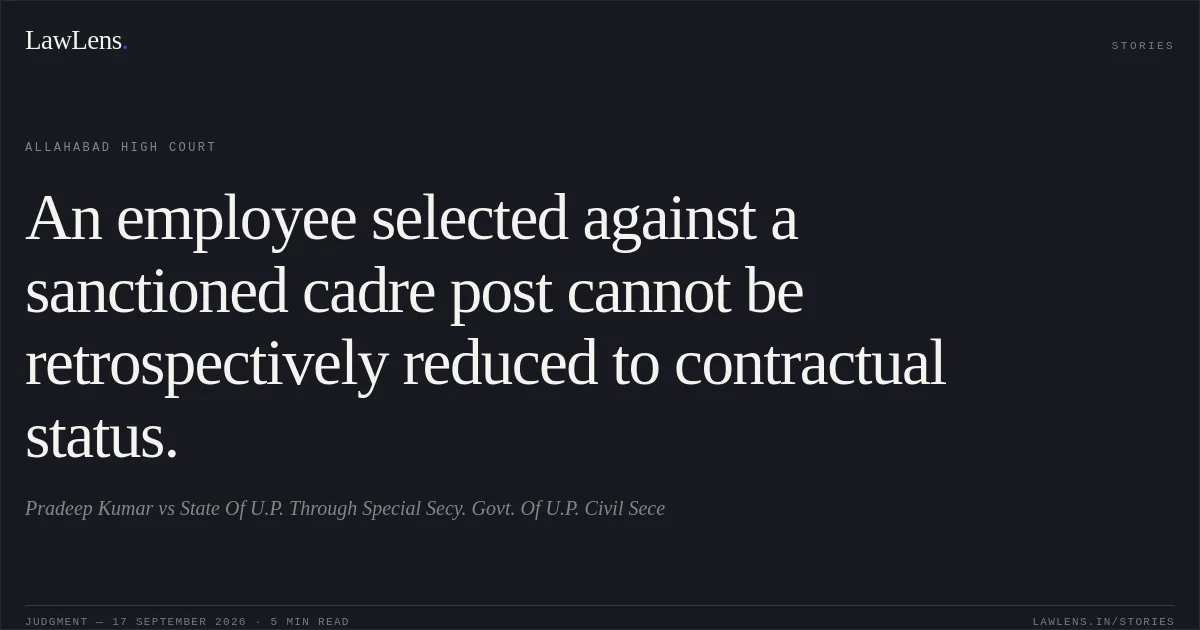
Whether the petitioner’s initial appointment as House Matron was made against a sanctioned cadre post pursuant to the recruitment procedure under the Rules, 1970, or was purely contractual in nature?
Source reference: paras. 62–68, 95–103Whether the respondents could, after the petitioner’s selection and appointment, treat him as a contractual employee and pay him consolidated remuneration contrary to the advertisement and Rule 20 of the Rules, 1970?
Source reference: paras. 70–73, 108–115Whether the termination order dated 9 May 2003, allegedly based on the absence of further need for the petitioner’s services, was legally sustainable when the post and work of House Matron continued?
Source reference: paras. 36–39, 127–134Whether the petitioner was entitled to continuity of service, regular-scale pay fixation, arrears, qualifying service and consequential retiral and pensionary benefits up to his superannuation?
Source reference: paras. 136–153Law Applied
The Court applied the U.P. Sainik Schools (Ministerial Establishment) Service Rules, 1970: Rule 3 read with Appendix I treats House Matron as part of the sanctioned establishment; Rule 4 provides for direct recruitment; Rules 12, 13, 15 and 16 prescribe recruitment, selection and appointment from the select list; Rule 18 prescribes two years’ probation for appointment against a substantive vacancy; Rule 19 provides for confirmation after satisfactory probation; and Rule 20 mandates the pay scale specified in Appendix I even for persons appointed in an officiating or temporary capacity.
Source reference: paras. 60–65, 97–100, 136–140The Court relied on Somesh Thapliyal v. Vice Chancellor, H.N.B. Garhwal University, holding that acceptance of employer-imposed conditions does not prevent an employee from challenging terms inconsistent with statutory requirements; M.D. Zamil Ahmed v. State of Bihar, that the State cannot take advantage of its own lapse after prolonged continuation without fraud or suppression; Lokendra Kumar Tiwari v. Union of India, that a regular recruitment process cannot be arbitrarily converted into a contractual appointment; and Bedanga Talukdar and K. Manjusree, that the terms of recruitment cannot be altered after the selection process.
Source reference: paras. 110–118The Court also applied the constitutional principles of non-arbitrariness under Articles 14 and 16, and the principle of equal pay for equal work as explained in Randhir Singh v. Union of India, while cautioning that long service alone does not create a right to regularisation.
Source reference: paras. 125, 130–131The Court distinguished Rajasthan SRTC v. Paramjeet Singh and Chief Executive Officer, Zila Parishad, Thane v. Santosh Tukaram Tiware, which concerned appointments expressly contractual or stopgap and lacking a regular selection process.
Source reference: paras. 119–122Reasoning
The Court found that the petitioner’s entry into service was materially different from a back-door or stopgap appointment.
Source reference: paras. 98–103, 117He had responded to a published advertisement for a sanctioned post, was sponsored through the Employment Exchange, was selected by a Selection Committee and appointed by the competent authority; there was no allegation of fraud, suppression or manipulation.
Source reference: paras. 98–103, 117The advertisement and governing Rules did not authorise an indefinite contractual appointment or consolidated remuneration, and the nomenclature used in subsequent extension orders could not override the statutory framework.
Source reference: paras. 104–110Rule 20 independently required payment of the prescribed scale, and the petitioner’s acceptance of consolidated wages, in circumstances of unequal bargaining power, did not amount to waiver of a statutory entitlement.
Source reference: paras. 110–112, 130–131The Court further held that repeated extensions and artificial breaks could not defeat the substance of the continuing employment relationship, particularly when the petitioner performed the same duties and the employer repeatedly required his services.
Source reference: para. 127The termination order’s stated reason—that his services were no longer required—was inconsistent with the subsequent advertisement for the same post and the continued availability of the work.
Source reference: para. 128Although the interim order did not itself create a substantive right, the petitioner’s continuation for approximately twenty-six years, combined with the original lawful selection, sanctioned post and conduct of the respondents, reinforced the conclusion that he had continued against the House Matron post rather than under an independent contractual arrangement.
Source reference: paras. 104–107, 134–135Since there was no valid order extending probation for recorded reasons and the petitioner’s work had consistently been appreciated, the Court held that the respondents could not indefinitely postpone the statutory consequences of the appointment by withholding confirmation and continuing to label the petitioner as contractual.
Source reference: paras. 136–139His service was therefore required to be recognised for pay fixation, increments, qualifying service and retiral benefits, subject to verification of the service record and applicable rules.
Source reference: paras. 140–143Holding
The writ petition was allowed.
The termination order dated 9 May 2003 was quashed.
Source reference: para. 146The challenge to the advertisement dated 7 June 2003 was treated as infructuous because the petitioner had continued in service and retired on 8 October 2024.
Source reference: para. 146The petitioner was directed to be treated as having continued against the sanctioned post of House Matron from 28/29 June 1999, subject to verification of the original service record.
Source reference: para. 147The respondents were directed to notionally fix his pay in the prescribed scale from the date of initial appointment, grant admissible increments, allowances and pay revisions, and calculate arrears after crediting the consolidated remuneration already paid.
Source reference: paras. 147–149The respondents were further directed to revise the petitioner’s last pay, pension, qualifying service, provident fund and other retiral benefits, and release the consequential monetary benefits.
Source reference: paras. 150–152The entire exercise was to be completed within four months of production of the certified order, with payment to follow within two further months.
Source reference: paras. 150–152Acts & Sections Cited
5 provisions across 3 statutes referred to in this judgment. Each provision opens on LawLens.
Indian Penal Code, 18603
Code of Criminal Procedure, 19731
General Clauses Act, 18971
Original Court PDF
Pradeep KumarvsState Of U.P. Through Special Secy. Govt. Of U.P. Civil Sece
Click to open original judgment
Original judgment, available to read, download and summarize on LawLens.in