01Facts
The petitioner was appointed as an unskilled labourer in the Shahapur Sub-Registrar’s office by order dated 5 November 2012.
¶ 2He claimed that he continued working after 2014, although his attendance-register evidence related only to February 2014; the State disputed that he worked after that month and stated that his appointment was not renewed.
¶ 2, 6, 8After seeking regularisation and arrears of salary through representations and a legal notice, he applied to the Karnataka State Administrative Tribunal for relief.
¶ 2The Tribunal rejected his application on 9 January 2026, finding no evidence of an extension of his appointment.
¶ 2, 8The petitioner challenged that decision under Articles 226 and 227 of the Constitution.
¶ 1, 302Issues
i.1. Whether the Tribunal was justified in rejecting the petitioner’s claims for arrears of salary and regularisation where he failed to establish that he continued working after February 2014 or that his appointment had been extended.
¶ 2, 8–9ii.2. Whether the Tribunal’s order disclosed an error warranting interference under Articles 226 and 227 of the Constitution.
¶ 1, 903Law Applied
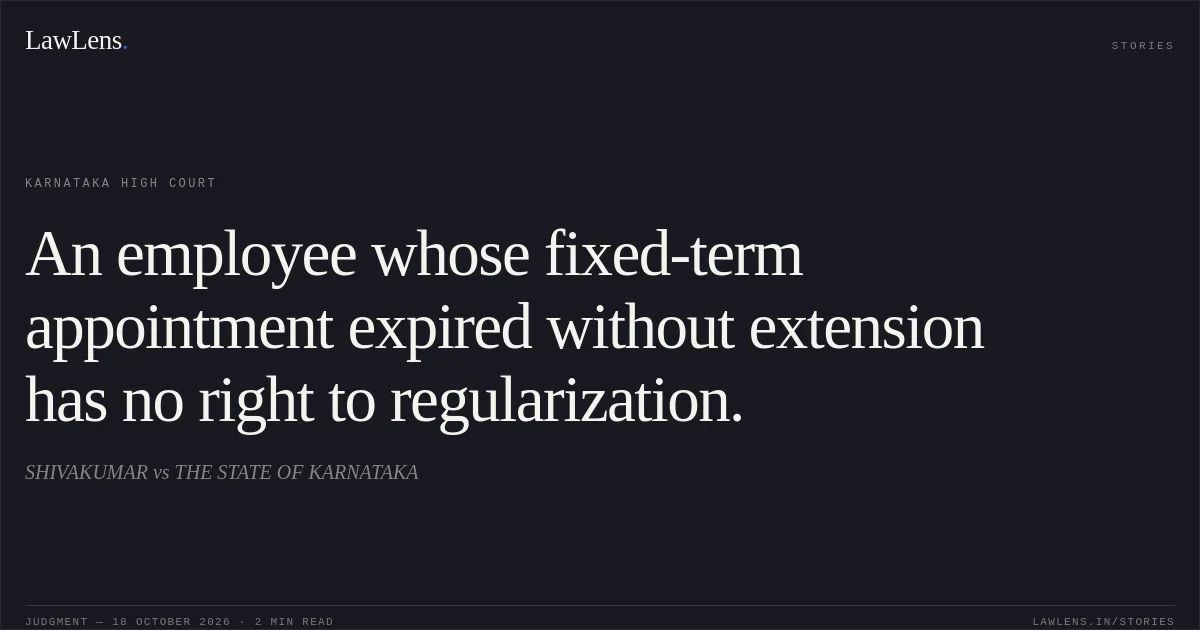
The Court applied the principle that an employee appointed for a fixed term cannot claim a right to continue in service after that term expires without evidence that the appointment was extended; absent such a right to continue, regularisation is not available on the facts of the case.
¶ 9The petition invoked Articles 226 and 227 of the Constitution, under which the High Court considered whether the Tribunal’s order warranted interference.
¶ 1, 9The judgment cited no statute or precedent governing regularisation.
04Reasoning
The Court found no material establishing that the petitioner continued to discharge duties after February 2014 and no extension order renewing his appointment.
¶ 8It therefore upheld the Tribunal’s finding that the appointment had not been renewed and concluded that the petitioner had no right to continue in service after the contractual period.
¶ 8–9Since regularisation could not be claimed without a right to continue, and the Tribunal had considered the material on record, the High Court found no basis to interfere.
¶ 905Holding
The Court answered both issues against the petitioner.
¶ 9–10It held that the Tribunal had rightly rejected the claim for regularisation and arrears in the absence of proof of continued employment or an extension of appointment, found no error warranting writ interference, and dismissed the writ petition.
¶ 9–10Original Court PDF
SHIVAKUMARvsTHE STATE OF KARNATAKA
Click to open original judgment
Original judgment, available to read, download and summarize on LawLens.in