Facts
The respondent worked as a security guard with the petitioner from 1 November 2011 at monthly wages of ₹5,500.
Source reference: no citationHe claimed that, after demanding payment of notified minimum wages, his services were terminated on 31 May 2017.
Source reference: no citationThe petitioner contended that the respondent had voluntarily abandoned employment after the completion of a site contract and had declined deployment to another site.
Source reference: no citationThe Labour Court rejected this defence, noting that the petitioner neither established the date of alleged abandonment nor issued any show-cause notice, absenteeism memo, or notice requiring the respondent to resume duty.
Source reference: pp. 2–3; paras. 2–5The Labour Court also rejected the petitioner’s reliance on a movement order dated 1 September 2020 and a subsequent letter dated 9 January 2021, finding that the alleged offer of re-employment was an afterthought and was not made during conciliation, minimum-wages proceedings, or the Labour Court proceedings.
Source reference: pp. 3–4; paras. 6–8It held that the termination was illegal.
Source reference: no citationSince the respondent had subsequently rejoined service, the Labour Court awarded ₹80,000 as lump-sum compensation in lieu of back wages for the period from 31 May 2017 to 31 August 2020, with interest at 8% per annum if payment was not made within thirty days of publication of the Award.
Source reference: pp. 1, 4–5; paras. 1, 10–12The petitioner challenged that Award before the High Court.
Source reference: no citationIssues
1. Whether the petitioner proved that the respondent had voluntarily abandoned his employment, rather than having been illegally terminated on 31 May 2017.
Source reference: pp. 2–4; paras. 3–92. Whether the petitioner’s alleged offer of re-employment through the movement order dated 1 September 2020 and letter dated 9 January 2021 was genuine and sufficient to defeat the respondent’s claim for back wages.
Source reference: pp. 3–4; paras. 6–8, 113. Whether the Labour Court’s award of ₹80,000 as lump-sum compensation in lieu of back wages warranted interference under the High Court’s writ jurisdiction.
Source reference: pp. 4–5; paras. 10–15Law Applied
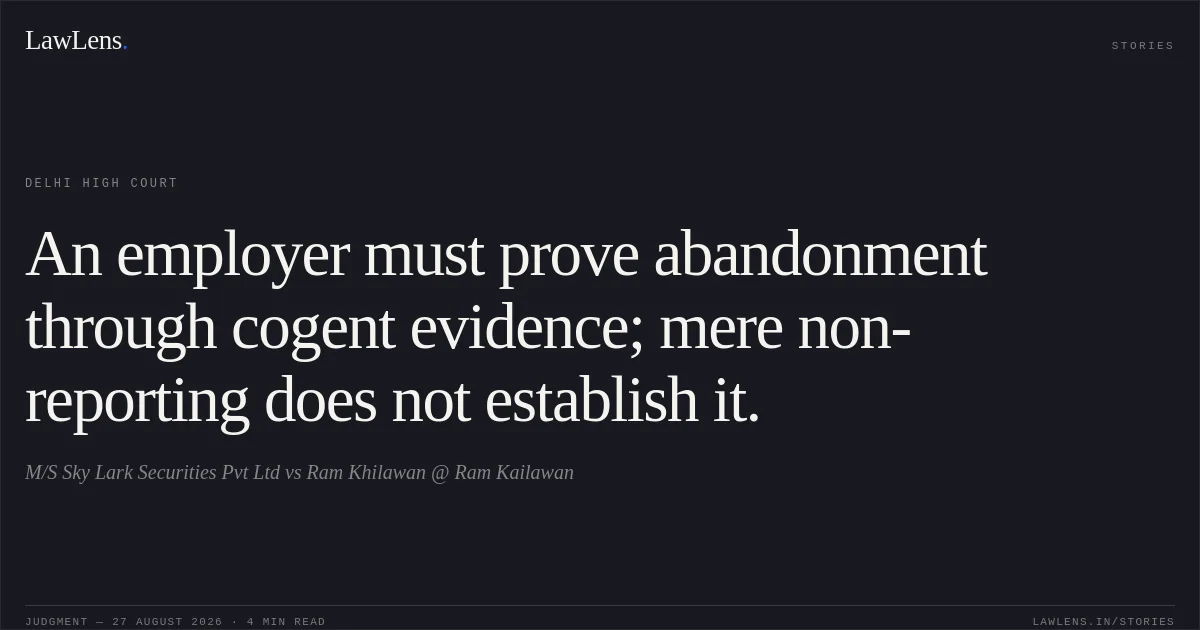
The Court applied the settled labour-law principle that an employer asserting abandonment of service bears the burden of producing cogent and credible evidence establishing such abandonment.
Source reference: p. 3; para. 5Mere non-reporting for duty does not, by itself, justify a presumption of abandonment; ordinarily, the employer must call upon the employee to resume duty and, if the employee fails or refuses to do so, initiate an appropriate domestic enquiry before taking consequential action.
Source reference: p. 3; para. 5The Court further applied the principle that an award of back wages is not automatic and must be determined having regard to the facts and evidence, including any earnings or alternative work undertaken by the workman.
Source reference: pp. 4–5; paras. 10–12In exercise of writ jurisdiction, the High Court does not interfere with a Labour Court’s fact-based award merely because another view may be possible, particularly where the award is supported by sound and cogent reasoning.
Source reference: p. 5; para. 13Reasoning
The Labour Court was justified in rejecting the abandonment defence because the petitioner did not identify the respondent’s last working day, could not specify when he allegedly abandoned employment, and produced no notice or enquiry record concerning his absence.
Source reference: pp. 2–3; paras. 4–5The alleged subsequent deployment offer was also reasonably treated as an afterthought because it was not made during conciliation, the minimum-wages proceedings, or the Labour Court proceedings, and was raised only after an unexplained delay of nearly three years.
Source reference: pp. 3–4; paras. 6–8Consequently, the finding that the respondent had been illegally terminated was supported by the evidence.
Source reference: no citationAs to monetary relief, the Labour Court correctly declined full back wages after considering the respondent’s admission that he had undertaken petty work to support his household, while still recognising that no genuine offer of re-employment had been made during the relevant period.
Source reference: pp. 4–5; paras. 10–12The resulting lump-sum award of ₹80,000 was therefore a fact-sensitive exercise of discretion and disclosed no perversity or jurisdictional error warranting writ interference.
Source reference: p. 5; para. 13Note: the judgment records the period for back wages as ending on 31 August 2020, while para. 10 also states that the respondent rejoined on 1 October 2025; the operative compensation period adopted by the Award was nevertheless 31 May 2017 to 31 August 2020.
Source reference: pp. 1, 4–5; paras. 1, 10–12Holding
The High Court answered the issues against the petitioner.
It upheld the Labour Court’s finding that the respondent’s services had been illegally terminated and that the petitioner had failed to prove abandonment or a timely bona fide offer of re-employment.
Source reference: pp. 3–4; paras. 6–9The award of ₹80,000 as lump-sum compensation in lieu of back wages, together with 8% per annum interest in the event of delayed payment, was found to be well-reasoned and supported by the record.
Source reference: pp. 4–5; paras. 11–13The writ petition was dismissed for want of merit, and the pending applications were disposed of.
Source reference: p. 5; paras. 14–15Original Court PDF
M/S Sky Lark Securities Pvt LtdvsRam Khilawan @ Ram Kailawan
Click to open original judgment
Original judgment, available to read, download and summarize on LawLens.in
![Courts will not interfere with transfers absent mala fides or violation of statutory rules.. M Ramya vs EMPLOYEES STATE INSURANCE CORPORATION (ESIC). CAT - ['Chennai']. LawLens](/stories/thumbnails/courts-will-not-interfere-with-transfers-absent-mala-fides-or-violation-of-statutory-rules-a6845e9ca6f548fca284c51c8351957f.webp)
![Courts cannot direct one-time recruitment age relaxation absent authority in the governing rules or advertisement.. UT OF PUDUCHERRY vs M ANDAL. CAT - ['Chennai']. LawLens](/stories/thumbnails/courts-cannot-direct-one-time-recruitment-age-relaxation-absent-authority-in-the-governing-895d78fde47143e2a8ed0207c4b6a44f.webp)
![A review cannot correct an allegedly erroneous decision absent an error apparent on the record.. Ajit Kumar Jha vs RAILWAY BOARD. CAT - ['Delhi']. LawLens](/stories/thumbnails/a-review-cannot-correct-an-allegedly-erroneous-decision-absent-an-error-apparent-on-the-re-8ac952fd4eba470c92f7da20af72a220.webp)