Facts
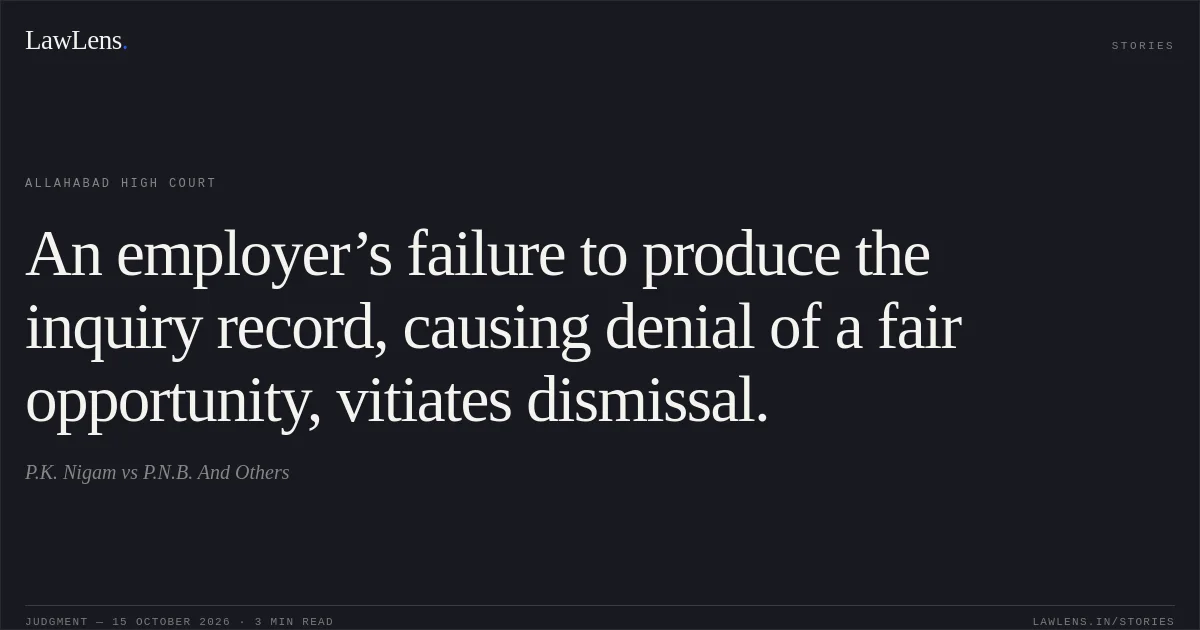
The petitioner, a Punjab National Bank peon, was dismissed on 21 May 1999 after a disciplinary inquiry into alleged financial misconduct; the Bank’s appellate authority affirmed the dismissal on 28 September 1999.
Source reference: para. 2, 4, 9–10The petitioner challenged the orders, alleging that relevant documents were not supplied and that he lacked a fair opportunity to defend himself.
Source reference: para. 11–13In 2006, the Court directed the Bank to produce the original inquiry record, but the Bank stated that it had been lost or misplaced and sought exemption from production.
Source reference: para. 11–13The petitioner reached superannuation in 2018.
Source reference: para. 2, 28Issues
1. Whether the dismissal and appellate orders were vitiated by denial of a fair opportunity to defend the disciplinary charges, particularly where the Bank did not establish that relevant documents were supplied and failed to produce the original inquiry record.
Source reference: para. 16, 19–262. Whether a fresh inquiry could be directed after the petitioner’s superannuation, and what consequential relief should follow if the disciplinary orders were quashed.
Source reference: para. 16, 27–30Law Applied
Judicial review of a departmental inquiry is limited to examining whether prescribed procedure was followed, a fair opportunity of defence was afforded, and the findings were supported by some evidence; the standard of proof is preponderance of probabilities, and a court does not reappraise evidence merely because another view is possible.
Source reference: para. 17Under Managing Director, ECIL, Hyderabad v. B. Karunakar, (1993) 4 SCC 727, an employee is entitled to the inquiry report and an effective opportunity to represent before the disciplinary authority decides, with procedural breach assessed for resulting prejudice.
Source reference: para. 18State of Uttar Pradesh v. Rajit Singh, (2022) 15 SCC 254, states the ordinary rule that an inquiry may resume from the stage of procedural defect, subject to the applicable rules and circumstances.
Source reference: para. 27Under Bhagirathi Jena v. Board of Directors, O.S.F.C., (1999) 3 SCC 666, disciplinary proceedings cannot continue after retirement absent a provision authorising continuation.
Source reference: para. 27–28Reasoning
The Bank’s unavailable original record was material to verifying whether documents had been supplied, how evidence and objections were handled, and whether the petitioner had a proper opportunity to participate.
Source reference: para. 20–24The Bank’s explanation for the loss was incomplete, and the available photocopies did not establish those matters; the inquiry report also recorded findings on certain charges despite noting an absence of concrete evidence or witnesses.
Source reference: para. 20–24The petitioner was given only until the day after his hearing to respond to the inquiry report, which, alongside the evidentiary gap created by the missing record, resulted in real prejudice and vitiated the disciplinary process.
Source reference: para. 25–26Although an inquiry may ordinarily resume after a procedural defect, the Bank identified no applicable rule permitting proceedings after retirement. Given the petitioner’s superannuation, the missing record, and the passage of time, a fresh inquiry was not warranted.
Source reference: para. 27–29Holding
The Court allowed the petition and quashed the dismissal order dated 21 May 1999 and appellate order dated 28 September 1999.
The Bank was directed to treat the petitioner as continuously employed until his superannuation in 2018, notionally refix his pay, and calculate his pension and other admissible retiral benefits accordingly.
Source reference: para. 29–31The petitioner was also awarded 50% of salary and allowances as back wages from dismissal to superannuation, subject to lawful adjustments.
Source reference: para. 29–31The Bank was directed to complete the exercise and pay the amount due within three months of production of a certified copy; unpaid retiral dues thereafter would carry simple interest at 6% per annum.
Source reference: para. 32Original Court PDF
P.K. NigamvsP.N.B. And Others
Click to open original judgment
Original judgment, available to read, download and summarize on LawLens.in