Facts
Goodricke Group operated a 100% EOU manufacturing Instant Tea. It used imported Chinese Oolong Tea for export production, while Instant Tea cleared to the Domestic Tariff Area (DTA) was manufactured wholly from indigenous raw materials, with separate accounts maintained for those inputs.
Source reference: pp. 2–3, paras. 2–3The appellant claimed concessional treatment under Serial No. 4 of Notification No. 23/2003-C.E. The Department considered that entry unavailable and assessed the clearances under Serial No. 2, issuing four notices that proposed differential duty, including a 2015 supplementary notice that substantially revised the computation and overlapped earlier periods.
Source reference: pp. 4–9, paras. 5–8The Commissioner confirmed duty of ₹1,13,79,425, interest and an equivalent penalty under Section 11AC, invoking the extended limitation period. The appellant appealed, contending, among other things, that Serial No. 3 applied and that the extended period and penalty were not justified.
Source reference: pp. 9–21, paras. 8, 10Issues
1. Whether the DTA clearances, though not eligible under Serial No. 4, were eligible for the benefit under Serial No. 3 of Notification No. 23/2003-C.E., rather than being assessed under Serial No. 2.
Source reference: pp. 25–29, paras. 13.4–15.22. Whether the extended period of limitation could be invoked where the Department had previously examined the relevant manufacturing facts and the dispute concerned the applicable notification entry and duty computation.
Source reference: pp. 31–33, paras. 18–18.33. Whether the penalty under Section 11AC was sustainable in the absence of evidence of fraud, wilful misstatement or suppression with intent to evade duty.
Source reference: pp. 33–34, para. 19Law Applied
Serial No. 3 of Notification No. 23/2003-C.E., as amended, applies to qualifying EOU goods manufactured wholly from indigenous raw materials and cleared to the DTA in accordance with the specified Foreign Trade Policy provisions, where like goods manufactured outside an EOU are not wholly exempt or chargeable to a nil rate of duty.
Source reference: pp. 23–28, paras. 13.3–14.3The correct exemption entry must be determined by applying its own conditions; rejection of a claim under one entry does not, by itself, establish that another entry governs.
Source reference: pp. 25–29, paras. 13.4–15.2Under Share Medical Care v. Union of India, an assessee is not barred from claiming a different exemption category where it fulfils that category’s conditions.
Source reference: pp. 30–31, paras. 17–17.1Under Nizam Sugar Factory v. Collector of Central Excise, prior departmental knowledge of the material facts weighs against invoking the extended period on the basis of suppression in later notices concerning those facts.
Source reference: pp. 32–33, paras. 18.2–18.3Section 11AC requires the statutory basis for penalty, including the requisite culpable conduct; an incorrect exemption-entry claim alone does not establish wilful suppression with intent to evade duty.
Source reference: pp. 33–34, para. 19Reasoning
The Tribunal found that the DTA Instant Tea was made wholly from indigenous inputs, relying on the earlier departmental verification and the absence of contrary material in the present proceedings.
Source reference: pp. 26–27, para. 14.1It also found that the clearances complied with the relevant Foreign Trade Policy provisions and that like domestic Instant Tea was dutiable, satisfying the remaining conditions of Serial No. 3.
Source reference: pp. 27–28, paras. 14.2–14.3The Department therefore could not move directly from rejecting Serial No. 4 to applying Serial No. 2 without considering Serial No. 3; the duty had to be assessed under the latter entry, with credit for duty already paid.
Source reference: pp. 29–31, paras. 15.1–17.3On limitation, the Tribunal relied on the earlier departmental examination and the sequence of notices to conclude that the Department had knowledge of the material facts and could not invoke the extended period on these facts.
Source reference: pp. 31–33, paras. 18–18.3It further held that the dispute arose from the selection of the exemption entry and that the record did not establish deliberate concealment or the other required grounds for Section 11AC penalty.
Source reference: pp. 33–34, para. 19Holding
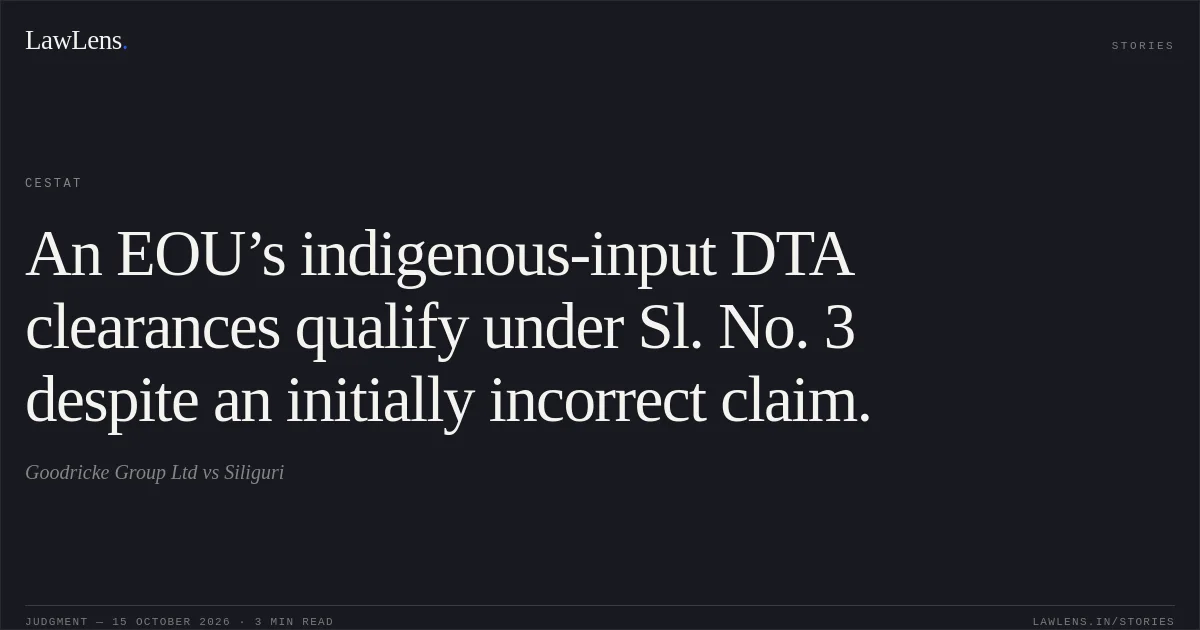
The Tribunal held that Serial No. 3 of Notification No. 23/2003-C.E. applied and set aside the demand of ₹1,13,79,425 and the associated interest as confirmed in the impugned order. It left the appellant liable for any duty and interest properly computable under Serial No. 3 that fell within the normal limitation period, after accounting for duty already paid; the extended-period demand was set aside.
The equivalent penalty under Section 11AC was set aside, and the appeal and Revenue’s cross-objection were disposed of accordingly.
Source reference: pp. 34–35, paras. 20(ii)–21Acts & Sections Cited
6 provisions across 3 statutes referred to in this judgment. Each provision opens on LawLens.
Central Excise Act, 19442
Customs Act,19623
Customs Tariff Act, 19751
Original Court PDF
Goodricke Group LtdvsSiliguri
Click to open original judgment
Original judgment, available to read, download and summarize on LawLens.in


