Facts
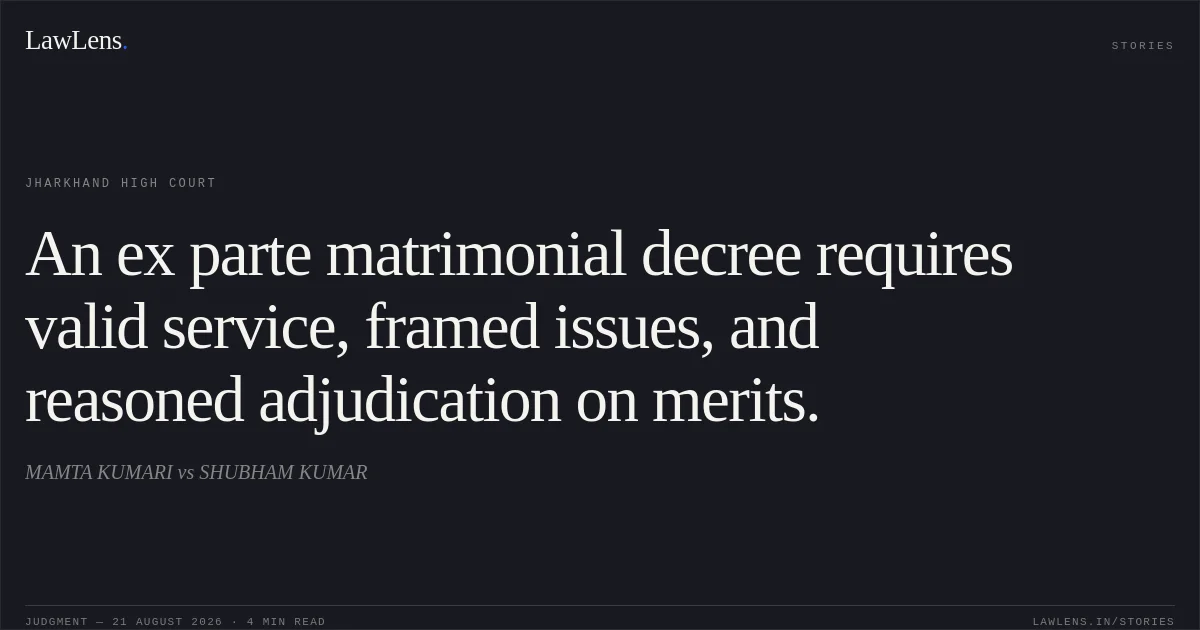
The parties married on 30 June 2020 according to Hindu rites and customs; no child was born from the marriage.
Source reference: para. 2(i)–(viii)The husband alleged that, approximately two months after marriage, the wife subjected him and his family to quarrels and insisted that he live as a ghar jamai at her parental home.
Source reference: para. 2(i)–(viii)He further alleged that she left the matrimonial home on 1 August 2020 and refused to return or cohabit with him when he approached her on 11 September 2020, which constituted cruelty.
Source reference: para. 2(i)–(viii)The husband instituted Original Case No. 760 of 2021 seeking divorce on the ground of cruelty.
Source reference: para. 2(ix)–(x)The wife did not appear before the Family Court, which proceeded ex parte on the basis of a postal track report showing delivery of notice on 9 March 2022.
Source reference: paras. 2(ix)–(x), 20By judgment dated 2 August 2022 and decree dated 12 August 2022, the Additional Principal Judge, Additional Family Court No. II, Dhanbad, dissolved the marriage on the ground of cruelty.
Source reference: no citationThe wife challenged the decree under Section 19(1) of the Family Courts Act, 1984, contending that service was invalid, no substituted service was attempted, and no issues were framed.
Source reference: paras. 1, 3–5Issues
Whether the Family Court could proceed ex parte and grant a decree of divorce merely on the basis of a postal track report, without adequately ensuring valid service of summons and, where necessary, adopting substituted modes of service.
Source reference: paras. 9, 12, 20–21, 31–33Whether, even in an ex parte matrimonial proceeding, the Family Court was required to frame issues or points for determination and independently adjudicate the husband’s claim for cruelty on the evidence.
Source reference: paras. 9, 22–28, 34Whether the impugned ex parte judgment and decree were legally sustainable in light of the alleged non-disclosure of pending criminal proceedings and the consequent denial of a meaningful opportunity of hearing to the wife.
Source reference: paras. 29–33Law Applied
The appeal was governed by Section 19(1) of the Family Courts Act, 1984, with the Court applying civil-procedure principles concerning service of summons and substituted service, as well as Order XIV Rule 1 of the Code of Civil Procedure, which requires the formulation of issues arising from the pleadings.
Source reference: paras. 1, 4(ii), 22–25The Court held that an ex parte proceeding does not relieve the court of its duty to scrutinise the claim on merits or to formulate and decide the material points in controversy.
Source reference: no citationRelying on Sugandhi v. P. Rajkumar, (2020) 10 SCC 706, and Jasraj Inder Singh v. Hemraj Multanchand, (1977) 2 SCC 155, the Court reiterated that procedure is the handmaid of justice and must facilitate substantial justice.
Source reference: paras. 17–19Under Makhan Lal Bangal v. Manas Bhunia, (2001) 2 SCC 652, framing issues is an imperative stage of civil adjudication, including where the defendant does not appear.
Source reference: para. 22The Court applied the standard of perversity explained in Arulvelu v. State, (2009) 10 SCC 206, under which a finding unsupported by evidence, based on irrelevant considerations, or arrived at through serious procedural irregularity is legally infirm.
Source reference: paras. 35–37Reasoning
The Court found that the Family Court relied solely on the postal tracking report to presume valid service and proceeded ex parte without adequately scrutinising whether the wife had actually received effective notice or attempting substituted service under the applicable procedure.
Source reference: paras. 20–21, 31–33The omission was particularly significant in a matrimonial dispute, where the consequences of an ex parte dissolution are serious.
Source reference: no citationThe Family Court also failed to frame issues concerning cruelty or desertion and proceeded directly to evaluate the husband’s evidence, thereby depriving the adjudication of the structured determination required by Order XIV Rule 1 CPC.
Source reference: paras. 22–28, 34Further, the record did not disclose that the husband or his witnesses had informed the Family Court about the pending Bishungarh P.S. Case No. 68 of 2022 under Sections 498A and 354/34 IPC and Sections 3/4 of the Dowry Prohibition Act, although the wife asserted that she learnt of the divorce proceedings only when the husband obtained bail in that case.
Source reference: paras. 29–30In these circumstances, the Court held that the decree rested on deemed service and procedural presumption rather than a fair adjudication, rendering the judgment perverse and unsustainable.
Source reference: paras. 31, 35–38Holding
The High Court answered the issues in favour of the appellant-wife.
It held that the Family Court improperly proceeded ex parte without securing effective service and without framing or addressing the necessary issues.
Source reference: no citationAccordingly, the judgment dated 2 August 2022 and decree dated 12 August 2022 in Original Case No. 760 of 2021 were quashed and set aside.
Source reference: para. 39The matter was remitted to the Additional Principal Judge, Additional Family Court No. II, Dhanbad, for fresh adjudication on merits after revival of the original case.
Source reference: para. 40Both parties were directed to appear before that court within four weeks, after which the Family Court was directed to frame the requisite issues and decide the matter in accordance with law, ensuring adequate opportunity of hearing to both sides.
Source reference: paras. 41–43Acts & Sections Cited
6 provisions across 3 statutes referred to in this judgment. Each provision opens on LawLens.
Family Courts Act, 19842
Indian Penal Code, 18602
Original Court PDF
MAMTA KUMARIvsSHUBHAM KUMAR
Click to open original judgment
Original judgment, available to read, download and summarize on LawLens.in