Facts
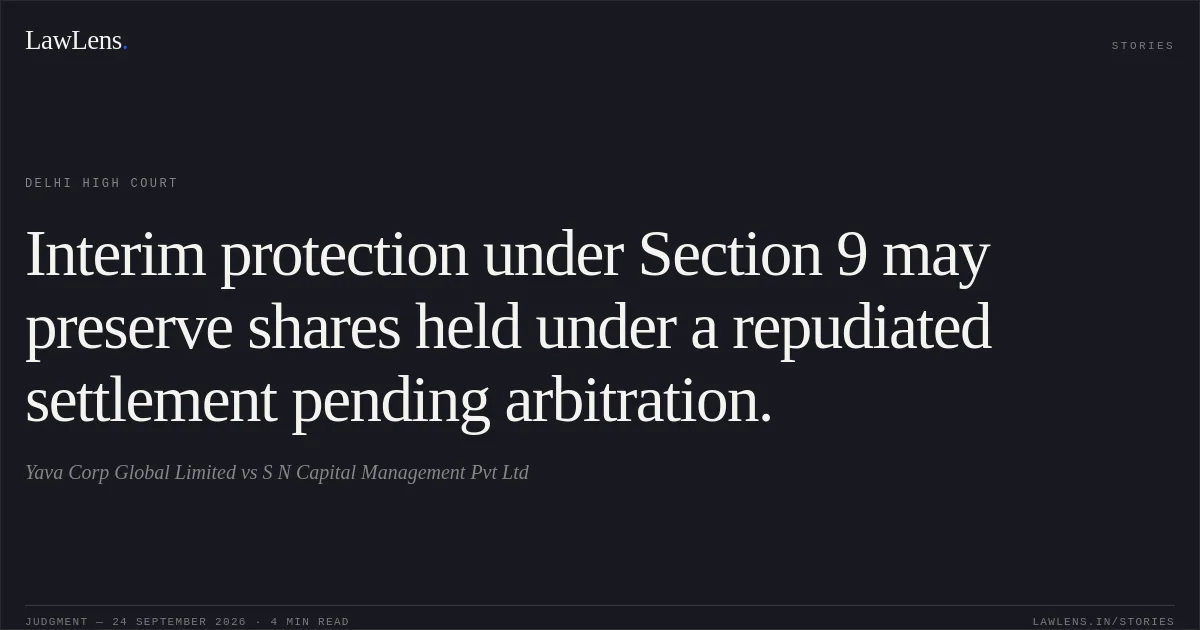
The petitioner filed a petition under Section 9 of the Arbitration and Conciliation Act, 1996, seeking interim protection in relation to disputes arising from a Joint Development Agreement dated 16 September 2025.
Source reference: para. 1; p. 1The petitioner had invoked arbitration under Section 21 of the Act by notice dated 22 June 2026, relying on Clause 9 of the Agreement.
Source reference: para. 2; p. 1Clause 9 provided that the “seat and venue” of arbitration would be “[Roorkie, Uttarakhand/Delhi]”.
Source reference: para. 3; p. 2However, Clause 10 stipulated that the courts at Roorkie, Uttarakhand, would have exclusive jurisdiction over all matters arising under or relating to the Agreement.
Source reference: para. 14; p. 6The petitioner contended that the parties had the option to arbitrate at either Roorkie or Delhi and that, as the Delhi petition had been filed first, Delhi should be treated as the seat and competent jurisdiction.
Source reference: para. 4; p. 2The respondents argued that the exclusive-jurisdiction clause in favour of the courts at Roorkie, read harmoniously with the arbitration clause, vested exclusive jurisdiction in Roorkie.
Source reference: para. 5; p. 2Issues
Whether the designation of both Roorkie and Delhi as the seat and venue of arbitration permitted the petitioner to invoke the jurisdiction of the Delhi High Court under Section 9 of the Act?
Source reference: paras. 4–5; pp. 2–3Whether the exclusive-jurisdiction clause conferring jurisdiction on the courts at Roorkie prevailed over, or clarified, the reference to Roorkie and Delhi as alternative seats and venues of arbitration?
Source reference: paras. 14–16; pp. 6–7Whether the Section 9 petition filed before the Delhi High Court was maintainable?
Source reference: paras. 16–18; p. 7Law Applied
The Court applied Sections 9 and 21 of the Arbitration and Conciliation Act, 1996, concerning interim measures and commencement of arbitral proceedings, respectively.
Source reference: paras. 1–2; p. 1It considered the principle in Indus Mobile Distribution Pvt. Ltd. v. Datawind Innovations Pvt. Ltd., (2017) 7 SCC 678, that designation of an arbitral seat ordinarily confers exclusive jurisdiction on the courts of that seat, but distinguished it because that case involved a single identified seat and corresponding exclusive jurisdiction.
Source reference: para. 8; p. 3The Court principally relied on Bhartia Infra Projects Ltd. v. M/s Vishwa Samudra Engineering Pvt. Ltd., SLP (C) Nos. 19870–19871/2026, decided on 15 June 2026, where the Supreme Court held that an arbitration clause specifying two possible seats or venues could nevertheless be read as conferring exclusive supervisory jurisdiction on the courts expressly designated in the exclusive-jurisdiction clause.
Source reference: paras. 11–13; pp. 4–5The Court also noted the principle from Arif Azim Company Ltd. v. Micromax Informatics FZE, 2025 (9) SCC 750, concerning multiple designated seats and forum non conveniens, while observing that the principle was distinguishable where the parties had expressly selected courts having exclusive jurisdiction.
Source reference: para. 13; p. 5Reasoning
The Court held that Clause 9, viewed in isolation, specified both Roorkie and Delhi as the seat and venue of arbitration.
Source reference: para. 15; p. 7However, Clause 10 expressly granted exclusive jurisdiction over all matters arising from or relating to the Agreement to the courts at Roorkie.
Source reference: para. 14; p. 6Applying the Supreme Court’s reasoning in Bhartia Infra, the Court harmoniously construed the two clauses and treated the exclusive-jurisdiction provision as identifying Roorkie as the forum possessing supervisory jurisdiction over the arbitration.
Source reference: no citationThe petitioner’s reliance on the first filing in Delhi was rejected because priority of filing could not override the parties’ contractual allocation of exclusive jurisdiction.
Source reference: paras. 4, 15–16; pp. 2, 7The Court therefore concluded that proceedings for interim relief under Section 9, as well as proceedings relating to appointment of an arbitrator under Section 11, could be pursued only before the competent courts at Roorkie.
Source reference: para. 16; p. 7Holding
The Delhi High Court held that, notwithstanding the reference to both Roorkie and Delhi as the seat and venue of arbitration, the exclusive-jurisdiction clause in favour of the courts at Roorkie vested Roorkie with exclusive jurisdiction over matters arising from the Agreement.
The Section 9 petition was consequently dismissed as not maintainable for want of jurisdiction.
Source reference: paras. 17–18; p. 7The petitioner was granted liberty to pursue appropriate remedies before a competent forum, and the Court clarified that it had not adjudicated the merits or affected the parties’ substantive rights and contentions.
Source reference: paras. 17–19; p. 7The petition and all pending applications were disposed of accordingly.
Source reference: para. 20; p. 7Acts & Sections Cited
9 provisions across 2 statutes referred to in this judgment. Each provision opens on LawLens.
Arbitration and Conciliation Act, 19963
Code of Civil Procedure, 19086
Original Court PDF
Rajesh Kumar GuptavsPritam Singh & Ors.
Click to open original judgment
Original judgment, available to read, download and summarize on LawLens.in