Facts
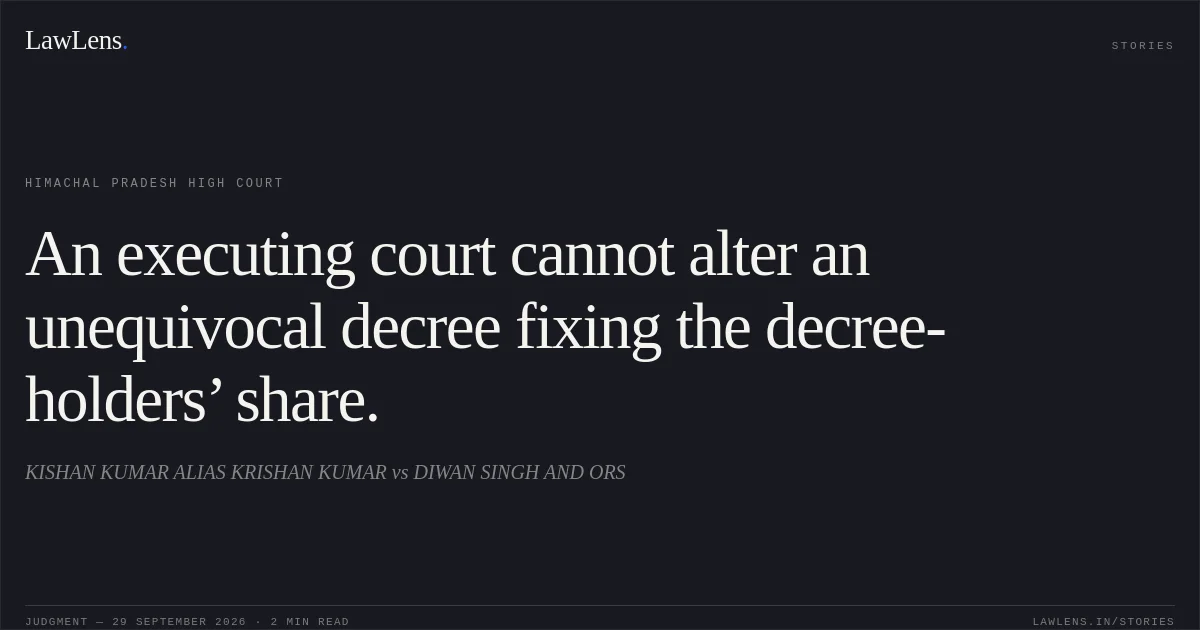
The decree-holders obtained a 1997 decree declaring Pat’s Will void, declaring them owners in possession of a 1/6th share in the suit land, and granting joint possession.
Source reference: paras. 3–4, 12–14The decree was affirmed on appeal, including in RSA No. 438 of 2003.
Source reference: paras. 3–4, 12–14In execution, the judgment-debtor objected that the decree-holders were entitled to only a 1/7th share, arguing that Pat’s widow was also an heir.
Source reference: paras. 5–8, 20–21The executing court ordered symbolic joint possession in accordance with the decree.
Source reference: paras. 5–8, 20–21The judgment-debtor challenged that order in revision, also contesting the treatment of his amended objections and the absence of framed issues.
Source reference: paras. 5–8, 20–21Issues
1. Whether the executing court could revisit the decree-holders’ declared 1/6th share and limit their entitlement to 1/7th based on the judgment-debtor’s inheritance argument.
Source reference: paras. 8, 10, 14–162. Whether the executing court’s handling of the amended objections, including its failure to frame issues, warranted revisional interference.
Source reference: paras. 20–22Law Applied
Under Order 21 Rules 11 and 35 CPC, the executing court may decide questions relating to execution, discharge, or satisfaction of a decree, but ordinarily must execute the decree according to its terms and cannot go behind or modify it (*Vasudev Dhanjibhai Modi v. Rajabhai Abdul Rehman*, (1970) 1 SCC 670; *Deepa Bhargava v. Mahesh Bhargava*, (2009) 2 SCC 294).
Source reference: paras. 5, 16, 18Where a decree is ambiguous, the executing court may construe it by reference to the judgment and, if necessary, the pleadings (*Sanwarlal Agrawal v. Ashok Kumar Kothari*, (2023) 7 SCC 307).
Source reference: para. 15An exception applies where the decree is a nullity for want of the court’s inherent jurisdiction; that objection may be raised in execution (*Sunder Dass v. Ram Prakash*, (1977) 2 SCC 662).
Source reference: para. 17An executing court need not frame issues as in a suit, but must decide disputes judicially.
Source reference: para. 21Reasoning
The decree expressly declared the decree-holders entitled to a 1/6th share and granted joint possession; it was affirmed on appeal and was not shown to be a nullity.
Source reference: paras. 12–14, 16–17The dispute over the widow’s inheritance could not be used in execution to alter that final determination.
Source reference: paras. 12–14, 16–17Because the decree was clear, the rule permitting construction of an ambiguous decree did not assist the judgment-debtor.
Source reference: para. 15The executing court considered the amended objection concerning the share and gave reasons for rejecting it.
Source reference: paras. 20–22Although it did not frame issues, it decided the dispute judicially by applying the decree’s express terms; no material irregularity or illegality justified revision.
Source reference: paras. 20–22Holding
The High Court held that the executing court could not reduce the decree-holders’ share from 1/6th to 1/7th or otherwise revisit the final decree.
Finding no illegality or material irregularity in the execution order, it dismissed the revision petition without costs and disposed of any pending applications.
Source reference: paras. 22–23Acts & Sections Cited
1 provisions across 1 statute referred to in this judgment. Each provision opens on LawLens.
Indian Contract Act, 18721
Original Court PDF
KISHAN KUMAR ALIAS KRISHAN KUMARvsDIWAN SINGH AND ORS
Click to open original judgment
Original judgment, available to read, download and summarize on LawLens.in