Facts
The opposite party obtained an ex parte decree for eviction against the petitioner in O. Suit No. 203 of 2010.
Source reference: para. 9–18The petitioner’s application under Order IX Rule 13 CPC to set aside that decree remained pending, as did his application under Section 47 CPC challenging executability on the grounds that the property was Khasmahal land and that he had been recorded as a raiyat. A separate title suit concerning the same property was also pending, and an order directing the parties to maintain status quo had been affirmed by the High Court. The Executing Court rejected the petitioner’s applications to stay execution; the petitioner challenged those orders in revision.
Source reference: para. 9–18Issues
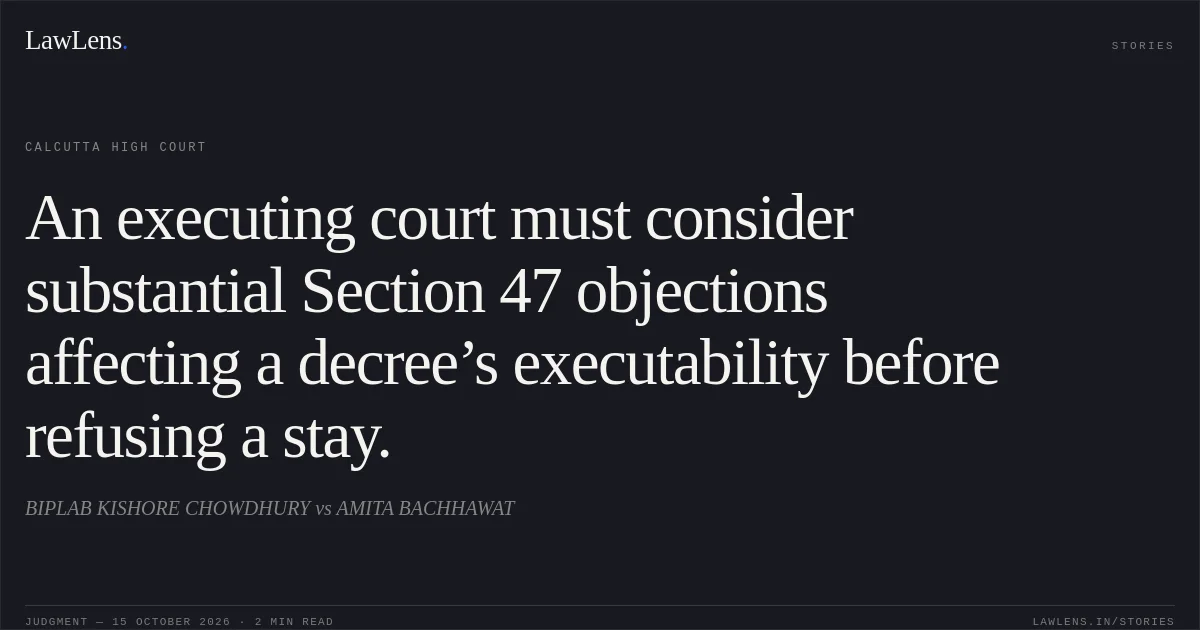
1. Whether the Executing Court was justified in refusing to stay execution while the petitioner’s Section 47 CPC application challenging the decree’s executability remained undecided.
Source reference: para. 15–18, 23–252. Whether execution should be stayed pending the petitioner’s application under Order IX Rule 13 CPC and in light of the pending title suit and status quo order.
Source reference: para. 19–20, 24–26Law Applied
Section 47 CPC permits the executing court to determine questions between the parties relating to execution, discharge or satisfaction of the decree; an executing court cannot go beyond the decree, but must consider a properly raised challenge to executability.
Source reference: para. 23–25Order IX Rule 13 CPC provides the procedure for seeking to set aside an ex parte decree, while Order XXI Rule 26 CPC was invoked by the petitioner as a basis for a stay.
Source reference: para. 20, 24–26Under Ramesh Kumar v. Kesho Ram, a court may take cautious cognizance of subsequent events materially affecting relief, subject to the limits of law and justice.
Source reference: para. 20Under Sawarni v. Inder Kaur, mutation or revenue entries do not create or extinguish title and have no presumptive value as to title.
Source reference: para. 21Under Jehal Tanti v. Nageshwar Singh, a transaction made in breach of an injunction may be unlawful.
Source reference: para. 22Reasoning
The Court held that the Executing Court had rejected the stay applications without considering the substance of the Section 47 application: the petitioner’s claim that the property was Khasmahal land, that he had obtained a possession certificate, and that he had been recorded as a raiyat. Those matters, together with the pending title suit concerning the same property, could bear on executability and required consideration; the Court did not decide their merits or treat the revenue entry as proof of title.
Source reference: para. 18, 23Although the petitioner’s Order IX Rule 13 application remained pending, he had not sought a stay from that court. The Court therefore ordered a limited stay and directed him to apply there, leaving that court to decide any application independently.
Source reference: para. 20, 24–26Holding
The revision was disposed of and the impugned orders refusing a stay were set aside.
Execution in O. Ex. No. 08 of 2018 was stayed until 31 December 2026 or until further orders, whichever occurred earlier. The petitioner was directed to approach the Order IX Rule 13 court for a stay; that court must decide any application in accordance with law and without being influenced by the observations in this judgment.
Source reference: para. 25–27Acts & Sections Cited
5 provisions across 4 statutes referred to in this judgment. Each provision opens on LawLens.
Code of Civil Procedure, 19081
Transfer of Property Act, 18821
Indian Contract Act, 18721
Original Court PDF
BIPLAB KISHORE CHOWDHURYvsAMITA BACHHAWAT
Click to open original judgment
Original judgment, available to read, download and summarize on LawLens.in
![The competent authority must decide the appeal by a reasoned, speaking order within four weeks.. DR NISHANT GOYAL vs HEALTH. CAT - ['Delhi']. LawLens](/stories/thumbnails/the-competent-authority-must-decide-the-appeal-by-a-reasoned-speaking-order-within-four-we-51ef3c532385466483f4156703e7e0bc.webp)
![Competent authority must decide the pending representation by a reasoned order within four weeks.. AJAY YADAV vs MUNICIPAL CORPORATION OF DELHI (GNCTD). CAT - ['Delhi']. LawLens](/stories/thumbnails/competent-authority-must-decide-the-pending-representation-by-a-reasoned-order-within-four-1bec6310839148709c127f0a0c64e2b5.webp)
