Facts
The Delhi Improvement Trust granted a 20-year lease dated 13 January 1950 in favour of Bhag Ram Handa for an ice factory, commencing on 1 June 1948 and expiring on 31 May 1968, with an option for renewal for a further 20 years.
Source reference: para. 5.1The leasehold interest was transferred to M/s Gian Chand Kedar Nath, which later parted with possession to entities operating under the name “Alfa Spice”.
Source reference: para. 5.2; para. 80.2Following the Master Plan for Delhi, 1962, the property was shown under residential land use and earmarked for a higher secondary school; DDA declined renewal and offered alternative land, which the petitioner refused.
Source reference: paras. 5.3–5.7The petitioner continued in possession after expiry of the lease.
Source reference: para. 5.9Eviction proceedings under the Public Premises (Eviction of Unauthorised Occupants) Act, 1971 culminated in an eviction order dated 2 May 1991.
Source reference: para. 5.9The Director (Lands), DDA rejected the request by a reasoned order dated 8 September 2011.
Source reference: paras. 34–43In the connected petition, M/s Alfa Gardens challenged the revocation of its ad hoc eating-house registration by MCD and suspension of its excise licence.
Source reference: paras. 5.12–5.19Issues
1. Whether the petitioner could seek conversion of an expired 20-year term lease into a perpetual lease under DDA’s policy dated 21 January 2011 and Office Order dated 11 March 2011.
Source reference: paras. 25–30, 58–622. Whether the internal notings dated 3 December 2010 and 2 May 2012 created an enforceable right to renewal or conversion of the lease.
Source reference: paras. 34–513. Whether DDA’s refusal to renew or convert the lease was arbitrary, perverse, discriminatory, or contrary to Article 14 of the Constitution, particularly in view of the treatment accorded to other ice factories and DLF Universal Ltd.
Source reference: paras. 30, 75–794. Whether the petitioner, whose lease had expired and whose occupation had been judicially held unauthorised, could claim protection of possession or conversion of the lease.
Source reference: paras. 63–74, 82–875. Whether the revocation of the ad hoc eating-house registration and suspension of the excise licence were liable to be quashed.
Source reference: paras. 1, 12, 966. Whether the Court could adjudicate the private dispute concerning the authority and succession of persons claiming to represent M/s Gian Chand Kedar Nath.
Source reference: para. 95Law Applied
The Court applied the Delhi Development Act, 1957, particularly the statutory framework governing DDA’s control over land use and disposal of public land, and the Public Premises (Eviction of Unauthorised Occupants) Act, 1971, under which occupation after expiry or determination of the authority to occupy constitutes “unauthorised occupation” under Section 2(g).
Source reference: paras. 70, 72It applied the principles of judicial review under Article 226: courts examine legality, procedural fairness, relevant considerations, irrationality, and abuse of power, but do not sit as appellate authorities over administrative decisions; the Court relied on Tata Cellular v. Union of India, Municipal Council, Neemuch v. Mahadeo Real Estate, and Om Kumar v. Union of India.
Source reference: paras. 31–33Relying on Bachhittar Singh v. State of Punjab, Sethi Auto Service Station v. DDA, and DDA v. Hello Home Education Society, the Court held that internal file notings, recommendations, and in-principle approvals do not create enforceable rights unless converted into a final, authenticated and communicated order.
Source reference: paras. 48–50It further applied the rule that renewal or conversion of leasehold rights into perpetual or freehold rights is not an automatic or vested entitlement, but depends on the applicable policy and administrative discretion.
Source reference: paras. 82–85Under Article 14, parity is available only to persons similarly situated in all material respects, and an illegally granted benefit cannot be claimed as a matter of equality, as recognised in State of Kerala v. N.M. Thomas, State of Punjab v. Davinder Singh, and Union of India v. M.K. Sarkar.
Source reference: paras. 76–79The Court also applied the principles of delay and laches and held that repeated representations do not revive a stale claim or create a fresh cause of action.
Source reference: paras. 88–91Finally, relying on Bharat Amratlal Kothari v. Dosukhan Samadkhan Sindhi, it held that relief ordinarily cannot be granted when the foundational relief has not been prayed for.
Source reference: paras. 92–94Reasoning
The Court held that the lease expired by efflux of time on 31 May 1968 and was never formally renewed. Clause IV(c) merely conferred an option to seek renewal; it did not mandate automatic renewal, particularly in view of the words “if the lease is extended” and DDA’s express communications declining renewal.
Source reference: paras. 63–69Consequently, the petitioner became an unauthorised occupant, a finding already affirmed in prior proceedings and not open to re-agitation.
Source reference: paras. 64–72The DDA policy and Office Order relied upon by the petitioner applied to cases where an application for conversion had been made during the subsistence of the lease; the petitioner’s applications were made decades after expiry and therefore fell outside the policy.
Source reference: paras. 58–62The internal noting dated 3 December 2010 was only a preliminary recommendation.
Source reference: paras. 34–43The Director (Lands) subsequently sought further documents and passed a detailed, reasoned order dated 8 September 2011 after considering the changed and adverse factual circumstances, including unauthorised construction, misuse, operation of a banquet hall and bar, non-conforming land use, and the property’s earmarking for a higher secondary school.
Source reference: paras. 34–43Similarly, the Lieutenant Governor’s noting dated 2 May 2012 was never communicated as a final decision and was superseded by the subsequent communication directing implementation of the eviction judgment.
Source reference: paras. 47–51The plea of parity failed because the other ice factories relied upon by the petitioner had subsisting leases and had applied for conversion during the currency of those leases, whereas the petitioner applied after expiry.
Source reference: para. 79The petitioner had additionally violated the lease by transferring the leasehold interest before completion of the ice factory, parting with possession without the lessor’s consent, and using the premises for a banquet hall and restaurant-cum-bar without permission.
Source reference: paras. 80–81These were rational and legally relevant grounds for refusing renewal or conversion.
Source reference: paras. 80–81The Court further held that long possession, payment of rent or deposits, and interim orders protecting possession did not revive an expired lease or create ownership or conversion rights.
Source reference: paras. 70, 73–74, 82–87The connected challenge to the MCD and excise actions could not succeed independently because the petitioner’s entitlement to operate the eating house and bar depended upon lawful occupation and compliance with statutory requirements.
Source reference: paras. 8.5–8.14; para. 96Holding
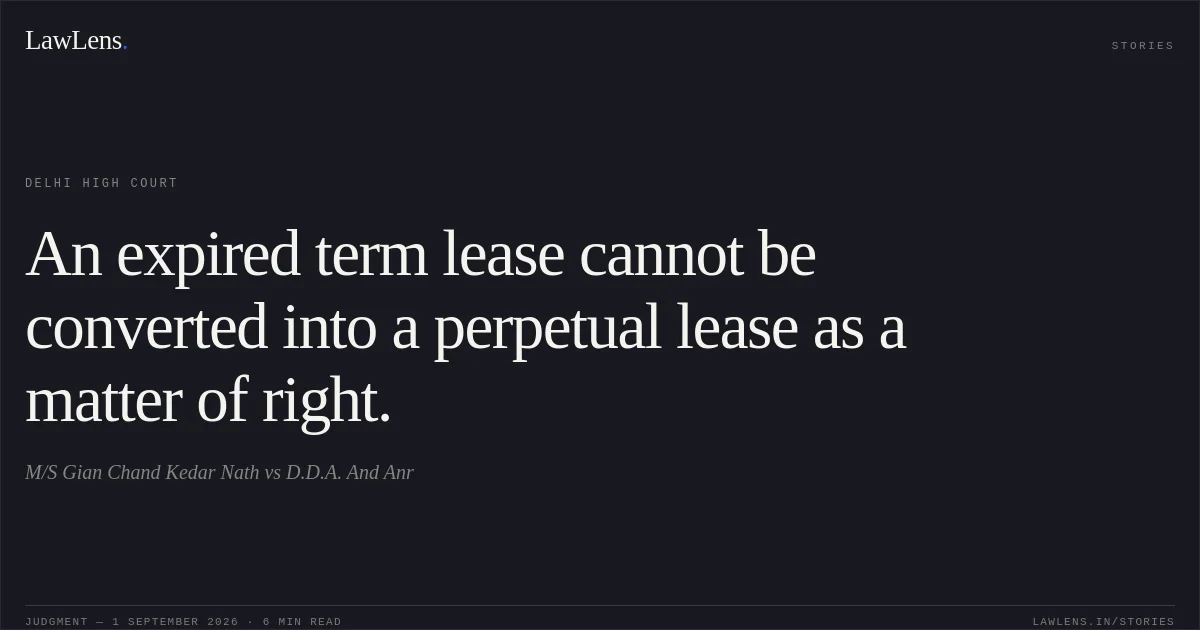
The Court dismissed W.P.(C) 2217/2013, holding that the petitioner had no subsisting lease, no right to automatic renewal, and no enforceable right to conversion into a perpetual lease.
The DDA’s decisions dated 8 September 2011 and 3 February 2016, as well as the communicated decision of the Lieutenant Governor, were found to be reasoned, policy-consistent and free from arbitrariness or perversity.
Source reference: paras. 51–62, 73–87The claim of parity was rejected, and the Court declined to grant the unprayed-for relief of restoration or fresh renewal of the expired lease.
Source reference: paras. 75–79, 92–94In consequence, the reliefs sought in W.P.(C) 12275/2004 challenging revocation of the eating-house registration and suspension of the excise licence were rendered infructuous and the petition was also dismissed.
Source reference: para. 96Any amount deposited by the petitioner towards lease rent was directed to be returned by DDA forthwith.
Source reference: para. 97The pending applications, including the impleadment application, were disposed of/dismissed; the private dispute concerning the valid representative or successor of the petitioner firm was left open for adjudication in appropriate independent proceedings.
Source reference: paras. 95, 98Acts & Sections Cited
14 provisions across 2 statutes referred to in this judgment. Each provision opens on LawLens.
Delhi Municipal Corporation Act, 1957
Original Court PDF
M/S Gian Chand Kedar NathvsD.D.A. And Anr
Click to open original judgment
Original judgment, available to read, download and summarize on LawLens.in