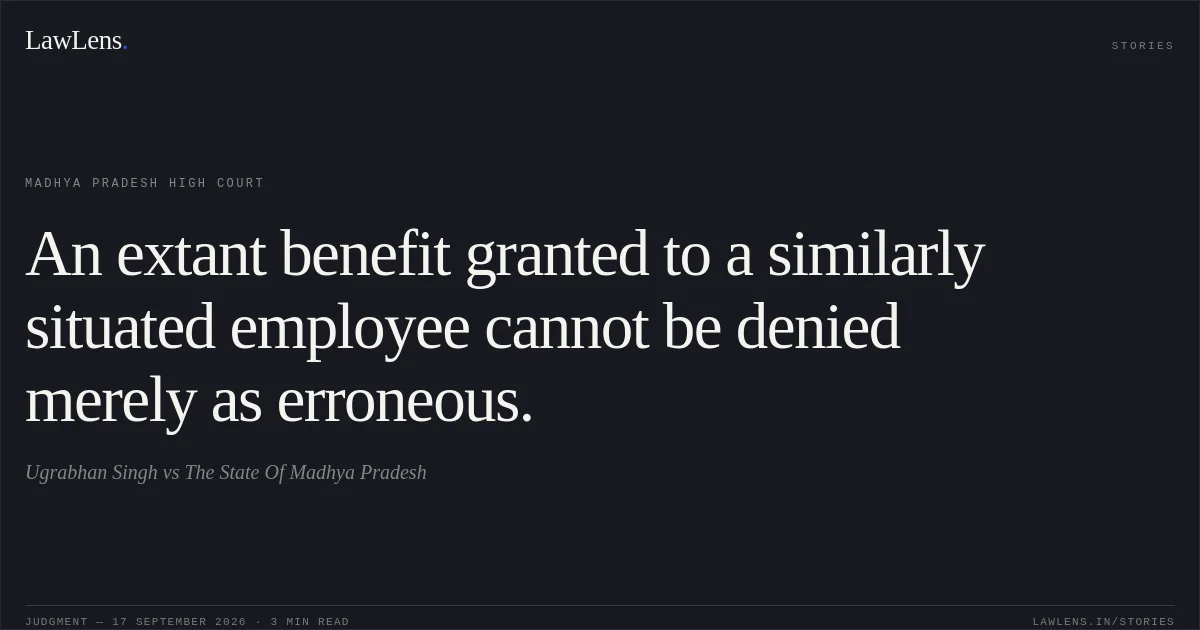
Facts
The petitioner was initially appointed as a Compressor Operator on daily wages on 11 February 1978 and was subsequently treated as a work-charged employee in 1996 in the pay scale of ₹950–1530.
Source reference: para. 2A similarly situated employee, Anand Kumar Singh, had obtained the benefit of the higher pay scale of ₹975–1650 pursuant to proceedings before the High Court, and the benefit was extended to him by the respondents in 2006.
Source reference: paras. 2, 7The petitioner claimed parity and sought the same pay scale and consequential benefits.
Source reference: no citationHis earlier writ petition was disposed of with a direction to the respondents to consider and decide his representation by a reasoned order.
Source reference: para. 3The representation was rejected on the ground that the benefit granted to Anand Kumar Singh had itself been erroneously extended and could not constitute a precedent.
Source reference: paras. 4, 8The petitioner consequently challenged the rejection order and sought pay arrears, pension revision and other consequential benefits.
Source reference: no citationIssues
Whether the respondents could deny the petitioner the benefit of the ₹975–1650 pay scale solely on the ground that the same benefit had allegedly been erroneously granted to a similarly situated employee, when that grant had neither been recalled nor set aside.
Source reference: paras. 7–9Whether the petitioner, having already superannuated, was entitled to arrears of salary or only notional pay fixation for revision of pension and other retiral benefits.
Source reference: paras. 10–11Law Applied
The Court applied Article 14 of the Constitution, which guarantees equality before the law and equal protection of the laws and prohibits arbitrary administrative action.
Source reference: para. 9It held that an existing benefit granted to a similarly situated employee cannot be denied to another similarly situated employee merely by characterising the earlier grant as erroneous, particularly when the grant remains operative and has not been judicially set aside.
Source reference: paras. 8–9The Court also relied on M.R. Gupta v. Union of India, (1995) 5 SCC 628, which distinguishes between continuing entitlement to correct pay fixation and recovery of arrears for a stale period; while wrong pay fixation may give rise to a recurring cause of action, arrears may be denied on the grounds of limitation or laches.
Source reference: para. 10Reasoning
The respondents accepted that Anand Kumar Singh was similarly situated and that the order granting him the higher pay scale had not been recalled or quashed.
Source reference: para. 5Therefore, the respondents could not lawfully reject the petitioner’s claim merely by describing the earlier grant as erroneous.
Source reference: no citationSo long as that grant continued to hold the field, denying the same benefit to the petitioner, without examining his entitlement under the applicable rules, was inconsistent with Article 14 and amounted to arbitrary administrative action.
Source reference: paras. 8–9However, because the petitioner had already retired, the principle in M.R. Gupta restricted the relief: he could receive correction of his pay fixation and consequential revision of pension, but not arrears of salary for the period preceding superannuation.
Source reference: paras. 10–11Holding
The High Court quashed the impugned order dated 6 September 2018 rejecting the petitioner’s representation.
It directed the respondents to extend to the petitioner the benefit of the ₹975–1650 pay scale granted to the similarly situated employee, Anand Kumar Singh.
Source reference: para. 9Since the petitioner had superannuated, the benefit was limited to notional pay fixation for recalculation of pension and other consequential retiral benefits; no arrears of salary were payable for the period before his superannuation.
Source reference: para. 11The writ petition was accordingly disposed of.
Source reference: para. 12Original Court PDF
Ugrabhan SinghvsThe State Of Madhya Pradesh
Click to open original judgment
Original judgment, available to read, download and summarize on LawLens.in
![Relief is made contingent on the Supreme Court’s eventual determination in the analogous pending case.. Ashok Tolani vs REVENUE. CAT - ['Jaipur']. LawLens](/stories/thumbnails/relief-is-made-contingent-on-the-supreme-courts-eventual-determination-in-the-analogous-pe-0a05b6600e0644cf9facfda571d15955.webp)