Facts
The petitioner, a Deputy Superintendent of Police in the Directorate of Vigilance and Anti-Corruption, Assam, was entrusted with Regular Enquiry No. 21(4) of 2017 into alleged disproportionate assets of a public servant.
Source reference: pp. 2–5, paras. 1–4After the Government approved registration of a regular case on 30 January 2018, the FIR alleged that the petitioner was directed to register the case, received the relevant note-sheet extract on 15 February 2018, but continued the enquiry and submitted a progress report in December 2018.
Source reference: pp. 2–5, paras. 1–4An internal enquiry later attributed responsibility for the delay to the petitioner, among others.
Source reference: pp. 2–5, paras. 1–4The petitioner sought to quash the subsequent FIR, registered under Sections 166-A(b), 217 and 201 IPC and Section 98(a) of the Assam Police Act, 2007, arguing, among other things, that he had not received the direction and that no separate FIR was required.
Source reference: pp. 2–5, paras. 1–4The High Court considered the FIR and the materials described in it.
Source reference: pp. 8–10, paras. 7–9Issues
Whether the FIR and accompanying materials, taken at face value, disclosed a prima facie cognizable offence against the petitioner warranting investigation, or instead met the threshold for quashing.
Source reference: pp. 6–8, para. 6; pp. 8–9, para. 7Whether the petitioner’s contention that the original enquiry petition should itself have been treated as the vigilance case, obviating the need for a fresh case, justified quashing the FIR.
Source reference: p. 10, para. 9Law Applied
The petitioner invoked Section 528 of the Bharatiya Nagarik Suraksha Sanhita, 2023, for the High Court’s inherent power to prevent abuse of process or secure the ends of justice.
Source reference: p. 2, para. 1Applying State of Haryana v. Bhajan Lal, 1992 Supp (1) SCC 335, the Court stated that quashing may be appropriate, among other circumstances, where the FIR’s allegations—even if accepted at face value—do not prima facie constitute an offence, or where the uncontroverted allegations and supporting material disclose no offence; conversely, an FIR disclosing a cognizable offence ordinarily does not warrant quashing at that stage.
Source reference: pp. 6–8, para. 6The FIR alleged offences under Sections 166-A(b), 217 and 201 of the IPC, read with Section 98(a) of the Assam Police Act, 2007.
Source reference: p. 2, para. 1Reasoning
The Court treated the alleged receipt of the note-sheet extract on 15 February 2018, the direction to register a case following Government approval, and the petitioner’s subsequent continuation of the enquiry and submission of a progress report as allegations that, if accepted at face value, disclosed a cognizable offence.
Source reference: pp. 8–10, paras. 7–8The petitioner’s denial of receipt raised a factual dispute unsuitable for determination in a quashing proceeding; the FIR and enquiry report expressly stated that he had received the extract.
Source reference: pp. 8–10, paras. 7–8The Court also rejected the argument that the original enquiry petition could substitute for a fresh case because the Government had specifically approved registration of a case against the public servant.
Source reference: p. 10, para. 9Holding
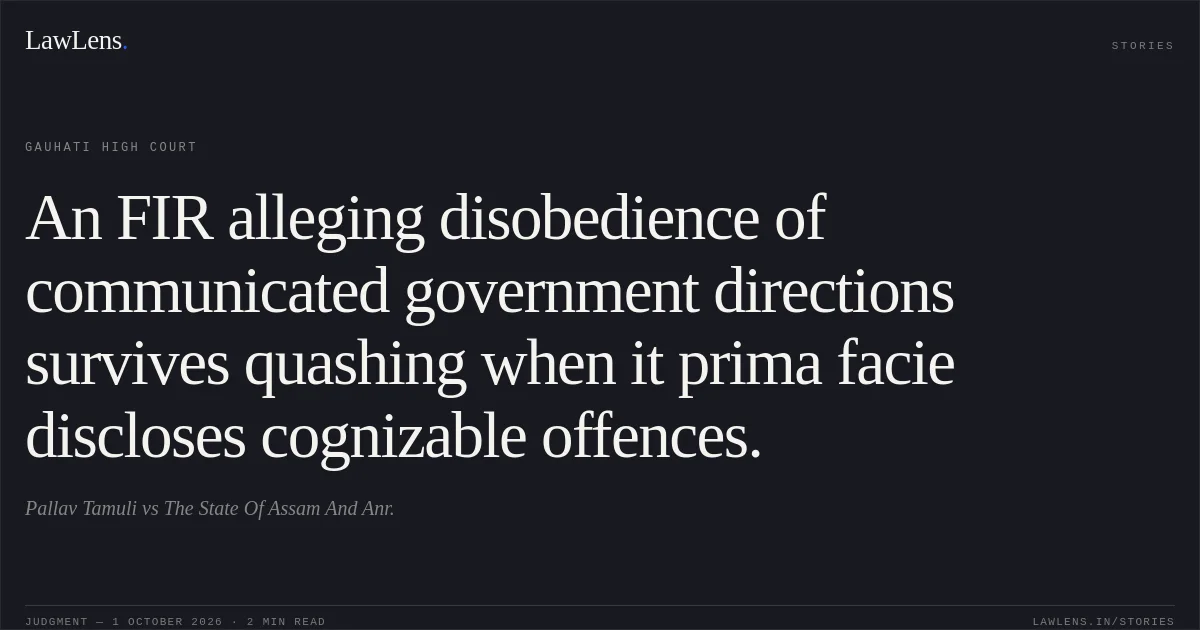
The High Court held that the FIR disclosed a prima facie cognizable offence and did not fall within the grounds for quashing identified in Bhajan Lal.
It declined to quash the FIR and dismissed and disposed of the petition.
Source reference: p. 10, para. 10Acts & Sections Cited
7 provisions across 4 statutes referred to in this judgment. Each provision opens on LawLens.
Bharatiya Nagarik Suraksha Sanhita, 20231
Indian Penal Code, 18602
Assam Police Act, 20071
Code of Criminal Procedure, 19733
Original Court PDF
Pallav TamulivsThe State Of Assam And Anr.
Click to open original judgment
Original judgment, available to read, download and summarize on LawLens.in