Facts
The complainant alleged that she and her daughter invested a total of ₹8,00,000 in the petitioners’ online-trading business in three instalments between November 2018 and February 2020.
Source reference: para. 2, 9The petitioners allegedly issued a cheque and forged investment agreements, failed to repay the full amount, and threatened the complainant when repayment was demanded.
Source reference: para. 2, 9The petitioners acknowledged receiving the amount and repaying ₹1,60,000, but claimed the dispute was civil in nature and arose from a separate loan and cheque transaction.
Source reference: para. 3, 7–8, 12The daughter had also brought a cheque-dishonour case against them, in which the petitioners had been convicted and an appeal was pending.
Source reference: para. 3, 7–8, 12Following a complaint to the Magistrate and a direction to register a case, the police registered an FIR for offences under Sections 420, 467, 471 and 506(ii) IPC.
Source reference: para. 1–2The petitioners sought to quash it under Section 482 Cr.P.C.
Source reference: para. 1–2Issues
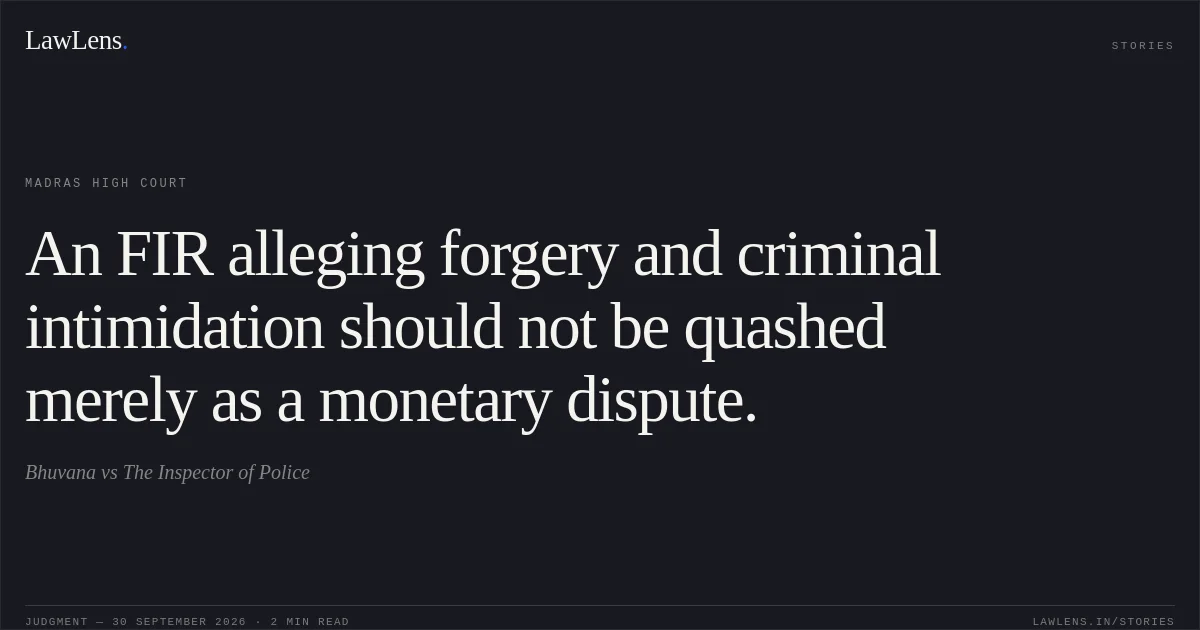
Whether the FIR alleging cheating, forgery, use of forged documents and criminal intimidation should be quashed under Section 482 Cr.P.C. as arising from a purely civil or monetary dispute.
Source reference: para. 4, 6, 15Whether the pending cheque-dishonour proceedings and the petitioners’ alleged partial repayment warranted quashing the FIR at the investigation stage.
Source reference: para. 7–8, 12–15Law Applied
Section 482 Cr.P.C. preserves the High Court’s inherent power to prevent abuse of process and secure the ends of justice, but that power is to be exercised sparingly.
Source reference: para. 11Relying on Neeharika Infrastructure Pvt. Ltd. v. State of Maharashtra, Criminal Appeal No. 330 of 2021, the Court reiterated that quashing an FIR at the investigation stage is generally inappropriate where the allegations disclose cognizable offences; courts should not prematurely assess the merits on incomplete or disputed facts, and the police should ordinarily be permitted to investigate.
Source reference: para. 11The alleged offences were under Sections 420, 467, 471 and 506(ii) IPC.
Source reference: para. 1, 9Reasoning
The Court noted that the petitioners did not dispute receiving ₹8,00,000 or repaying ₹1,60,000, leaving an alleged balance of ₹6,40,000; it also noted their assertion that the cheque was issued as security.
Source reference: para. 7However, the complaint additionally alleged forged agreements, dishonest non-repayment and threats—allegations which, if investigated, could disclose the charged offences.
Source reference: para. 9, 14–15The cheque-dishonour case and the monetary nature of the dealings did not, in the Court’s view, establish that the FIR was an abuse of process or eliminate the need to investigate the distinct allegations.
Source reference: para. 11–15The Court therefore declined to determine disputed facts at the quashing stage.
Source reference: para. 11–15Holding
The Court answered the issue against the petitioners and dismissed the quash petition, holding that the grounds raised did not merit quashing the FIR.
It directed the first respondent to complete the investigation and file a final report within three months of receiving a copy of the order; the connected miscellaneous petition was closed.
Source reference: para. 16Acts & Sections Cited
8 provisions across 2 statutes referred to in this judgment. Each provision opens on LawLens.
Code of Criminal Procedure, 19734
Indian Penal Code, 18604
Original Court PDF
BhuvanavsThe Inspector of Police
Click to open original judgment
Original judgment, available to read, download and summarize on LawLens.in