Facts
On 1 September 2008, the claimant was travelling in a minibus when it collided head-on with a lorry, causing him injuries and the deaths of two other persons.
Source reference: p.1–4He sought ₹10,00,000 in compensation. The Motor Accident Claims Tribunal found composite negligence, apportioning liability equally between the two drivers, and awarded ₹1,59,191 with 7.5% annual interest.
Source reference: p.1–4The insurance company appealed, contending that the FIR and final report against the lorry driver established that the accident was attributable to that driver alone.
Source reference: p.1–4Issues
Whether the Tribunal was justified in apportioning negligence equally between the lorry and minibus drivers despite the FIR having been registered against the lorry driver.
Source reference: p.6Whether the Tribunal correctly assessed the compensation awarded to the claimant.
Source reference: p.6Law Applied
The Court applied the principle of composite negligence: where the evidence does not establish that one vehicle’s driver alone caused a collision involving multiple vehicles, responsibility may be apportioned between the drivers.
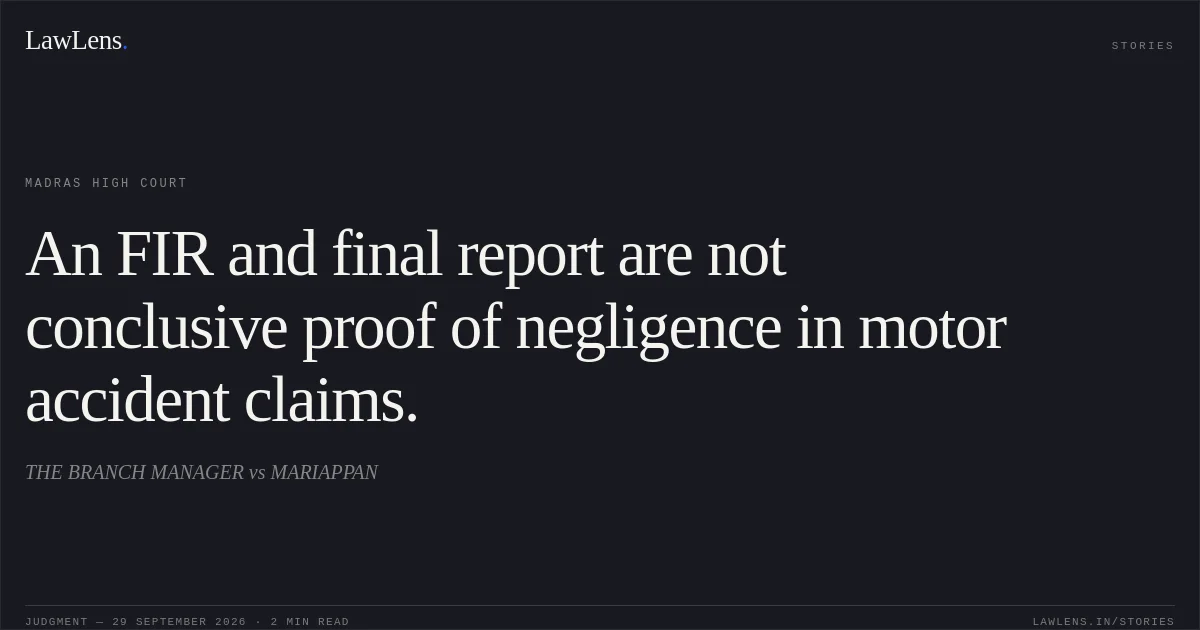
Source reference: p.5–7It also held that an FIR and final report, without supporting evidence, are not conclusive proof of negligence in a motor accident claim; the Tribunal must assess the evidence independently.
Source reference: p.5–7The appeal was brought under Section 173 of the Motor Vehicles Act, 1988, but the judgment cites no further statutory provisions or precedents.
Source reference: p.1, 5–7Reasoning
The Tribunal had considered the injured claimant’s testimony and the other material on record, and found that the head-on collision did not provide sufficient basis to attribute the entire negligence to either driver.
Source reference: p.6–8The High Court found no evidentiary or other basis to disturb the equal apportionment, observing that the FIR and final report against the lorry driver did not, by themselves, establish sole negligence.
Source reference: p.6–8On quantum, it found no ground to interfere with the award, which it considered just in light of the injuries and disability.
Source reference: p.8Holding
The Court answered both issues against the appellant, dismissed the appeal, and confirmed the Tribunal’s award of ₹1,59,191 with interest at 7.5% per annum, including the equal apportionment of liability.
It directed the appellant to deposit its 50% share, with accrued interest and costs if not already deposited, within six weeks; the claimant may withdraw the amount in accordance with the Tribunal’s order.
Source reference: p.9The other insurer’s liability for the remaining 50% was also confirmed, with no order as to costs.
Source reference: p.9Acts & Sections Cited
1 provisions across 1 statute referred to in this judgment. Each provision opens on LawLens.
Motor Vehicles Act, 19881
Original Court PDF
THE BRANCH MANAGERvsMARIAPPAN
Click to open original judgment
Original judgment, available to read, download and summarize on LawLens.in