01Facts
The petitioner, a retired Village Accountant, faced criminal prosecution and departmental proceedings arising from an allegation that he demanded and accepted a bribe in connection with mutation of land records.
pp. 3–4 · ¶ 2–3The Special Court acquitted him on 31 October 2013.
pp. 3–4 · ¶ 2–3In the departmental enquiry, the Enquiry Officer found the charges proved, and the disciplinary authority ordered permanent withholding of 50% of his pension on 17 June 2021.
pp. 3–4 · ¶ 2–3The Karnataka State Administrative Tribunal dismissed his challenge to that order on 23 August 2025; he then filed this writ petition.
pp. 3–4 · ¶ 2–3The High Court compared the charges and witnesses in the criminal and departmental proceedings.
pp. 8–10 · ¶ 10–1302Issues
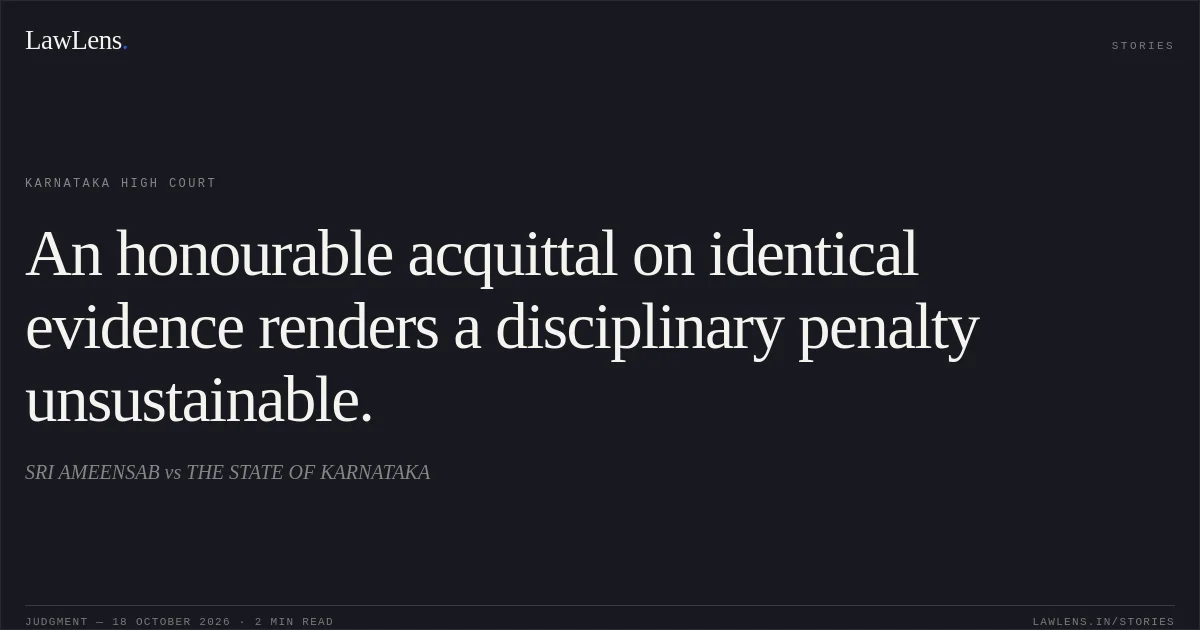
i.1. Whether the departmental penalty could stand when the petitioner had been acquitted in the criminal case and the charges and evidentiary basis in both proceedings were substantially the same.
pp. 10–11, 17 · ¶ 13–15ii.2. Whether the Tribunal erred in dismissing the petitioner’s application challenging the penalty.
p. 17 · ¶ 1503Law Applied
Under *G.M. Tank v. State of Gujarat*, (2006) 5 SCC 446, where criminal and departmental proceedings rest on identical facts, charges, evidence, witnesses and circumstances, and the employee is acquitted after a regular trial, it may be unjust and oppressive to allow contrary departmental findings to stand; the differing standards of proof do not govern such a case in the usual way.
pp. 11–17 · ¶ 14The Court also referred to *R.P. Kapur v. Union of India*, *Corpn. of the City of Nagpur v. Ramchandra*, and *Paul Anthony v. Bharat Gold Mines Ltd.*, as discussed in *G.M. Tank*, concerning the effect of acquittal on disciplinary proceedings.
pp. 11–17 · ¶ 14The disciplinary action arose under the Karnataka Civil Services (Conduct) Rules, 1966.
p. 9 · ¶ 10The petition was brought under Articles 226 and 227 of the Constitution.
p. 2Provisions in the judgment · 5 · Linked ones open on LawLens
Prevention of Corruption Act, 1988 Section 7Section 13
Indian Penal Code, 1860 Section 147Section 353Section 329
04Reasoning
The Court found that the criminal and departmental cases arose from the same alleged bribe transaction and substantially the same charges, facts and evidentiary material; the complainant and the Lokayukta officer were examined in both proceedings.
pp. 8–11 · ¶ 10–13Applying *G.M. Tank*, it held that the disciplinary authority had not adequately considered the effect of the acquittal and that maintaining the departmental finding in these circumstances was contrary to the governing principle.
p. 17 · ¶ 15The Court therefore concluded that the Tribunal had erred in upholding the penalty.
p. 17 · ¶ 1505Holding
The High Court allowed the writ petition, set aside the Tribunal’s order dated 23 August 2025, allowed Application No. 20031 of 2024, and quashed the disciplinary authority’s order dated 17 June 2021 withholding 50% of the petitioner’s pension.
p. 18 · ¶ 16 and order clauses i–ivOriginal Court PDF
SRI AMEENSABvsTHE STATE OF KARNATAKA
Click to open original judgment
Original judgment, available to read, download and summarize on LawLens.in