Facts
The plaintiff, Jagan Nath, instituted a suit in 1977 seeking declaration of ownership, permanent injunction and, alternatively, possession of the suit land.
Source reference: para. 2–3He alleged that the defendant, Om Prakash, had merely been appointed as caretaker while the plaintiff and his father were residing away from the village, but had, in collusion with revenue officials, procured revenue entries showing himself as a tenant.
Source reference: para. 2–3The defendant claimed that he had been inducted as a tenant by the plaintiff’s father and had consequently acquired proprietary rights under the Himachal Pradesh Tenancy and Land Reforms Act.
Source reference: para. 4The trial Court decreed the suit for possession on 23.03.1982. After an earlier appellate remand concerning civil-court jurisdiction, the District Judge, on 22.02.2008, affirmed the trial Court’s findings.
Source reference: para. 6–8Issues
Whether the first appellate Court committed a jurisdictional or legal error in disregarding the additional evidence, Ex. A-1 to Ex. A-13, and whether the presumption attached to the continuity of revenue entries stood rebutted by the plaintiff’s evidence.
Source reference: para. 10, substantial question of law No. 1Whether the concurrent findings that the defendant was not a tenant were erroneous, perverse, or based on misreading of the oral and documentary evidence.
Source reference: para. 10, substantial question of law No. 2Whether the defendant’s entry as a tenant in the Khasra Girdawari, made without following the prescribed revenue procedure, could create valid tenancy or proprietary rights.
Source reference: para. 42–51Whether the defendant, being established as a caretaker or agent, could claim any independent right, title or interest in the suit land.
Source reference: para. 61–65Law Applied
The Court applied Section 38 of the Himachal Pradesh Land Revenue Act, which restricts alteration of record-of-rights and periodical records except on the basis of proved or admitted facts, agreement of the parties, or a binding decree or order.
Source reference: para. 45–48It relied on clauses 8.15 and 9.8 of the Himachal Pradesh Land Records Manual, requiring due inquiry and reasonable opportunity of hearing before altering entries relating to possession, rent or tenancy.
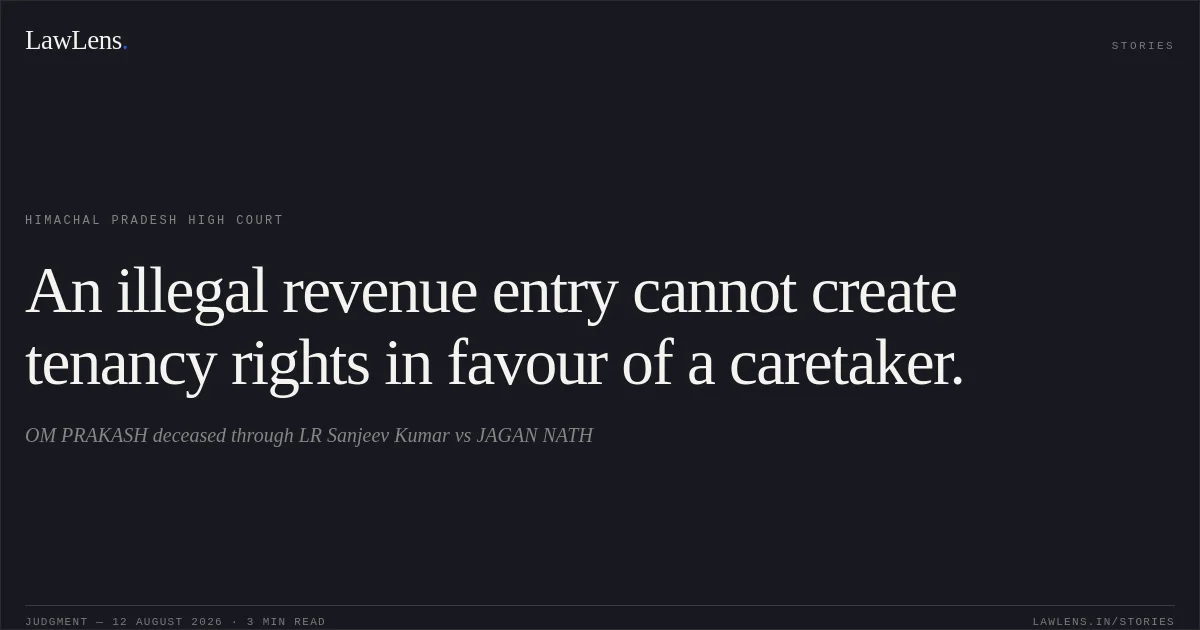
Source reference: para. 40, 45–46The Court held that tenancy is founded on a bilateral agreement and cannot be inferred merely from an unauthorised revenue entry.
Source reference: para. 43It further applied the principle that a caretaker, servant or agent holds possession on behalf of the owner and acquires no proprietary or possessory interest irrespective of the duration of occupation, relying on Maria Margarida Sequeira Fernandes v. Erasmo Jack de Sequeira, 2012 (5) SCC 370, and the principles stated therein from Puran Singh v. State of Punjab and Mahabir Prasad Jain.
Source reference: para. 62–64Finally, under Section 100 CPC, interference with concurrent findings of fact is permissible only in cases involving perversity, misapplication of mandatory law, inadmissible evidence or findings unsupported by evidence; the Court relied on Navaneethammal v. Arjuna Chetty, Kondiba Dagadu Kadam v. Savitribai Sopan Gujar, Naresh v. Hemant, Gurdev Kaur v. Kaki and Brij Narayan Shukla v. Sudesh Kumar.
Source reference: para. 66–71Reasoning
The Court found that the defendant’s own admissions and letters, Ex. DW-1/A to Ex. DW-1/N, showed that he was managing the land and reporting its cultivation, repairs and produce to the plaintiff’s father—conduct consistent with that of a caretaker or manager, not an independent tenant.
Source reference: para. 31–37, 61The defendant produced no rent receipts or written tenancy agreement, and his witnesses could not establish payment of rent or a valid induction into tenancy.
Source reference: para. 23–30The 1976 Khasra Girdawari entry was held unreliable because the mandatory procedure under clause 9.8 of the Land Records Manual and Section 38 of the Himachal Pradesh Land Revenue Act had not been followed; the plaintiff was neither associated with the inquiry nor afforded an opportunity of hearing.
Source reference: para. 39–51Since the foundational tenancy entry was illegal, subsequent revenue entries showing the defendant as owner could not carry a presumption of truth.
Source reference: para. 54–57The Court also held that the concurrent factual findings were supported by the evidence and disclosed no perversity or substantial error of law warranting interference under Section 100 CPC.
Source reference: para. 66–74Holding
The Court answered the substantial questions of law against the defendant.
It held that the revenue entries and additional documents did not establish a valid tenancy or proprietary rights, that the defendant was only a caretaker whose possession was unauthorised, and that the concurrent findings of the Courts below were neither perverse nor legally erroneous.
Source reference: para. 57, 63–65, 73–74The regular second appeal was accordingly dismissed, along with pending applications, and the decree in favour of the plaintiff for possession was affirmed.
Source reference: para. 74–75Acts & Sections Cited
1 provisions across 1 statute referred to in this judgment. Each provision opens on LawLens.
Code of Civil Procedure, 19081
Original Court PDF
OM PRAKASH deceased through LR Sanjeev KumarvsJAGAN NATH
Click to open original judgment
Original judgment, available to read, download and summarize on LawLens.in