Facts
The respondent-workman claimed that he had worked as a daily-wage chaukidar with the State for approximately 14 years, at daily wages of Rs.65.50, and that his services were terminated on 30 September 1999 without notice, notice pay, or retrenchment compensation.
Source reference: p.2Upon failure of conciliation, the dispute was referred to the Labour Court, Bhavnagar, which directed reinstatement with continuity of service and 20% back wages by award dated 31 August 2017.
Source reference: p.2The State challenged the award under Articles 226 and 227 of the Constitution, contending that the workman had neither proved continuous service nor completion of 240 days in the preceding 12 months, and that the work was seasonal.
Source reference: p.3The State produced muster-rolls for 1988–1989 to 1999–2000, but not the complete records for the period directed by the Labour Court.
Source reference: pp.3, 5The Labour Court also found violation of the “last come, first go” principle under Section 25G, as juniors were allegedly retained in service.
Source reference: p.6During the writ proceedings, the workman reached the age of superannuation in 2025, making reinstatement impracticable.
Source reference: p.4Issues
1. Whether the Labour Court was justified in holding that the workman had established the requisite continuous service and completion of 240 days under Sections 25B and 25F of the Industrial Disputes Act, 1947, despite the State’s production of incomplete muster-rolls?
Source reference: pp.3, 5–62. Whether the termination violated Section 25G of the Industrial Disputes Act, 1947, on account of the alleged retention of junior daily-wage workers?
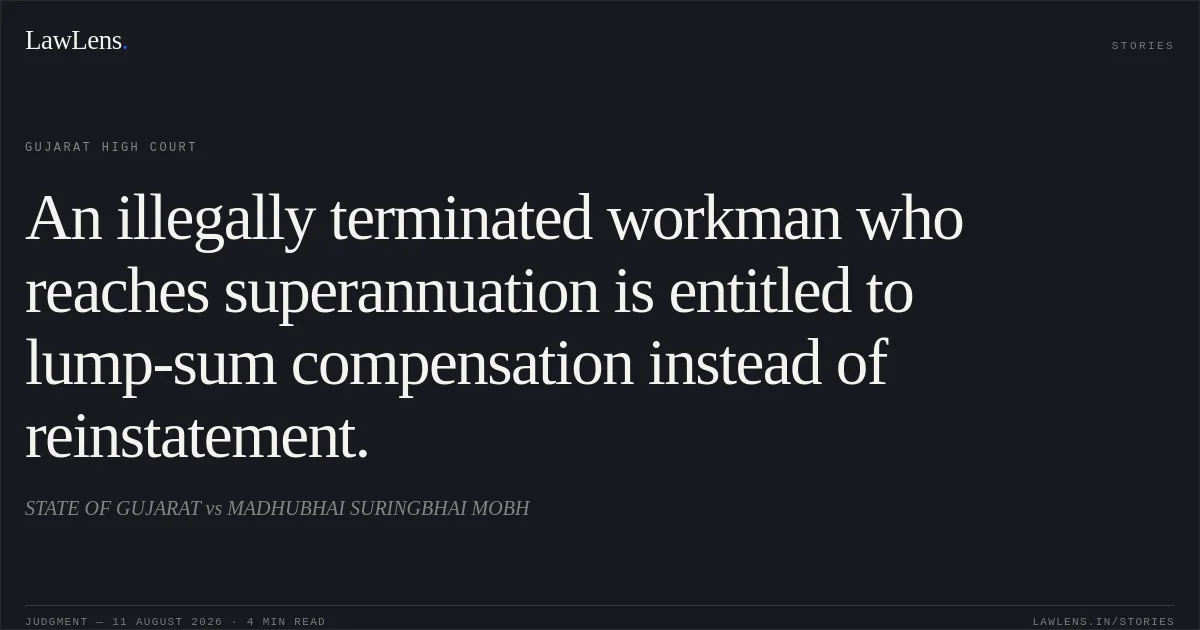
Source reference: p.63. Whether, upon the workman attaining the age of superannuation, reinstatement should be substituted by lump-sum monetary compensation, and what amount would be just and reasonable?
Source reference: pp.7–8Law Applied
The Court applied Sections 25B, 25F and 25G of the Industrial Disputes Act, 1947. Section 25B concerns continuous service and the statutory requirement of 240 days; Section 25F requires notice or notice pay and retrenchment compensation before retrenchment; and Section 25G embodies the “last come, first go” rule.
Source reference: pp.3, 6The Court applied the evidentiary principle that where an employer withholds the best available employment records or produces them incompletely, an adverse inference may be drawn against the employer.
Source reference: p.5It further applied the settled principle that where termination is held illegal but reinstatement is no longer feasible because the workman has attained superannuation, lump-sum compensation may be awarded in lieu of reinstatement.
Source reference: p.7The Court considered Allahabad Bank v. Krishan Pal Singh, 2021 (0) AIJEL-SC 67706, in which compensation was awarded upon superannuation, but distinguished it on the basis that the employee there was a confirmed bank clerk, whereas the present workman was a daily wager.
Source reference: pp.4, 7–8Reasoning
The Court found that the State had been directed to produce attendance sheets, salary statements, seniority records and other relevant documents for the period from 1985 to 1999, but had produced only incomplete muster-rolls from 1988–1989 onwards.
Source reference: p.5Since the best evidence was within the State’s possession and had not been fully produced, the Court declined to accept the State’s contention that the workman had failed to prove the statutory requirement of continuous service and 240 days under Section 25B.
Source reference: p.5The workman’s unrebutted evidence that juniors were retained, together with the seniority material on record and the absence of effective cross-examination on that point, supported the finding of breach of Section 25G.
Source reference: p.6The Court therefore found no basis to interfere with the finding that the termination was illegal for non-compliance with the statutory safeguards under Section 25F.
Source reference: p.6However, because the workman had superannuated in 2025, reinstatement could not practically be ordered.
Source reference: pp.7–8In assessing compensation, the Court considered his length of service, daily-wage status, nature of duties, wages, period of litigation, and asserted unemployment.
Source reference: pp.7–8It distinguished the higher compensation awarded in Allahabad Bank because that case concerned a confirmed nationalised-bank employee and materially different facts.
Source reference: p.8Holding
The Court substantially upheld the Labour Court’s finding that the workman’s termination was illegal and that the State had not established compliance with the requirements of the Industrial Disputes Act.
Since reinstatement was no longer feasible after the workman’s superannuation, the award was modified: the State was directed to pay Rs.7,50,000 as lump-sum compensation in lieu of reinstatement and other benefits within eight weeks from receipt of the order.
Source reference: p.8In default, the amount would carry interest at 5% per annum from the date of the Labour Court’s award until realization.
Source reference: p.8The writ petition was accordingly dismissed and the Rule discharged.
Source reference: p.8Acts & Sections Cited
4 provisions across 1 statute referred to in this judgment. Linked provisions open on LawLens.
Industrial Disputes Act, 19474
Original Court PDF
STATE OF GUJARATvsMADHUBHAI SURINGBHAI MOBH
Click to open original judgment
Original judgment, available to read, download and summarize on LawLens.in