Facts
The petitioner, then serving as Station House Officer, Police Station Kotgate, Bikaner, received court notices for service upon certain respondents in Criminal Case No. 56/2022 pending before the Additional District & Sessions Judge No. 2, Bikaner. The notices were not returned to the Court within the stipulated time.
Source reference: paras. 1–2.1; pp. 1–2In response to a notice issued under Section 173 IPC, the petitioner explained that he had been engaged in duties relating to the Police Constable Recruitment Examination, 2021, from 13.05.2022 to 16.05.2022, resulting in an inadvertent delay. He denied any intentional non-compliance, expressed regret, and assured future diligence.
Source reference: paras. 1–2.1; pp. 1–2The Sessions Court was not satisfied with the explanation and lodged a complaint, pursuant to which the Additional Chief Judicial Magistrate No. 2, Bikaner took cognizance under Section 173 IPC by order dated 30.05.2022. The petitioner challenged that order under Section 482 CrPC.
Source reference: paras. 1–2.1; pp. 1–2Issues
Whether the petitioner’s failure to return the court notices within the prescribed time, in the absence of material showing deliberate disobedience or mala fide intent, constituted an offence under Section 173 IPC?
Source reference: para. 5; pp. 3–4Whether the Magistrate’s order taking cognizance under Section 173 IPC, based merely on the fact of non-compliance and without examining the petitioner’s explanation or recording prima facie satisfaction regarding criminal intent, amounted to an abuse of the process of law warranting interference under Section 482 CrPC?
Source reference: paras. 6.3–6.4; pp. 5–6Law Applied
The Court applied Section 482 CrPC, which preserves the High Court’s inherent power to prevent abuse of the process of any court and secure the ends of justice, and Section 173 IPC concerning intentional omission or disobedience relating to the production or delivery of documents or things before a public servant.
Source reference: paras. 6–6.5; pp. 4–6The Court held that criminal prosecution for an official omission requires more than a mere procedural lapse; the material must prima facie disclose wilful disobedience, conscious disregard of a lawful direction, deliberate defiance, or mala fide intent. Criminal law should not be invoked for every inadvertent or bona fide administrative error, particularly where the conduct of a public servant does not transcend negligence or inadvertence and assume the character of deliberate criminal misconduct.
Source reference: paras. 6–6.5; pp. 4–6Reasoning
The Court found that the petitioner had acknowledged the delay and furnished a plausible explanation based on official deployment in the recruitment examination. Nothing on record suggested that he had intentionally withheld the notices, sought to obstruct the judicial process, or acted with an oblique motive.
Source reference: paras. 6.1–6.4; pp. 4–6The mere failure to return the process within time, without proof of deliberate or contumacious disobedience, did not satisfy the requisite ingredients for prosecution under Section 173 IPC. The Magistrate’s order did not consider the explanation or identify circumstances establishing the necessary criminal intent; it proceeded solely on the fact of non-compliance and therefore reflected a mechanical exercise of jurisdiction.
Source reference: paras. 6.1–6.4; pp. 4–6Holding
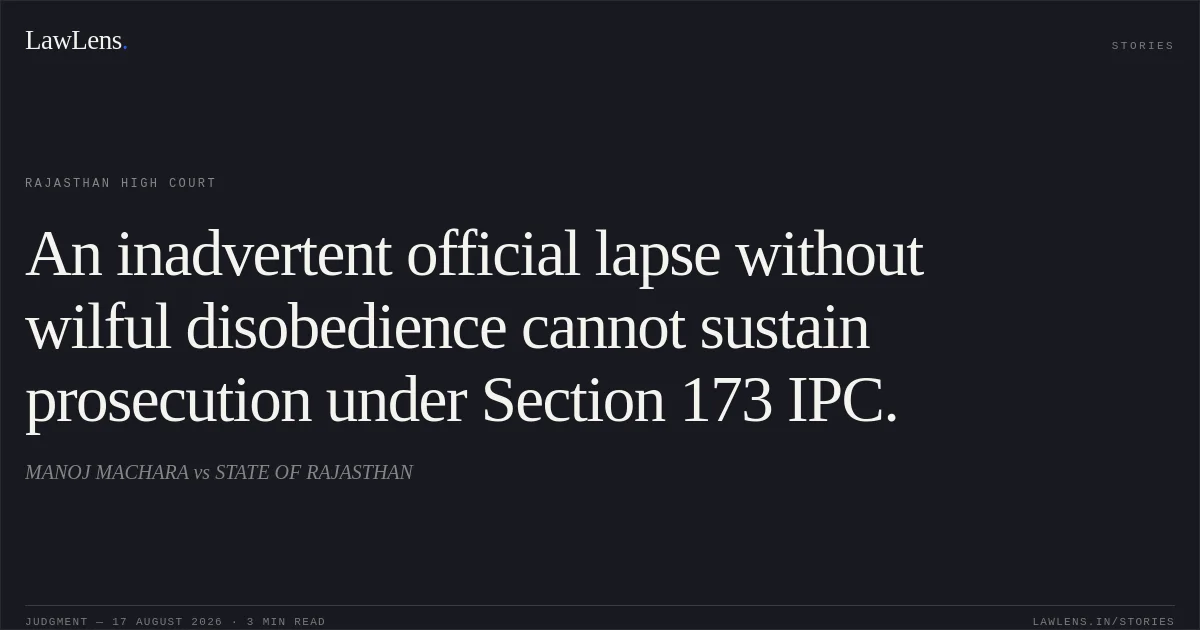
The High Court held that the petitioner’s conduct amounted, at most, to an inadvertent procedural lapse arising from official exigencies and did not constitute the deliberate, contumacious, or mala fide conduct necessary to attract liability under Section 173 IPC.
Exercising its inherent jurisdiction under Section 482 CrPC, the Court allowed the petition, quashed and set aside the order dated 30.05.2022 taking cognizance in Criminal Case No. 4593/2022, and terminated all proceedings arising from it. The stay petition and pending applications were also disposed of.
Source reference: paras. 6.5–8; pp. 6–7Acts & Sections Cited
2 provisions across 2 statutes referred to in this judgment. Each provision opens on LawLens.
Code of Criminal Procedure, 19731
Indian Penal Code, 18601
Original Court PDF
MANOJ MACHARAvsSTATE OF RAJASTHAN
Click to open original judgment
Original judgment, available to read, download and summarize on LawLens.in