01Facts
The appellant, the deceased Shabana’s husband and original complainant, challenged the judgment dated 9 February 2012 by which the Sessions Court, Junagadh acquitted Shabana’s parents of offences under Sections 306 and 114 of the Indian Penal Code (“IPC”).
¶ 1, 5–6The prosecution alleged that the respondents opposed Shabana’s marriage, pressurised her to obtain a divorce, quarrelled with her and subjected her to mental harassment, which allegedly led her to pour kerosene on herself and commit suicide on 20 September 2009.
¶ 2Shabana sustained approximately 98% burns and was taken to hospital, where the police recorded her statement and an Executive Magistrate recorded a dying declaration implicating her parents and other family members.
¶ 12–13The medical history, however, recorded that she was frustrated and did not name the accused.
¶ 13The evidence also indicated that, on the day before the incident, the complainant and Shabana had gone to the accused’s house, where a quarrel occurred and the complainant allegedly assaulted Shabana’s sister with an iron rod or pipe, resulting in a separate complaint against him.
¶ 13–16After trial, the Sessions Court acquitted the respondents, leading to the present appeal under Section 378(4) of the Code of Criminal Procedure, 1973.
¶ 102Issues
i.1. Whether the trial court correctly acquitted the respondents of the offences under Sections 306 and 114 IPC.
¶ 11(1)ii.2. Whether the trial court properly appreciated the oral and documentary evidence produced by the prosecution.
¶ 11(2)–(3)iii.3. Whether the dying declaration recorded by the Executive Magistrate under Section 32 of the Indian Evidence Act, 1872, was reliable and sufficient to establish the respondents’ culpable abetment of suicide.
¶ 11(4)iv.4. Whether the acquittal judgment suffered from illegality, irregularity, perversity or misappreciation of material evidence warranting appellate interference.
¶ 11(5)03Law Applied
The court applied Section 306 IPC, which requires proof of abetment of suicide, read with Section 107 IPC, under which abetment requires instigation, participation in a conspiracy accompanied by an act or illegal omission, or intentional aid.
¶ 10.1Section 114 IPC was relevant to alleged abetment by persons present at the commission of the offence.
The court considered Section 32 of the Indian Evidence Act, 1872, governing the admissibility and evidentiary value of a dying declaration, and relied on Irfan alias Naka v. State of Uttar Pradesh, AIR 2023 SC 4129, for factors including voluntariness, absence of tutoring, proper recording, consistency, the earliest opportunity for recording and the declarant’s physical and mental capacity.
¶ 18On appeals against acquittal, the court applied the principles in Chandrappa v. State of Karnataka, (2007) 4 SCC 415; Rajesh Prasad v. State of Bihar, (2022) 3 SCC 471; Babu Sahebagouda Rudragoudar v. State of Karnataka, (2024) 8 SCC 149; and Ramesh v. State of Karnataka, (2024) 9 SCC 169: an appellate court may reappreciate the evidence, but must respect the reinforced presumption of innocence following acquittal and should not interfere where two reasonable views are possible, absent perversity or manifest illegality.
¶ 20–23Provisions in the judgment · 5 · Linked ones open on LawLens
Code of Criminal Procedure, 1973 Section 378Section 313
Indian Penal Code, 1860 Section 306Section 114Section 107
04Reasoning
The High Court held that the prosecution failed to establish the essential causal link between the respondents’ conduct and Shabana’s suicide.
Although the dying declaration attributed pressure to obtain a divorce to her parents, the medical history recorded contemporaneously stated only that she was frustrated and did not identify any accused; the doctor also found her semi-conscious when brought to the hospital.
¶ 13The alleged earlier complaint concerning pressure to divorce was approximately one year old, and no evidence established continuing harassment, cruelty or any proximate act by the respondents before the suicide.
¶ 13The evidence of the prosecution witnesses instead showed continuing disputes initiated or participated in by the complainant, including the quarrel on the day before the incident and the separate assault case against him.
¶ 13–16The alleged independent witnesses were also affected by their association with the complainant and did not provide sufficiently reliable evidence of instigation or intentional aid.
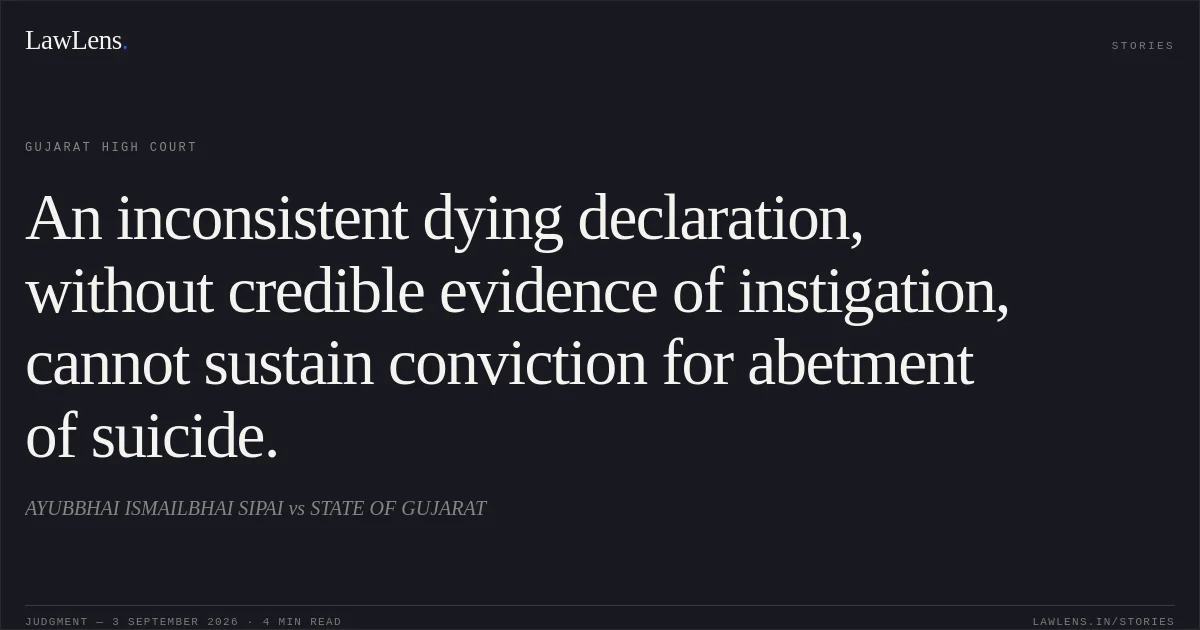
¶ 14–16Applying the principles governing dying declarations and the heightened restraint applicable to appeals against acquittal, the court found that the dying declaration, viewed with the surrounding circumstances and other evidence, was insufficient to prove abetment beyond reasonable doubt.
¶ 18–2505Holding
The court answered the issues against the appellant.
It held that the prosecution had not proved beyond reasonable doubt that the respondents abetted Shabana’s suicide or committed the charged offences under Sections 306 and 114 IPC.
¶ 24–25Finding no illegality, infirmity or perversity in the trial court’s acquittal, the High Court dismissed the appeal and confirmed the judgment dated 9 February 2012.
¶ 26The respondents’ bail bonds were cancelled, and the record and proceedings were directed to be returned to the trial court.
¶ 26Original Court PDF
AYUBBHAI ISMAILBHAI SIPAIvsSTATE OF GUJARAT
Click to open original judgment
Original judgment, available to read, download and summarize on LawLens.in