Facts
The parties married on 14.05.2014 according to Hindu rites.
Source reference: paras. 2.1–3The husband, an Indian Army Jawan, alleged that the wife repeatedly left the matrimonial home, quarrelled with him and his family, refused to reside with him at Jabalpur, and had lived separately since October 2015.
Source reference: paras. 2.1–3, 11The wife denied the allegations and pleaded dowry-related harassment, physical assault, eviction from the matrimonial home, and hospitalization at Jabalpur Military Hospital.
Source reference: paras. 5–6She had also instituted a criminal case under Section 498-A IPC and a maintenance proceeding, in which she was awarded ₹4,000 per month.
Source reference: paras. 2.3, 5–6The Family Court, Chatra, proceeded substantially on the husband’s evidence, noted that the wife neither cross-examined the husband’s witnesses except the husband himself nor led evidence, and decreed divorce on 31.08.2021, with the decree being signed on 09.09.2021 in Original Suit No. 18 of 2019.
Source reference: paras. 12–13, 21–22The wife appealed under Section 19 of the Family Courts Act, 1984.
Source reference: no citationIssues
Whether the wife could raise, for the first time in appeal, the plea that her non-appearance before the Family Court was caused by COVID-19 infection?
Source reference: paras. 32(i), 34–42Whether the Family Court was bound to consider the defence pleaded in the written statement despite the wife’s failure to cross-examine most of the husband’s witnesses and her failure to adduce evidence?
Source reference: paras. 32(ii)–(iv), 43–57Whether a written statement, once filed, could be disregarded merely because the defendant subsequently failed to appear or lead evidence?
Source reference: paras. 43–52Whether the Family Court’s failure to consider the wife’s pleaded case of dowry-related cruelty, physical assault and hospitalization rendered the divorce decree perverse and unsustainable?
Source reference: paras. 53–64Law Applied
The Court applied Section 19 of the Family Courts Act, 1984, and Sections 13(1)(ia) and 13(1)(ib) of the Hindu Marriage Act, 1955, concerning divorce on the grounds of cruelty and desertion.
Source reference: paras. 1, 3, 11It held that an appellate court ordinarily cannot permit a wholly new factual case to be introduced for the first time in appeal, relying on Divyagnakumari Harisinh Parmar v. Union of India, 2025 SCC OnLine SC 2064, which reiterates that relief cannot be granted on a case not founded in the pleadings.
Source reference: paras. 34–37On the meaning of perversity, the Court relied on Arulvelu v. State, (2009) 10 SCC 206, and Damodar Lal v. Sohan Devi, (2016) 14 SCC 197, holding that a finding is perverse where it ignores relevant material, considers irrelevant material, or is so irrational that no reasonable judicial forum could have reached it.
Source reference: paras. 28–31Under the civil procedure governing written statements and ex parte proceedings, the Court held that a written statement forms part of the record and cannot be ignored merely because the defendant later fails to appear or adduce evidence; this principle was supported by Rina Kumari @ Rina Devi @ Reena v. Dinesh Kumar Mahto, 2025 INSC 55.
Source reference: paras. 44–52The Court also invoked the principle that procedure is the handmaid of justice, relying on Sugandhi v. P. Rajkumar, (2020) 10 SCC 706.
Source reference: paras. 58–61Reasoning
The Court rejected the COVID-19 plea because it had not been raised before the Family Court or supported by any contemporaneous request or explanation, and therefore constituted a new factual ground at the appellate stage.
Source reference: paras. 38–42However, it held that the wife’s written statement was already part of the record and that her subsequent failure to cross-examine witnesses or lead evidence did not authorise the Family Court to disregard it altogether.
Source reference: paras. 43–52The trial court had relied principally on the husband’s evidence while failing to properly address the wife’s specific defence that she had been subjected to dowry-related cruelty, physical assault and hospitalization at Jabalpur.
Source reference: paras. 53–54Further, the husband admitted in cross-examination that even if the wife wished to live with him, he would not continue the marital relationship.
Source reference: para. 55According to the High Court, this admission was relevant to determining whether the wife had withdrawn from the husband’s society and whether desertion was established against her.
Source reference: para. 55Because the Family Court failed to evaluate these material pleadings and relevant admissions, its findings on cruelty and desertion were incomplete and fell within the legal threshold of perversity.
Source reference: paras. 56, 62–64Holding
The High Court held that the COVID-19 plea could not be considered as a fresh factual ground raised for the first time in appeal.
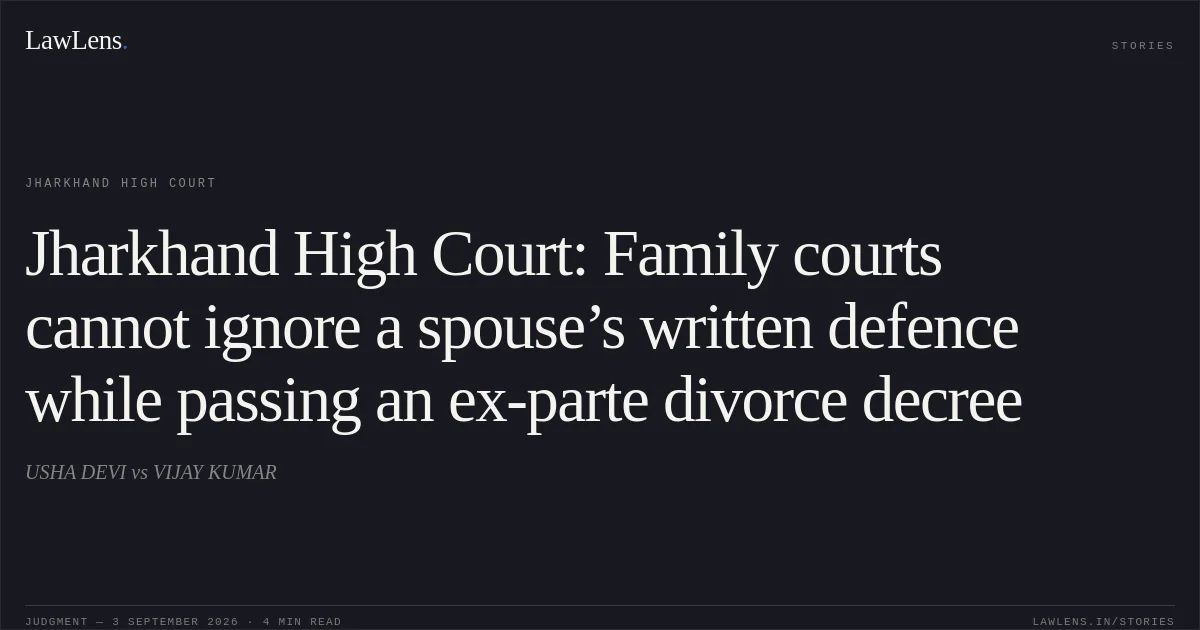
Nevertheless, the Family Court was legally bound to consider the wife’s written statement, notwithstanding her subsequent non-appearance and failure to adduce evidence.
Source reference: paras. 62–65The divorce judgment dated 31.08.2021 and decree dated 09.09.2021 in Original Suit No. 18 of 2019 were therefore quashed and set aside as perverse.
Source reference: paras. 62–65The matter was remitted to the Principal Judge, Family Court, Chatra, with directions to revive the suit, permit the parties to appear within four weeks, proceed from the stage of cross-examination of the husband’s witnesses, allow the wife an opportunity to lead evidence, and decide the matter afresh in accordance with law.
Source reference: paras. 66–69Acts & Sections Cited
3 provisions across 3 statutes referred to in this judgment. Each provision opens on LawLens.
Family Courts Act, 19841
Hindu Marriage Act, 19551
Code of Criminal Procedure, 19731
Original Court PDF
USHA DEVIvsVIJAY KUMAR
Click to open original judgment
Original judgment, available to read, download and summarize on LawLens.in