01Facts
The appellant was convicted by the Additional Sessions Judge-06/Special Judge (POCSO), East District, Delhi, under Section 10 of the Protection of Children from Sexual Offences Act, 2012, for allegedly making obscene comments and sexually assaulting the prosecutrix on 15 July 2013.
p. 2 · ¶ 1–3The conviction judgment was delivered on 14 October 2022, but the appellant had not yet been sentenced when he filed the appeal.
p. 6 · ¶ 8Subsequently, during proceedings for production and sentencing, the Jail Superintendent reported that the appellant was mentally unfit and suffering from dementia.
p. 3 · ¶ 6A Medical Board diagnosed dementia with Behavioural and Psychological Symptoms, cerebral atrophy, and severe global cognitive impairment, rendering him unable to effectively defend himself.
pp. 3–5 · ¶ 6The trial court therefore postponed the proceedings under the provisions relating to accused persons of unsound mind.
pp. 3–5 · ¶ 6In the appeal, the appellant sought to rely on his mental condition both to challenge his fitness to stand trial and to establish the defence under Section 84 of the Indian Penal Code, 1860.
p. 3 · ¶ 502Issues
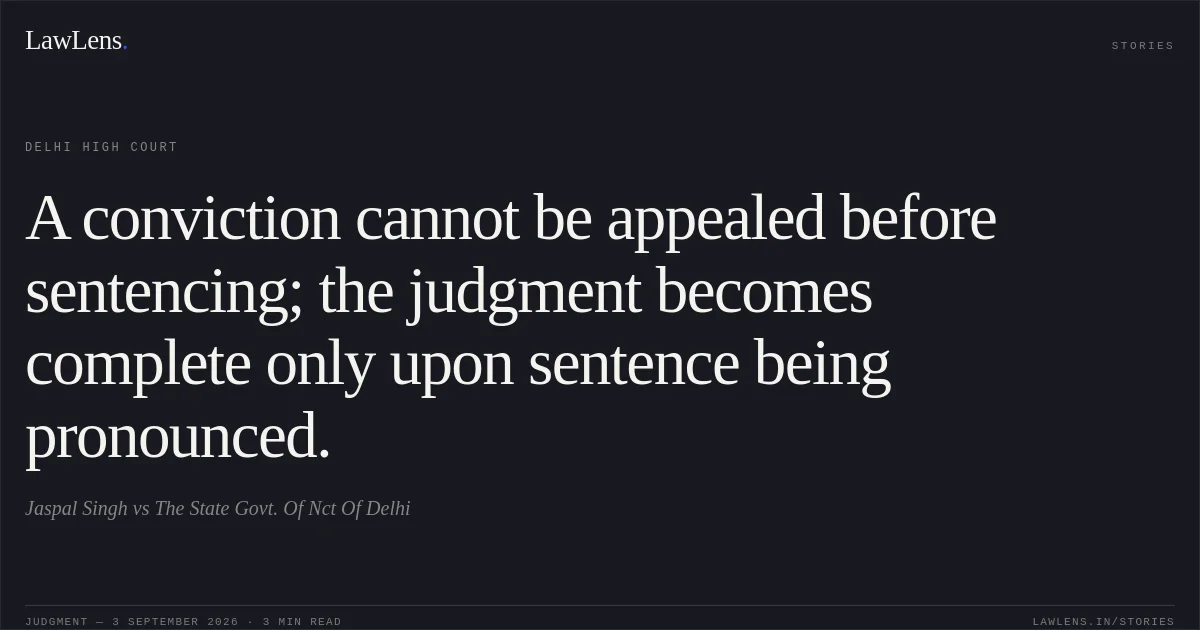
i.1. Whether an appeal against a conviction could be maintained when the appellant had not yet been sentenced and the judgment was therefore incomplete.
p. 6 · ¶ 8ii.2. Whether the trial court had correctly followed the statutory procedure applicable to an accused found to be of unsound mind and unable to defend himself.
pp. 5–6 · ¶ 7iii.3. Whether, upon resumption of proceedings, the appellant should be afforded an opportunity to establish that he was incapable of understanding the consequences of his act at the time of the alleged offence under Section 84 IPC.
pp. 6–8 · ¶ 7, 1003Law Applied
The Court applied Section 415 of the Bharatiya Nagarik Suraksha Sanhita, 2023, corresponding to Section 374(2) of the Code of Criminal Procedure, 1973, governing appeals to the High Court from convictions by a Sessions or Additional Sessions Judge.
p. 6 · ¶ 8It relied on the principle that a criminal judgment is incomplete until sentence is pronounced and that an appeal ordinarily lies only after conviction and sentence, as recognised in Rama Narang v. Ramesh Narang, (1995) 2 SCC 513.
p. 6 · ¶ 8The Court further applied Section 368 BNSS, corresponding to Section 329 CrPC, concerning the procedure where an accused is found to be of unsound mind during trial, and Sections 330–332 CrPC concerning custody, postponement, and resumption of proceedings involving such an accused.
pp. 5–8 · ¶ 6–10Section 84 IPC governs the defence of a person incapable of understanding the nature or wrongfulness of the act because of unsoundness of mind.
p. 3 · ¶ 5Provisions in the judgment · 11 · Linked ones open on LawLens
Bharatiya Nagarik Suraksha Sanhita, 2023 Section 415Section 528Section 432Section 368
Protection of Children from Sexual Offences Act, 2012 Section 10
Indian Penal Code, 1860 Section 84
Code of Criminal Procedure, 1973 Section 329Section 330Section 374Section 331Section 332
04Reasoning
The Court noted that the appellant had challenged only the conviction, although no sentence had been imposed.
p. 6 · ¶ 8Applying Section 415 BNSS/Section 374(2) CrPC and Rama Narang, it held that the judgment was not complete for appellate purposes until sentencing had taken place.
p. 6 · ¶ 8As to the appellant’s mental condition, the trial court had obtained medical evaluation, considered the Medical Board’s findings, and concluded that the appellant was unable to make his defence; it had accordingly postponed the proceedings under Section 329 CrPC, corresponding to Section 368 BNSS.
pp. 3–6 · ¶ 6–7The High Court therefore found no need to interfere at that stage, while preserving the appellant’s opportunity, if proceedings resumed, to lead evidence concerning his mental capacity at the time of the alleged offence under Section 84 IPC.
pp. 6–8 · ¶ 7, 1005Holding
The appeal was dismissed as withdrawn, with liberty to the appellant to file an appeal at the appropriate stage after sentencing.
p. 8 · ¶ 10The trial court was permitted to complete the formalities under Section 330(3) CrPC, if pending.
p. 8 · ¶ 10If the trial resumed under Sections 331 and 332 CrPC, the trial court was directed to provide the appellant an opportunity to establish that he was incapable of understanding the consequences of his act when the offence was allegedly committed.
p. 8 · ¶ 10Pending applications were closed.
p. 8 · ¶ 11Original Court PDF
Jaspal SinghvsThe State Govt. Of Nct Of Delhi
Click to open original judgment
Original judgment, available to read, download and summarize on LawLens.in