01Facts
The petitioner was promoted from Joint Director (Agriculture) to Additional Director (Agriculture) pursuant to the Departmental Promotion Committee’s recommendation and an order dated 14 December 2022.
¶ 1–3 · pp. 2–4He joined and served on the promotional post.
¶ 1–3 · pp. 2–4Subsequently, on 30 August 2024, the Under Secretary cancelled his promotion and reverted him to the post of Joint Director, while promoting Respondent No. 5 to the post of Additional Director.
¶ 1–3 · pp. 2–4The impugned order was passed on the basis of Respondent No. 5’s representation, without issuing notice to, or providing an opportunity of hearing to, the petitioner.
¶ 1–3 · pp. 2–4During the proceedings, he retired on 30 November 2025, and the surviving grievance concerned the legality of his reversion.
¶ 3 · p. 3The State admitted that no opportunity of hearing had been given before passing the impugned order.
¶ 3, 5 · pp. 3–402Issues
i.Whether the cancellation of the petitioner’s promotion and his reversion from Additional Director to Joint Director, having been ordered without notice or an opportunity of hearing, violated the principles of natural justice?
¶ 2–6 · pp. 2–5ii.Whether the State could be permitted to pass a fresh order after affording the petitioner and Respondent No. 5 an opportunity of hearing?
¶ 7 · p. 503Law Applied
The Court applied the principles of natural justice, particularly the rule of audi alteram partem.
¶ 6 · p. 4Administrative action producing adverse civil consequences must ordinarily comply with the requirement of prior notice and a reasonable opportunity of hearing, unless such compliance is expressly excluded by statute.
¶ 6 · p. 4An order affecting an employee’s service status, including demotion or reversion, cannot be sustained when made in violation of this substantive procedural safeguard.
¶ 6 · p. 4The Court also applied the principle that an order vitiated for breach of natural justice may be quashed while preserving the authority’s liberty to undertake the decision-making process afresh in accordance with law.
¶ 7 · p. 504Reasoning
The petitioner’s promotion had been implemented and he had joined the promotional post.
¶ 2, 5–6 · pp. 2–4Its subsequent cancellation and his reversion adversely affected his service position and therefore entailed civil consequences.
¶ 2, 5–6 · pp. 2–4Since the State admitted that neither notice nor an opportunity of hearing had been provided before the adverse order was passed, the decision-making process violated the rule of audi alteram partem.
¶ 6–9 · pp. 4–5The defect was procedural and went to the validity of the impugned order; accordingly, the Court quashed the order to the extent that it reverted the petitioner.
¶ 6–9 · pp. 4–5However, without expressing any view on the merits of the competing claims, the Court preserved the State’s power to reconsider the matter after hearing both affected employees.
¶ 6–9 · pp. 4–505Holding
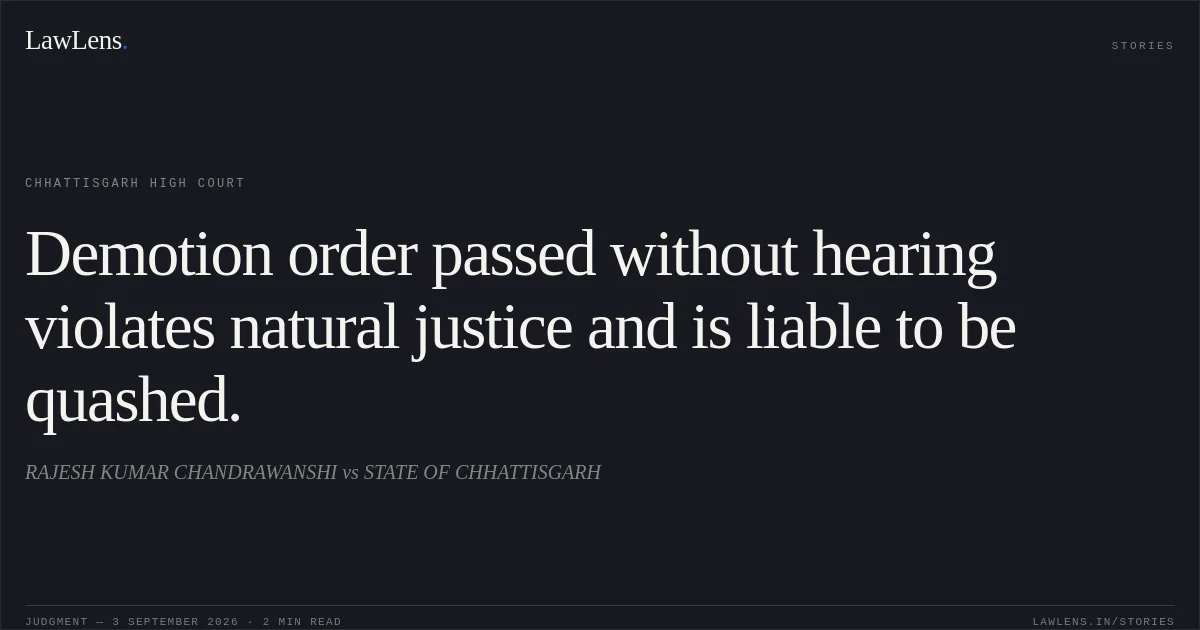
The High Court held that the petitioner’s reversion from Additional Director (Agriculture) to Joint Director (Agriculture) was unsustainable because it was ordered without notice or an opportunity of hearing.
¶ 7–9 · p. 5The impugned order dated 30 August 2024 was therefore quashed insofar as it concerned the petitioner’s demotion.
¶ 7–9 · p. 5The State was granted liberty to pass a fresh order within 30 days, in accordance with law, after affording due opportunity of hearing to both the petitioner and Respondent No. 5.
¶ 7–9 · p. 5The Court clarified that it had expressed no opinion on the merits, and the writ petition was disposed of accordingly.
¶ 7–9 · p. 5Original Court PDF
RAJESH KUMAR CHANDRAWANSHIvsSTATE OF CHHATTISGARH
Click to open original judgment
Original judgment, available to read, download and summarize on LawLens.in