Facts
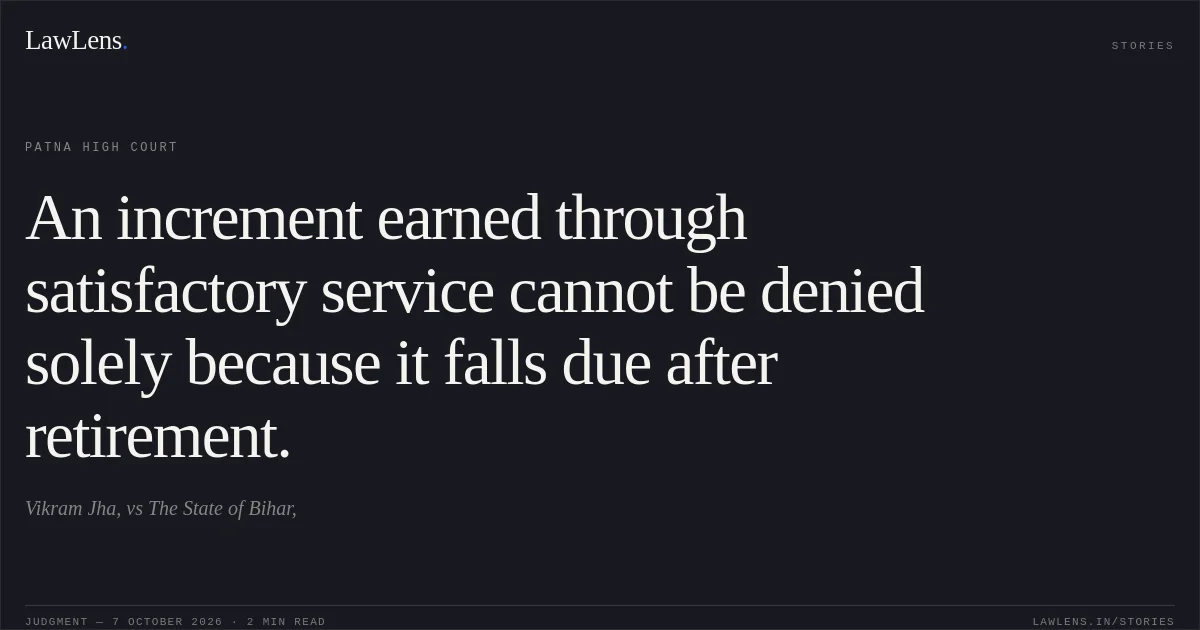
The petitioners, former employees of the Building Construction Department, sought the increment falling due on 1 July in the year of their retirement, after retiring on 30 June. They challenged paragraph 5 of the State Government resolution dated 22 July 2024 and departmental letters dated 25 March 2025 and 19 June 2026, which denied increments to certain petitioners. They also sought consequential revision of salary and retirement benefits, among other reliefs.
Source reference: p. 2–3, para. 2The petitioners relied on Supreme Court decisions concerning increments earned before retirement and a Division Bench decision of the Patna High Court.
Source reference: p. 3, para. 3Issues
1. Whether employees retiring on 30 June may be denied an increment falling due on 1 July, despite having rendered the preceding year’s service.
Source reference: p. 3–5, paras. 4–52. Whether the impugned departmental letters denying the petitioners’ claims should be quashed and their cases reconsidered under the governing Supreme Court principles.
Source reference: p. 5–6, paras. 6–9Law Applied
In The Director (Admn. & HR), KPTCL v. C.P. Mundinamani, (2023) 14 SCC 411, the Supreme Court held that an annual increment is earned upon completion of the requisite period of service with good conduct and efficiency; its becoming payable on the day after superannuation does not, by itself, defeat the employee’s claim.
Source reference: p. 3–5, paras. 4–5All India Judges Association v. Union of India, (2024) 1 SCC 546, applied that principle to an increment falling due on 1 July after retirement on 30 June and directed that it be notionally included in the last pay for pension calculation.
Source reference: p. 3–5, paras. 4–5The Court treated these authorities as governing the petitioners’ claims.
Source reference: p. 3–5, paras. 4–5Reasoning
The Court found that the issue was no longer res integra in light of the Supreme Court’s decisions.
Source reference: p. 3–5, paras. 4–5Because the petitioners claimed increments falling due immediately after their retirement, the Court held that the State’s resolution could not override the governing legal principles and that paragraph 5 of the resolution had lost relevance.
Source reference: p. 3–5, paras. 4–5Rather than itself determining each petitioner’s entitlement, the Court directed the authorities to examine their service particulars and decide their claims by applying those principles.
Source reference: p. 6, paras. 8–9Holding
The Court quashed the departmental letters dated 25 March 2025 and 19 June 2026.
It directed the Additional Chief Secretary, Building Construction Department, to consider each petitioner’s case under KPTCL and All India Judges Association and issue a decision within six weeks of receiving the order.
Source reference: p. 6, paras. 7–10If an adverse decision is contemplated, the petitioners must be given an opportunity of hearing and a reasoned order must be passed.
Source reference: p. 6, paras. 7–10The writ petition was disposed of accordingly.
Source reference: p. 6, paras. 7–10Original Court PDF
Vikram Jha,vsThe State of Bihar,
Click to open original judgment
Original judgment, available to read, download and summarize on LawLens.in