Facts
Jamia Hamdard advertised the post of Registrar to be filled on tenure or deputation basis. The Executive Council approved Col. Tahir Mustafa’s appointment on deputation, and an offer was issued for an initial three-year term, extendable by two years.
Source reference: paras. 4–6; pp. 2–3Clause 7(ii) of the appointment terms reserved the University’s right to repatriate him to his parent organisation on administrative, disciplinary or performance-related grounds, without notice or compensation.
Source reference: paras. 4–6; pp. 2–3Following a dispute during the 73rd Emergent Meeting of the Executive Council on 22 July 2026 concerning the nomination of a representative to the Vice-Chancellor Search-cum-Selection Committee, the Officiating Vice-Chancellor issued a show-cause notice to the Petitioner on 24 July 2026. The Petitioner replied on 3 August 2026. On the same day, the Vice-Chancellor issued an Office Order prematurely repatriating him to the Ministry of Defence under Clause 7(ii) and Regulation 23C(2) of the UGC (Institutions Deemed to be Universities) Regulations, 2023.
Source reference: paras. 7–12; pp. 3–4The Petitioner challenged the Office Order before the Delhi High Court, contending principally that the Executive Council, and not the Vice-Chancellor, was competent to decide his continuance as Registrar. The Court stayed the Office Order on 4 August 2026.
Source reference: paras. 13–14; p. 5Subsequently, pursuant to the Court’s order dated 12 August 2026, the Executive Council considered the issue independently on 14 August 2026 and unanimously resolved that the Petitioner’s deputation should be repatriated on administrative grounds.
Source reference: paras. 15–20; pp. 5–6Issues
Whether the Executive Council’s resolution dated 14 August 2026 constituted an independent exercise of statutory power or merely an impermissible ratification of the Vice-Chancellor’s earlier Office Order dated 3 August 2026?
Source reference: paras. 3, 21, 27–36; pp. 2, 6–13Whether the Petitioner had an enforceable right to continue on deputation for the specified tenure despite Clause 7(ii), which permitted premature repatriation on administrative grounds?
Source reference: paras. 37–43; pp. 14–16Whether the Executive Council was required to issue a fresh show-cause notice and provide a further hearing before deciding the Petitioner’s repatriation?
Source reference: paras. 44–48; pp. 16–17Whether the chronology of events established mala fides or a collateral purpose behind the Petitioner’s repatriation?
Source reference: paras. 49–52; pp. 18–19Whether the Petitioner was entitled to three months’ notice before repatriation, and from what date that period was to be reckoned?
Source reference: paras. 53–58; pp. 19–20Law Applied
The Court applied the UGC (Institutions Deemed to be Universities) Regulations, 2023, under which the Executive Council is the principal executive and decision-making body in administrative and personnel matters, while the Registrar is appointed by the Executive Council under Regulation 23F.
Source reference: para. 25; p. 11Regulation 23F(2), prescribing a five-year term for a Registrar, does not prohibit premature repatriation of a Registrar appointed on deputation.
Source reference: para. 41; p. 15The Court relied on Marathwada University v. Seshrao Balwant Rao Chavan, (1989) 3 SCC 132, for the rule that an act performed without statutory authority cannot be retrospectively validated by ratification.
Source reference: paras. 27–28; pp. 11–12The Court relied on V.C., Banaras Hindu University v. Shrikant, (2006) 11 SCC 42, concerning the invalidity of post facto approval where the original decision was without jurisdiction and the subsequent consideration was illusory.
Source reference: paras. 34–35; pp. 13–14Under Kunal Nanda v. Union of India, (2000) 5 SCC 362, a deputationist has no vested right to continue on deputation; under Union of India v. V. Ramakrishnan, (2005) 8 SCC 394, a specified tenure should ordinarily not be curtailed except on just grounds.
Source reference: paras. 38–39; pp. 14–15Monu Sharma v. Union of India, 2025 SCC OnLine Del 10100, holding that a deputationist has no absolute right to continue until expiry of tenure unless premature repatriation is expressly prohibited, and that operational or administrative requirements may constitute just grounds.
Source reference: paras. 38–39; pp. 14–15Ashok Kumar Ratilal Patel v. Union of India, (2012) 7 SCC 757, was applied for the principle that appointment on deputation following selection attracts the protections of Articles 14 and 16 against arbitrary action.
Source reference: para. 42; p. 16The Court further considered Clause 7(ii) of the appointment terms and paragraph 9 of the DoPT Office Memorandum dated 17 June 2010 concerning three months’ advance notice.
Source reference: paras. 40, 56–58; pp. 15, 19–20Reasoning
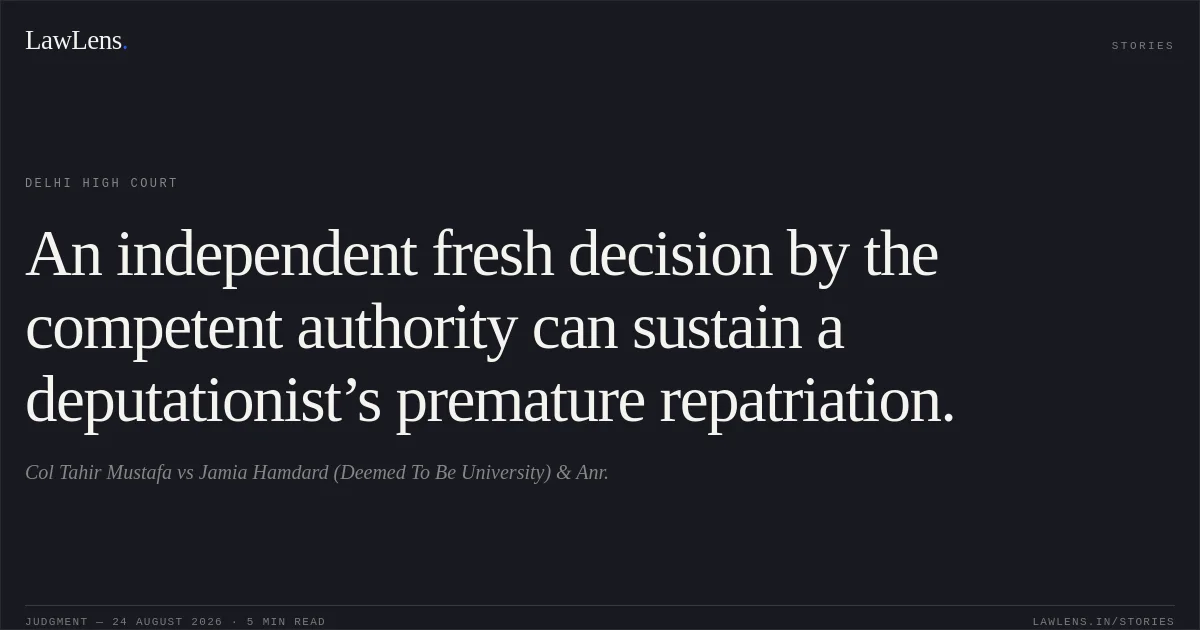
The Court accepted the general rule that a statutory authority cannot cure an act performed without jurisdiction through subsequent ratification. However, it held that the rule did not invalidate the present Executive Council resolution because the Council had not approved or retrospectively validated the Vice-Chancellor’s Office Order.
Source reference: paras. 29–35; pp. 12–14Instead, after the Court expressly permitted it to consider the matter, the Council independently examined the appointment terms, administrative circumstances, institutional requirements, the show-cause material, the Petitioner’s reply, the DoPT O.M. and the pending proceedings, and reached its own unanimous conclusion.
Source reference: paras. 29–35; pp. 12–14Clause 7(ii) expressly permitted premature repatriation on administrative grounds, and the Council’s finding that the Petitioner’s continuation was not conducive to efficient administration or institutional interest constituted a legally sustainable administrative ground. The fixed tenure under Regulation 23F(2) did not override that express contractual power.
Source reference: paras. 40–43; pp. 15–16The Court further held that no fresh show-cause notice was necessary because the Petitioner had already received notice of the factual matters relied upon and had submitted a detailed reply, which was placed before and considered by the Executive Council.
Source reference: paras. 44–48; pp. 16–17Since the Council did not adjudicate misconduct or impose a disciplinary penalty, but made an administrative decision regarding continuation on deputation, repetition of the notice process was unnecessary.
Source reference: paras. 44–48; pp. 16–17Although the chronology justified initial judicial scrutiny, it did not establish mala fides once the competent collective body had independently considered and unanimously decided the matter; suspicion alone could not displace that decision.
Source reference: paras. 49–52; pp. 18–19As to notice, the Court did not decide the conflict between Clause 7(ii), which dispensed with notice, and the DoPT O.M. The University’s undertaking to provide three months’ notice was made binding.
Source reference: paras. 56–58; pp. 19–20Because the Executive Council’s resolution was treated as a fresh and independent decision, the three-month period was reckoned from 14 August 2026, rather than from the date of the Vice-Chancellor’s earlier Office Order.
Source reference: paras. 56–58; pp. 19–20Holding
The Court held that the Executive Council’s resolution dated 14 August 2026 was an independent exercise of power by the competent statutory authority and not an impermissible ratification of the Vice-Chancellor’s Office Order.
The resolution therefore governed the Petitioner’s repatriation, while the Office Order dated 3 August 2026 was not permitted to operate as an independent basis for repatriation.
Source reference: para. 62; p. 20The Petitioner was directed to continue performing the functions of Registrar for three months reckoned from 14 August 2026, and the University was directed to permit him to discharge those functions in accordance with the 2023 Regulations, the appointment terms and lawful directions of the competent authorities.
Source reference: paras. 63–64; p. 21Upon expiry of that period, the University was at liberty to implement the Executive Council’s resolution and repatriate him to the Ministry of Defence in accordance with law.
Source reference: paras. 63–64; p. 21The writ petition and pending applications were disposed of, and the interim order dated 4 August 2026 was merged into the judgment.
Source reference: paras. 65–67; p. 21Acts & Sections Cited
1 provisions across 1 statute referred to in this judgment. Linked provisions open on LawLens.
University Grants Commission Act, 19561
Original Court PDF
Col Tahir MustafavsJamia Hamdard (Deemed To Be University) & Anr.
Click to open original judgment
Original judgment, available to read, download and summarize on LawLens.in