Facts
A case initially registered under IPC provisions was transferred to the National Investigation Agency and re-registered against 12 accused under Sections 120-B, 465, 468 and 471 IPC and Sections 13 and 18 of the Unlawful Activities (Prevention) Act, 1967 (“UAPA”). The original final report was filed on 23.06.2020.
Source reference: para. 9The appellant was subsequently added as Accused No. 13 and arrested on 21.12.2020. A supplementary charge-sheet alleged offences under Sections 120-B, 471 and 201 IPC, Sections 18, 38 and 39 UAPA, and Sections 4 and 5 of the Explosive Substances Act.
Source reference: para. 10The prosecution alleged that he participated in an ISIS/Daish-related terror conspiracy, including procurement of materials for an improvised explosive device, participation in meetings concerning jihad and ISIS, proposed travel for “Hijrah,” and destruction of incriminating electronic material.
Source reference: paras. 11–12His earlier bail appeal had been dismissed on 18.06.2024 after the Court found a prima facie case and held that the bar under Section 43D(5) UAPA applied.
Source reference: para. 13The present appeal challenged the Special Court’s subsequent rejection of bail dated 18.07.2025. At the time of hearing, cognizance had been taken, charges had been framed against Accused Nos. 1–19 on 10–11.03.2025, seven prosecution witnesses had been examined, and the prosecution undertook to limit the witnesses to 90 and complete the trial within six months.
Source reference: para. 16Issues
Whether the appellant was entitled to bail under Section 21(4) of the National Investigation Agency Act, 2008, notwithstanding the restriction under Section 43D(5) UAPA?
Source reference: paras. 2–6, 12–15Whether the appellant’s prolonged incarceration, in light of Article 21 of the Constitution and the delayed progress of the trial, justified grant of bail?
Source reference: paras. 2, 13, 16Whether any new material or changed circumstance warranted review of the earlier finding that a prima facie case existed against the appellant?
Source reference: paras. 13–15Law Applied
The Court considered the appellate jurisdiction under Section 21(4) of the National Investigation Agency Act, 2008 and applied Section 43D(5) UAPA, under which bail cannot ordinarily be granted where, on a perusal of the case diary or charge-sheet, there are reasonable grounds for believing that the accusation is prima facie true.
Source reference: paras. 4, 13The Court relied on Union of India v. K.A. Najeeb, recognising that constitutional courts may grant bail notwithstanding statutory restrictions where prolonged incarceration and inordinate trial delay make continued detention incompatible with Article 21; however, the application of that principle depends on the gravity of the offence, the accused’s specific role, the nature of the evidence, and the actual progress of the trial.
Source reference: paras. 4, 13The Court also applied the principle that a concluded finding of a prima facie case is not to be revisited in the absence of a genuine change in circumstances or material capable of undermining the earlier determination.
Source reference: paras. 13–15Reasoning
The Court held that the earlier order dated 18.06.2024 had already examined the allegations and witness statements and found a prima facie case involving offences under Chapters IV and VI of the UAPA, thereby attracting Section 43D(5).
Source reference: paras. 12–13The appellant’s reliance on invoices for potassium nitrate and batteries did not materially alter that assessment. Although each item could have an innocent individual use, the prosecution case concerned their collective procurement, along with sugar and other substances, for preparing and operating an IED in furtherance of violent jihad.
Source reference: paras. 14–15The Court therefore declined to review its earlier prima facie finding.
Source reference: paras. 14–15On Article 21, the Court acknowledged the duration of custody but found that the trial had commenced, charges had been framed, seven prosecution witnesses had already been examined, and the prosecution had undertaken to complete the trial within six months after pruning the witness list.
Source reference: para. 16In those circumstances, continued detention was not held to justify overriding the statutory bail restriction.
Source reference: para. 16Holding
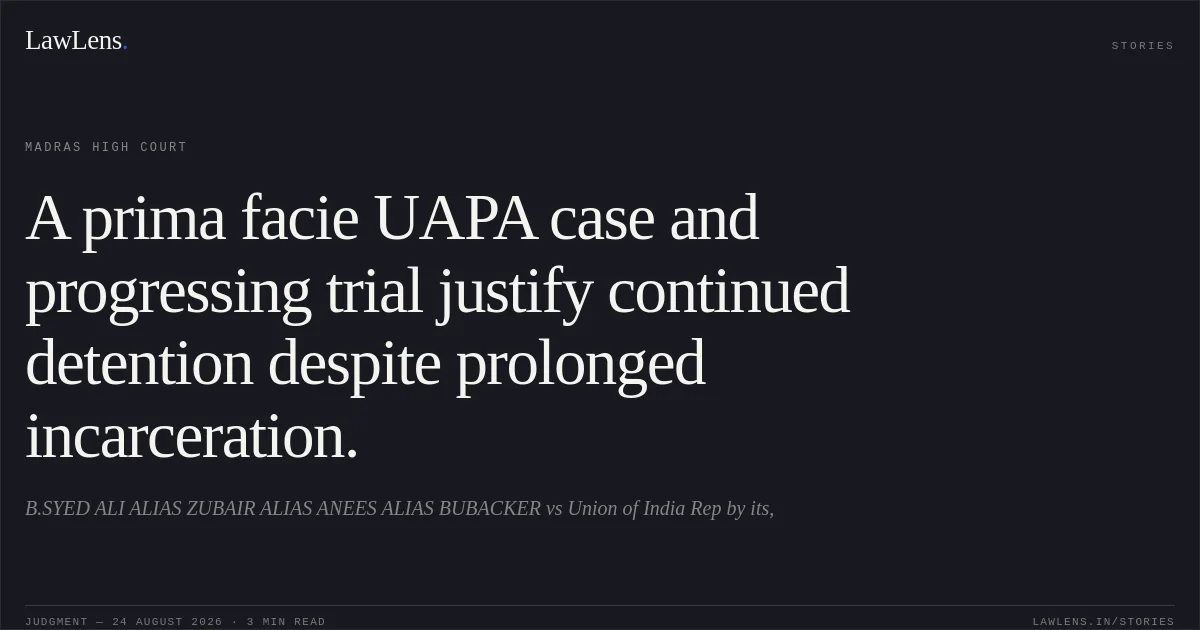
The Court answered the bail issue against the appellant. It held that the earlier finding of a prima facie case remained operative, the bar under Section 43D(5) UAPA continued to apply, and the appellant had not demonstrated any material change or sufficient Article 21-based ground warranting release.
The criminal appeal challenging the order dated 18.07.2025 was accordingly dismissed, with no order as to costs.
Source reference: para. 17Acts & Sections Cited
10 provisions across 4 statutes referred to in this judgment. Each provision opens on LawLens.
National Investigation Agency Act, 20081
Unlawful Activities (Prevention) Act, 19674
Indian Penal Code, 18604
Code of Criminal Procedure, 19731
Original Court PDF
B.SYED ALI ALIAS ZUBAIR ALIAS ANEES ALIAS BUBACKERvsUnion of India Rep by its,
Click to open original judgment
Original judgment, available to read, download and summarize on LawLens.in