Facts
The petitioner, a registered partnership firm engaged in trading disposable products, instituted a commercial suit seeking recovery of ₹23,09,361 with interest from the respondent, who was engaged in manufacturing and selling such products.
Source reference: p.2, paras. 2–4The parties had a continuing commercial relationship involving an open and running account.
Source reference: p.2, paras. 2–4The petitioner alleged that the respondent’s last two consignments were substandard and overpriced, and claimed that ₹21,18,680 remained outstanding as on 15 June 2024.
Source reference: p.2, paras. 2–4The respondent filed a written statement and an application under Section 8 of the Arbitration and Conciliation Act, 1996, relying on arbitration clauses contained in invoices dated 9 April, 10 April, 24 May, 13 June and 15 June 2024.
Source reference: p.2, paras. 5–6The petitioner opposed the application, contending that the invoices were unsigned by it and therefore did not constitute a valid arbitration agreement under Section 7.
Source reference: p.3, paras. 7–10The Commercial Court allowed the application and referred the parties to arbitration on 10 July 2026.
Source reference: p.1, para. 1; p.3, para. 8The petitioner challenged that order under Article 227 of the Constitution.
Source reference: p.1, para. 1; p.3, para. 8Issues
Whether an arbitration clause contained in invoices, which were not signed by the petitioner, could constitute a valid arbitration agreement under Section 7 of the Arbitration and Conciliation Act, 1996.
Source reference: p.3, paras. 9–11; p.5, paras. 16–21Whether the petitioner’s conduct—acceptance of the invoices, advance payments, continuing business dealings and reliance on the invoices in the recovery suit—demonstrated consent and an intention to be governed by the arbitration clause.
Source reference: p.7–9, paras. 22–27Whether the Commercial Court had correctly referred the dispute to arbitration under Section 8 on a prima facie examination of the arbitration agreement.
Source reference: p.7–8, paras. 22–24Law Applied
Section 7(3) of the Arbitration and Conciliation Act, 1996 requires an arbitration agreement to be in writing, but Section 7(4) does not mandate a signature in every case; an arbitration agreement may be established through written documents, correspondence or the parties’ conduct.
Source reference: p.5–7, paras. 18–21In Caravel Shipping Services Pvt. Ltd. v. Premier Sea Foods Exim Pvt. Ltd., the Supreme Court held that a party relying on an unsigned document as the basis of its claim cannot reject the arbitration clause contained in the same document, and that an arbitration agreement need not invariably be signed.
Source reference: p.5–6, paras. 16–18Glencore International AG v. Shree Ganesh Metals similarly recognises acceptance of contractual terms containing an arbitration clause through conduct, despite non-signing.
Source reference: p.6–7, para. 19Scholar Publishing House Pvt. Ltd. v. Khanna Traders confirms that Section 7 does not prescribe a particular form and that arbitration may be inferred from correspondence and conduct.
Source reference: p.7, para. 20Under Vidya Drolia v. Durga Trading Corporation, In Re: Interplay Between Arbitration Agreements and the Indian Stamp Act, 1899, and SBI General Insurance Co. Ltd. v. Krish Spinning, the referral court’s role under Section 8 is limited to a prima facie examination of the existence and validity of the arbitration agreement.
Source reference: p.7–8, para. 23In cases of doubt, the law favours reference to arbitration where the parties’ conduct indicates acceptance of the arbitration arrangement.
Source reference: p.8, para. 24Reasoning
The Court held that the absence of the petitioner’s signature on the invoices was not determinative.
Source reference: p.8–9, paras. 24–27The invoices were in writing and contained a complete arbitration clause.
Source reference: p.8–9, paras. 24–27More importantly, the petitioner had engaged in continuous transactions with the respondent, maintained an open and running account, made advance payments against the transactions, accepted and acted upon the invoices, and relied on those invoices as part of the cause of action in the recovery suit.
Source reference: p.8–9, paras. 24–27Having relied on the invoices for its substantive claim, the petitioner could not selectively disown the arbitration clause contained in them.
Source reference: p.9, para. 27These circumstances established, at least prima facie, the petitioner’s acceptance of the invoice terms and its intention to be governed by arbitration.
Source reference: p.9, para. 27The Court further held that the Commercial Court was not required, at the Section 8 stage, to conduct a detailed inquiry into consent or the merits of the dispute; the prima facie existence and validity of the arbitration agreement were sufficient.
Source reference: p.7–8, paras. 22–24The authorities relied upon by the petitioner were distinguished as factually inapplicable.
Source reference: p.9–10, paras. 28–30Holding
The Court answered the issues in favour of the respondent.
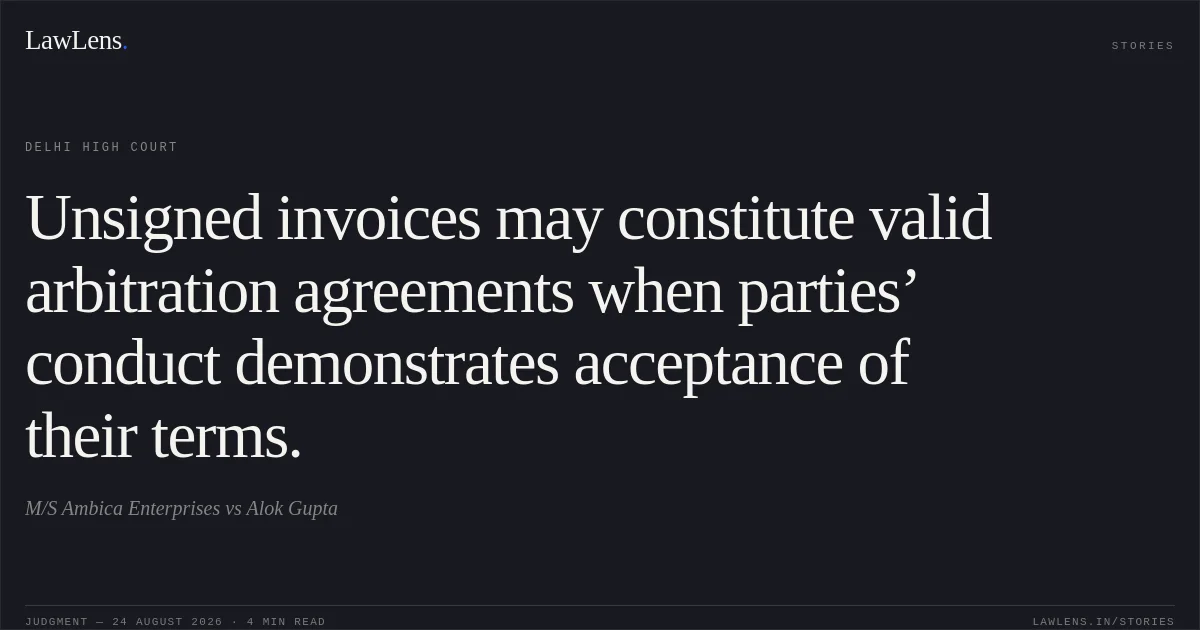
It held that the unsigned invoices, read with the parties’ conduct and the petitioner’s reliance upon them, constituted a valid arbitration agreement for the purposes of Section 7, and that the dispute was properly referable under Section 8.
Source reference: p.8–9, paras. 24–27The challenge to the Commercial Court’s order dated 10 July 2026 was dismissed, along with the pending applications.
Source reference: p.10, paras. 31–32The Court clarified that it had expressed no opinion on the merits of the underlying dispute, leaving all rights and contentions open before the arbitral tribunal.
Source reference: p.10, para. 33Acts & Sections Cited
3 provisions across 1 statute referred to in this judgment. Linked provisions open on LawLens.
Arbitration and Conciliation Act, 19963
Original Court PDF
M/S Ambica EnterprisesvsAlok Gupta
Click to open original judgment
Original judgment, available to read, download and summarize on LawLens.in