Facts
The Appellant–developer represented that it was entitled to obtain Development Rights Certificates (DRC) arising from a slum rehabilitation project in Pune and agreed to transfer TDR of 5,200 sq. metres to the Respondent.
Source reference: pp. 2–4The parties executed an MOU dated 13 July 2022 for a total consideration of ₹8,23,05,600, against which the Respondent paid approximately ₹4 crore.
Source reference: pp. 2–4Clauses 4A and 4B contemplated security cheques and provided that, if the DRC was not obtained within the stipulated period, the Respondent could claim interest or terminate the MOU and obtain a refund with interest.
Source reference: pp. 9–10; para. 8After the Appellant failed to obtain the DRC, it issued a notice dated 18 October 2023 cancelling the MOU.
Source reference: pp. 3–4The Respondent instituted Special Civil Suit No. 387 of 2024 seeking, inter alia, declaration that the termination was illegal and specific performance of the MOU, along with an injunction restraining the Appellant from creating third-party rights in the TDR.
Source reference: pp. 3–4The Trial Court allowed the Respondent’s application under Exhibit-5 and restrained the Appellant from transferring, alienating or creating third-party interests in the relevant TDR until disposal of the suit.
Source reference: p. 4The Appellant challenged that order under Order XLIII Rule 1(r) read with Section 104 of the CPC.
Source reference: para. 1Issues
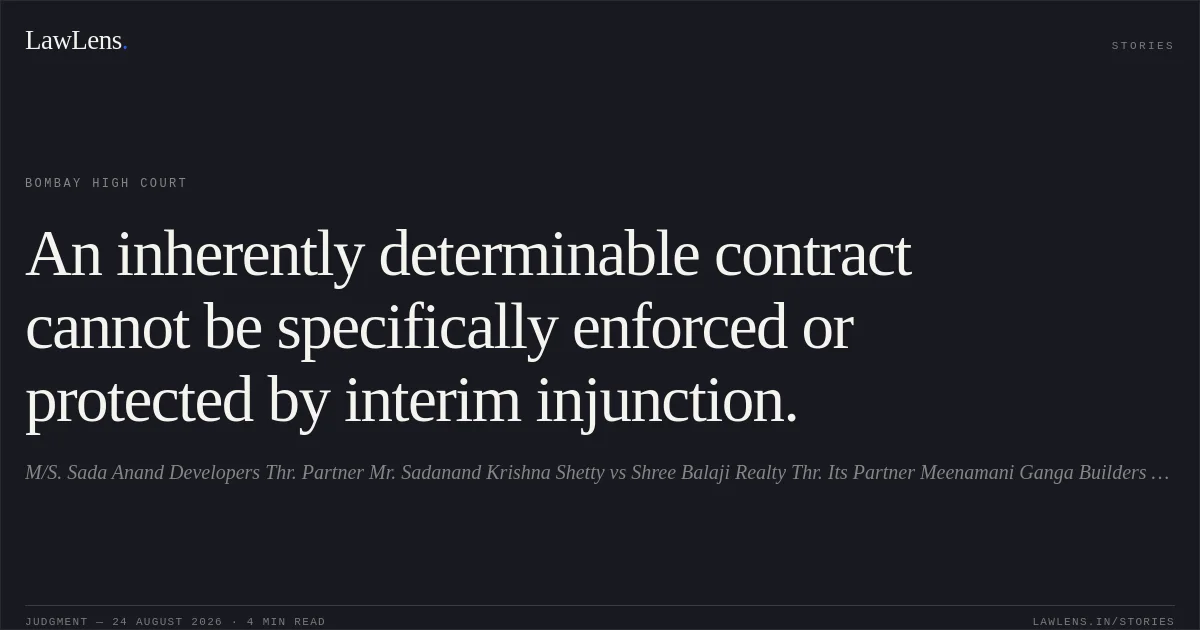
Whether the MOU dated 13 July 2022 was, by its nature, determinable and consequently incapable of specific performance under Section 14(d) of the Specific Relief Act, 1963?
Source reference: pp. 5–6, 9–11; paras. 4–6, 8–10Whether an injunction restraining alienation or creation of third-party rights could be granted under Order XXXIX Rule 1 of the CPC when the underlying MOU was prima facie not specifically enforceable?
Source reference: pp. 10–11, 17; paras. 10, 13–14Whether the Trial Court erred by granting the temporary injunction without first recording a prima facie finding on the enforceability of the MOU?
Source reference: pp. 10–11, 17; paras. 10, 13Law Applied
The Court applied Section 14(d) of the Specific Relief Act, 1963, which provides that a contract that is in its nature determinable cannot be specifically enforced, read with Section 41(e), which prohibits an injunction to prevent breach of a contract whose performance cannot be specifically enforced.
Source reference: pp. 10–16; paras. 10–12It also applied the principle that interim relief must be ancillary to and in aid of the final relief and cannot be granted where the final relief of specific performance is prima facie unavailable.
Source reference: pp. 14–16; para. 12Under Order XXXIX Rule 1 of the CPC, an injunction may be granted to protect property threatened with waste, damage, alienation or wrongful disposition, but the Court must first assess the plaintiff’s prima facie right and the nature of the property or interest sought to be protected.
Source reference: p. 11; para. 10The Court relied on Narendra Hirawat and Company v. Sholay Media Entertainment Pvt. Ltd., 2020 (5) Mh.L.J. 173, which discusses the meaning of a contract “in its nature determinable,” and on Chetan Iron LLP v. NRC Ltd., 2022 SCC OnLine Bom 159, which holds that a determinable contract cannot be specifically enforced and that injunctive relief cannot be granted to indirectly enforce it.
Source reference: pp. 11–16; paras. 11–12The Court also referred to Indian Oil Corporation Ltd. v. Amritsar Gas Service, (1991) 1 SCC 533, and Spice Digital Ltd. v. Vistaas Digital Media Pvt. Ltd., 2012 SCC OnLine Bom 1536, on the bar against specific performance or injunction in respect of determinable contracts.
Source reference: pp. 12–16; para. 12Reasoning
The Court read Clauses 4A and 4B of the MOU together rather than in isolation.
Source reference: pp. 9–10; paras. 8–9Clause 4A required the Appellant to provide cheques towards repayment if the agreement was cancelled or the period for obtaining the DRC expired, while Clause 4B gave the Respondent the option to claim interest or terminate the MOU and obtain an unconditional refund with interest.
Source reference: pp. 9–10; paras. 8–9On this construction, the Court held that the MOU contained contractual mechanisms for termination and repayment and was therefore prima facie determinable; consequently, specific performance could not be insisted upon under Section 14(d).
Source reference: p. 10; para. 10Since Section 41(e) also barred an injunction to prevent breach of a contract incapable of specific performance, the Trial Court ought to have first considered the enforceability of the MOU before granting relief under Order XXXIX Rule 1.
Source reference: pp. 10–11; paras. 10, 13The Trial Court’s reliance principally on the Respondent’s payment of approximately ₹4 crore and the possibility of future alienation of the TDR was held insufficient, particularly because the relevant DRC/TDR was not yet in existence and the Appellant had issued repayment cheques with consent for their encashment.
Source reference: pp. 6–7, 17; paras. 7, 13The Court therefore found that the Trial Court had failed to apply the governing principles for temporary injunctions and had incorrectly granted relief without recording a prima facie view on the central issue of specific enforceability.
Source reference: p. 17; paras. 13–14Holding
The Court held that the MOU dated 13 July 2022 was prima facie determinable and could not be specifically enforced.
Accordingly, an injunction restraining the Appellant from dealing with the TDR could not be sustained as an indirect means of enforcing that MOU.
Source reference: pp. 10–17; paras. 10–14The order dated 14 February 2025 passed by the Trial Court below Exhibit-5 was quashed and set aside; the Trial Court was directed to decide the suit expeditiously and in accordance with law.
Source reference: p. 17; para. 14The Appeal from Order was allowed without costs, and Interim Application No. 4389 of 2026 was disposed of as infructuous.
Source reference: p. 17; para. 14Acts & Sections Cited
15 provisions across 5 statutes referred to in this judgment. Linked provisions open on LawLens.
Code of Civil Procedure, 19081
Income-tax Act, 19611
Maharashtra Slum Areas (Improvement, Clearance and Redevelopment) Act, 19718
Specific Performance Act, 18771
Arbitration and Conciliation Act, 19964
Original Court PDF
M/S. Sada Anand Developers Thr. Partner Mr. Sadanand Krishna ShettyvsShree Balaji Realty Thr. Its Partner Meenamani Ganga Builders Llp Thr.Its Anju Umesh Goel
Click to open original judgment
Original judgment, available to read, download and summarize on LawLens.in