Facts
The petitioner–defendant had friendly relations with the respective respondents, who allegedly advanced him loans in 2008 without executing formal loan documents. The petitioner deducted and deposited TDS on interest payable on the loans and executed signed balance confirmations acknowledging the outstanding amounts, with confirmations continuing up to March 2014 and TDS deductions continuing until 31 March 2015.
Source reference: paras. 4–5; pp. 2–3After payments ceased, the respondents issued a legal notice dated 29 May 2017 and instituted recovery suits in 2017.
Source reference: para. 6; p. 2The petitioner sought rejection of the plaints under Order VII Rule 11 read with Section 151 CPC, contending that the suits were barred by limitation under Article 19 of the Limitation Act, 1963, since the loans had been advanced in 2008 and the three-year limitation period had expired in 2011.
Source reference: paras. 7, 12; pp. 2–3The Trial Court dismissed the applications, holding that limitation was a mixed question of fact and law requiring evidence.
Source reference: paras. 8–10; pp. 3–4The petitioner challenged those orders under Article 227 of the Constitution.
Source reference: para. 11; p. 4Issues
Whether the plaints were ex facie barred by limitation under Article 19 of the Limitation Act, 1963 and liable to be rejected under Order VII Rule 11(d) CPC.
Source reference: paras. 12, 24; pp. 3, 6–7Whether the petitioner’s signed balance confirmations and continued deduction and deposit of TDS constituted acknowledgment of liability or payment on account of the debt so as to attract Sections 18 and 19 of the Limitation Act and give rise to a fresh period of limitation.
Source reference: paras. 20–22, 25–32; pp. 5–9Whether the Trial Court committed a jurisdictional error or patent illegality in declining to reject the plaints at the threshold.
Source reference: paras. 31–34; pp. 9–10Law Applied
The Court applied Article 19 of the Limitation Act, 1963, which prescribes a three-year limitation period for recovery of money lent; Section 18, under which a written and signed acknowledgment of liability made before expiry of limitation can give rise to a fresh limitation period; and Section 19, under which payment on account of a debt, subject to the statutory requirements, may result in computation of a fresh limitation period.
Source reference: paras. 24, 26, 32; pp. 6–9Under Order VII Rule 11(d) CPC, a plaint may be rejected only where the suit appears from the plaint and the documents relied upon to be barred by law; however, rejection is a drastic power and must be exercised with particular circumspection where limitation involves disputed facts.
Source reference: no citationThe Court relied on Ramisetty Venkatanna v. Nasyam Jamal Saheb regarding rejection of plaints disclosing an illusory cause of action through clever drafting.
Source reference: para. 13; p. 4Ansal Housing Ltd. v. Samyak Projects Pvt. Ltd. and the Division Bench decision in Samyak Projects (P) Ltd. v. Ansal Housing Ltd. held that TDS deposits connected with the relevant transaction may constitute payment on account of the debt and extend limitation under Section 19.
Source reference: paras. 20, 27–28; pp. 5, 7–8Salim D. Agboatwala v. Shamalji Oddhavji Thakkar emphasized that limitation is ordinarily a mixed question of fact and law and that Order VII Rule 11 should be applied cautiously.
Source reference: para. 33; pp. 9–10The contrary Bombay High Court decisions in S.P. Brothers v. Biren Ramesh Kadakia and ACTAL v. India Infoline Ltd. were treated as persuasive, not binding, and distinguishable in light of the subsequent Delhi High Court Division Bench decision in Samyak Projects.
Source reference: paras. 14–16, 29–30; pp. 4–8Reasoning
The Court held that the petitioner’s limitation argument could not be determined solely by treating 2008 as the date of the loan.
Source reference: no citationThe plaints and supporting material referred not only to the original advances but also to signed balance confirmations and TDS deductions deposited to the respondents’ credit, including deductions made up to 31 March 2015.
Source reference: paras. 24–26, 32; pp. 6–9Although the Court did not finally determine the evidentiary or legal effect of those documents at the interlocutory stage, the continued TDS deposits could not prima facie be disregarded because, under Ansal Housing and Samyak Projects, such deposits may amount to payment on account of the debt for purposes of Section 19.
Source reference: paras. 26–28; pp. 7–8The balance confirmations could additionally attract consideration under Section 18.
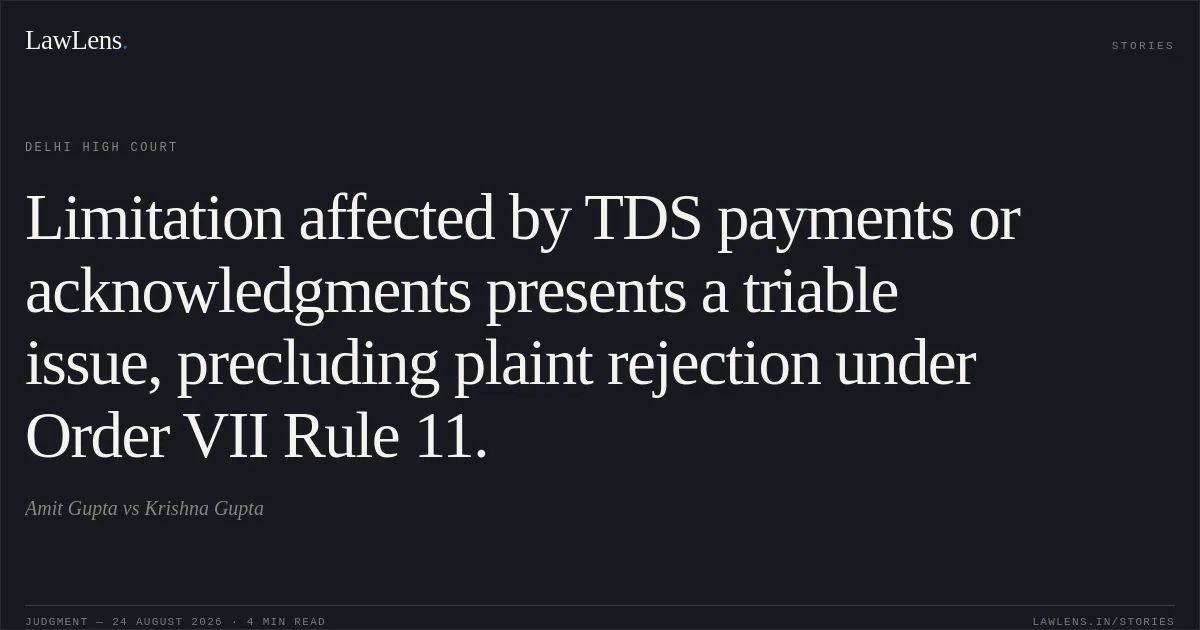
Source reference: para. 32; p. 9Consequently, the material raised a triable issue concerning acknowledgment, payment, and computation of limitation.
Source reference: no citationSince the suit was not demonstrably barred on the face of the plaint, rejection under Order VII Rule 11(d) CPC was unwarranted.
Source reference: paras. 31–34; pp. 9–10Holding
The Court answered the issues against the petitioner.
It held that the effect of the signed balance confirmations and TDS deductions on limitation required examination at trial and that the suits could not be rejected at the threshold under Order VII Rule 11(d) CPC.
Source reference: paras. 31–34; pp. 9–10The Trial Court had committed no jurisdictional error, perversity, or patent illegality in dismissing the petitioner’s applications.
Source reference: para. 35; p. 11Both petitions, together with the pending applications, were dismissed.
Source reference: para. 35; p. 11Acts & Sections Cited
5 provisions across 3 statutes referred to in this judgment. Linked provisions open on LawLens.
Code of Civil Procedure, 19082
Indian Evidence Act, 18721
Income-tax Act, 19612
Original Court PDF
Amit GuptavsKrishna Gupta
Click to open original judgment
Original judgment, available to read, download and summarize on LawLens.in