Facts
On 31 August 2024, Vijay Kumar allegedly travelled from Ghaziabad to Meerut after purchasing a second-class railway ticket and boarded an unknown passenger train. During the journey, he allegedly fell from the moving train near the Vivekananda Flyover, sustained serious injuries, and died
Source reference: p.2, para. 2His father, Ravindra Singh, filed a claim before the Railway Claims Tribunal. The Tribunal dismissed the claim, holding that the deceased was not proved to be a bona fide passenger and that the occurrence was not an “untoward incident” under the Railways Act, 1989
Source reference: p.2, para. 3The appellants challenged that decision under Section 23 of the Railway Claims Tribunal Act, 1987, contending that non-recovery of the ticket was not fatal and that the evidence indicated a fall from a train rather than a run-over incident
Source reference: p.2, para. 4The Railway Administration relied on the absence of a recovered ticket, the post-mortem injuries, the location of the body between the tracks, and a later DRM inquiry to contend that the deceased had been run over
Source reference: p.2–3, paras. 5, 12Issues
1. Whether the deceased was a bona fide railway passenger notwithstanding the non-recovery of his journey ticket
Source reference: p.3–4, paras. 6–72. Whether the deceased’s death resulted from an accidental fall from a passenger train and therefore constituted an “untoward incident” under the Railways Act, 1989, rather than a run-over incident
Source reference: p.4–5, paras. 8–9, 123. Whether the Tribunal’s dismissal of the claim warranted interference under Section 23 of the Railway Claims Tribunal Act, 1987
Source reference: p.2, para. 1; p.6, paras. 13–15Law Applied
The appeal was governed by Section 23 of the Railway Claims Tribunal Act, 1987, and the statutory concept of an “untoward incident” under the Railways Act, 1989.
Source reference: p.2, para. 1; p.2, para. 3; p.4, para. 8Under Union of India v. Rina Devi, (2019) 3 SCC 572, and Lata v. Union of India, 2026 SCC OnLine SC 1350, non-recovery of a journey ticket is not by itself fatal to a railway compensation claim: the claimant must initially place relevant facts and circumstances establishing bona fide travel, after which the burden shifts to the Railway Administration to rebut the claim by cogent evidence.
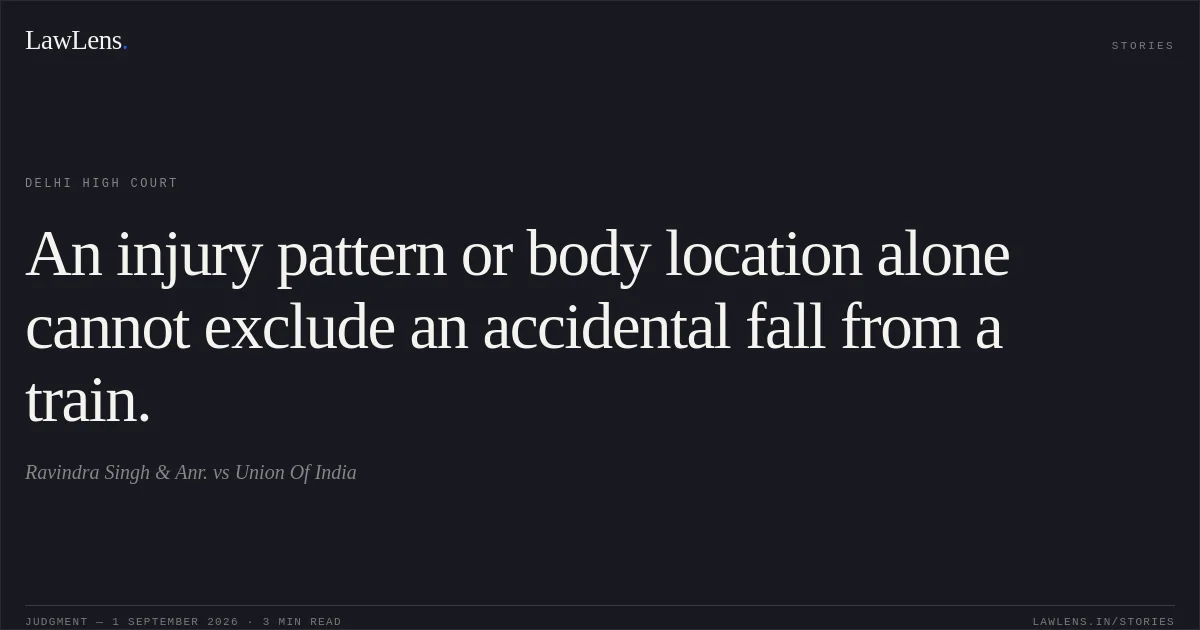
Source reference: p.3, paras. 6–7The beneficial statutory scheme must receive a purposive and liberal interpretation, and the nature or location of injuries and the body cannot, in isolation, conclusively determine whether the deceased fell from a train or was run over.
Source reference: p.4–5, paras. 8–9Relying on Rajpati v. Union of India, 2014 SCC OnLine Del 2540, the Court held that even a body found in a cut-up condition does not necessarily exclude the possibility of an accidental fall from a train.
Source reference: p.4–5, para. 9Reasoning
The Court held that AW-1’s affidavit specifically stated that the deceased had informed him that he was travelling from Ghaziabad to Meerut with a journey ticket. Although AW-1 had not mentioned the ticket to the police, that omission was treated as a minor discrepancy which did not materially undermine his consistent testimony, particularly in light of the principles in Rina Devi and Lata.
Source reference: p.3–4, paras. 6–7On the nature of the occurrence, the Court found that the Tribunal had treated the amputation of the deceased’s left leg, the position of the body between the tracks, and the alleged trajectory of a falling passenger as determinative of a run-over incident. Applying the beneficial and liberal interpretation required under the statutory scheme, the Court held that those circumstances could not conclusively exclude an accidental fall from a moving train.
Source reference: p.4–5, paras. 8–9The Railway Administration had produced neither eyewitness evidence nor a contemporaneous statement from the train driver or guard establishing that the deceased had been run over while trespassing. Further, the DRM inquiry was initiated nearly one year after the incident and was therefore insufficient, in the circumstances, to rebut the appellants’ case by cogent evidence.
Source reference: p.5, para. 12Holding
The Court answered both principal issues in favour of the appellants: the deceased was held to be a bona fide passenger, and his death was held to fall within the scope of an “untoward incident” under the Railways Act, 1989.
The Tribunal’s judgment dated 8 December 2025 was set aside. The matter was remanded to the Tribunal to assess the compensation payable in accordance with law and to direct disbursement within two months of receiving the High Court’s order. The matter was directed to be listed before the Tribunal on 21 September 2026.
Source reference: p.6, paras. 14–16Acts & Sections Cited
1 provisions across 1 statute referred to in this judgment. Each provision opens on LawLens.
Railway Claims Tribunal Act, 19871
Original Court PDF
Ravindra Singh & Anr.vsUnion Of India
Click to open original judgment
Original judgment, available to read, download and summarize on LawLens.in