Facts
Aithappa Gowda obtained an order dated 10 July 2001 granting occupancy rights over 2.22 acres in Survey No. 48/1B, Hirebandady Village. Form No. 11-CCC was issued and the land was entered in his name in the revenue records
Source reference: pp. 7–8; para. 7Respondents 1–4 appealed to the Karnataka Appellate Tribunal on 27 August 2012, along with an application to condone a delay of 10 years, 11 months and 17 days (4,004 days). They claimed they were unaware of the grant until later; the Tribunal accepted that explanation, condoned the delay and allowed the appeal on the merits
Source reference: pp. 8–9; paras. 8–9Aithappa Gowda challenged the Tribunal’s order under Articles 226 and 227 of the Constitution
Source reference: pp. 3–5; paras. 1, 3Issues
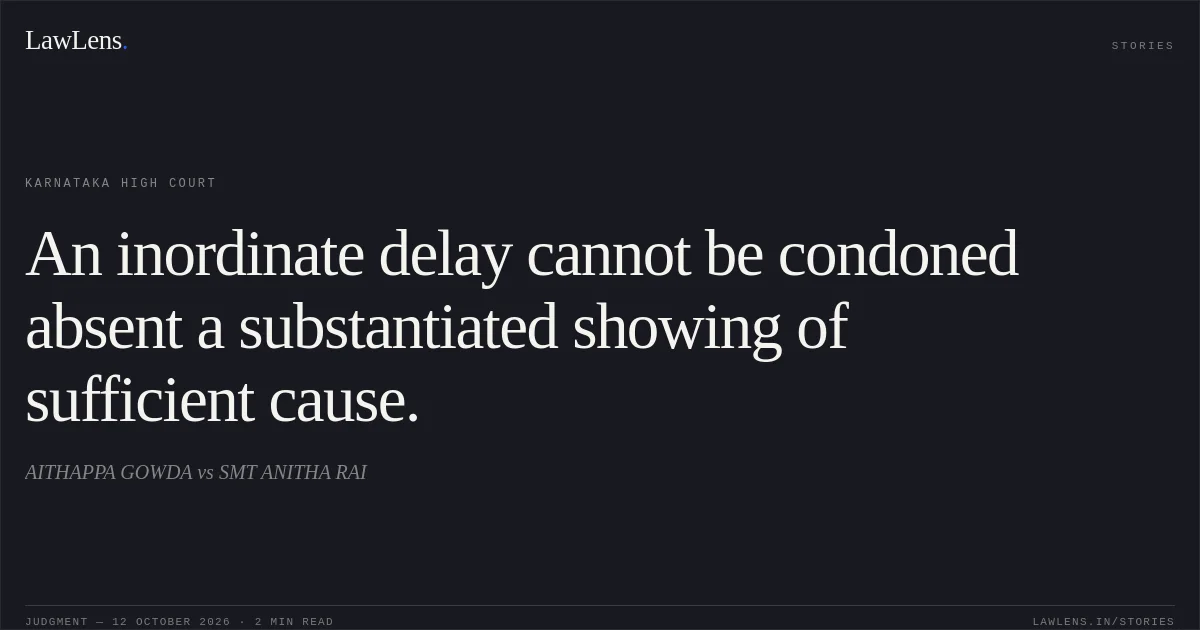
1. Whether the Tribunal was justified in condoning the 4,004-day delay in filing the appeal without a sufficiently supported and bona fide explanation.
Source reference: pp. 9–10; paras. 8–9, 122. Whether the Tribunal’s order allowing the appeal on the merits could stand when its decision to condone delay was legally unsustainable.
Source reference: pp. 31–33; paras. 12–13Law Applied
Section 5 of the Limitation Act, 1963 permits delay to be condoned only where sufficient cause is shown; the discretion must be exercised judicially, having regard to the explanation, diligence and bona fides of the party, and the length of delay. Limitation serves public policy by bringing litigation to an end, and a liberal approach cannot displace the statutory requirement of sufficient cause.
Source reference: no citationThe Court relied on Pathapati Subba Reddy (Died) by LRs v. Special Deputy Collector (LA), which emphasises that merits should not substitute for a sufficient explanation and that inordinate delay, negligence or want of due diligence may justify refusal.
Source reference: pp. 10–11; para. 9Union of India v. Jahangir Byramji Jeejeebhoy (D) through his LR, which requires scrutiny of the bona fides and particulars of the explanation before considering the merits.
Source reference: pp. 11–24; para. 10Majji Sannemma @ Sanyasiro v. Reddy Sridevi, which holds that condonation without an adequate explanation is an improper exercise of discretion.
Source reference: pp. 24–31; para. 11Reasoning
The respondents’ assertion that they lacked knowledge of the 2001 grant was unsupported by documentary evidence and did not identify a specific date on which they learned of the order.
Source reference: pp. 9–10; para. 9Further, the original records showed that Warisu Subbaiah Rai had appeared for late Koragappa and contested the proceedings before the competent authority; the judgment also noted that the respondents’ father had filed a vakalat and contested the matter.
Source reference: pp. 31–32; para. 13That evidence undermined the claimed lack of awareness. Applying the principles governing Section 5, the Court held that the Tribunal had condoned an inordinate delay without an acceptable explanation and had therefore exercised its discretion erroneously.
Source reference: pp. 32–33; para. 13Since the delay ruling was unsustainable, the Court did not examine the merits of the grant.
Source reference: pp. 32–33; para. 13Holding
The High Court held that the Tribunal was not justified in condoning the delay of 4,004 days without sufficient cause.
It allowed the writ petition, set aside the Karnataka Appellate Tribunal’s order dated 19 January 2018, and confirmed the competent authority’s order dated 10 July 2001 granting occupancy rights to Aithappa Gowda.
Source reference: p. 33; Order clauses (i)–(iii)Acts & Sections Cited
2 provisions across 1 statute referred to in this judgment. Each provision opens on LawLens.
Original Court PDF
AITHAPPA GOWDAvsSMT ANITHA RAI
Click to open original judgment
Original judgment, available to read, download and summarize on LawLens.in