01Facts
The appellant-plaintiff instituted a suit for specific performance of an agreement for sale concerning the predecessor-in-interest of the respondents’ 1/7th share in the subject property. The agreement was embodied in a money receipt, marked Exhibit 1.
The respondents did not appear despite service of summons, and the suit proceeded ex parte.
¶ 3The Trial Court dismissed the suit on four grounds: absence of a formal property schedule, insufficiency of stamp duty, absence of an attesting witness, and absence of the plaintiff’s signature on the agreement.
¶ 4In appeal, the appellant contended that the property was sufficiently described in the plaint and agreement, that an agreement for sale need not be attested, that the plaintiff’s conduct established consensus ad idem, and that the agreement need not bear the full stamp duty applicable to the eventual sale deed.
¶ 5–1002Issues
i.Whether the absence of a formal schedule in the plaint invalidated the suit when the property was sufficiently identified in the agreement and the plaint.
¶ 12–15ii.Whether an agreement for sale was required to be attested by witnesses, thereby attracting Section 68 of the Indian Evidence Act, 1872.
¶ 16–18iii.Whether the absence of the plaintiff’s signature on the money receipt/agreement rendered the agreement unenforceable.
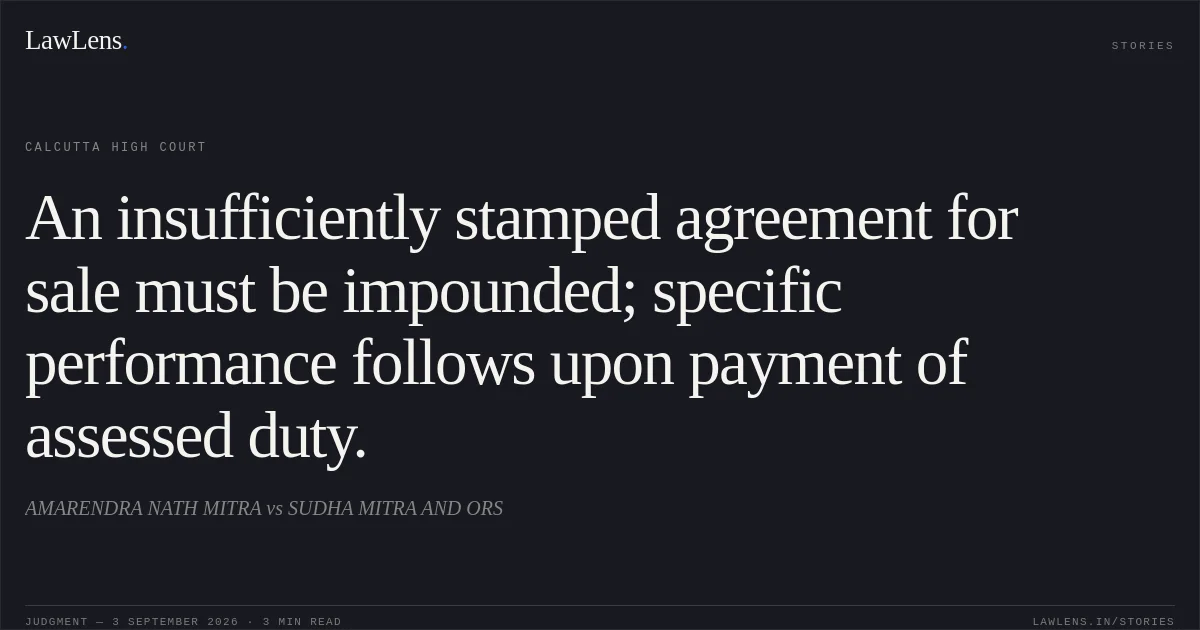
¶ 19–20iv.Whether the agreement for sale was insufficiently stamped and, if so, whether the Trial Court ought to have impounded the document instead of dismissing the suit.
¶ 21–2703Law Applied
Section 68 of the Indian Evidence Act, 1872, operates only where another statute independently requires the document to be attested; it does not itself impose an attestation requirement.
¶ 16–18The Court relied on Bommaka Nagabhushana Reddy v. W. Srinivasa Rao, (2002) 9 SCC 664, for the principle that a promise to transfer property may constitute an agreement for sale.
¶ 8, 19The Court relied on Gurmail Singh v. Sukhdev Singh for the proposition that mandatory attestation is confined to documents for which an independent statutory provision requires attestation.
¶ 9–10, 16Under Sections 3 and 4 of the Indian Stamp Act, 1899, as applicable in West Bengal, Section 4 applies where several instruments presently operate together to complete an already-concluded transaction; it does not permit an agreement for sale to avoid applicable stamp duty merely because a sale deed may be executed in the future.
¶ 21–24Where an instrument is insufficiently stamped, the statutory course is impoundment and assessment of the deficit duty under the Stamp Act, rather than dismissal of the substantive suit.
¶ 25–27Provisions in the judgment · 6 · Linked ones open on LawLens
Indian Stamp Act, 1899 Section 3Section 4Section 35Section 36
Indian Succession Act, 1925 Section 63
Transfer of Property Act, 1882 Section 123
04Reasoning
Exhibit 1, read with paragraph 6 of the plaint, adequately identified the property and the 1/7th share proposed to be transferred; a formal schedule was therefore unnecessary, particularly because the relief sought was enforcement of the agreement rather than declaration of corporeal rights in the property.
¶ 12–15An agreement for sale is not one of the instruments statutorily required to be attested, so Section 68 of the Evidence Act was inapplicable.
¶ 16–18The absence of the plaintiff’s signature did not defeat the agreement because the predecessor-in-interest had executed the money receipt containing the contractual terms, while the plaintiff’s conduct, institution of the suit, and oral evidence demonstrated acceptance and consensus ad idem.
¶ 19–20The future sale deed could not be treated as an existing instrument forming part of a completed transaction for purposes of Section 4.
¶ 21–24Although Exhibit 1 was insufficiently stamped, the Trial Court’s proper course was to impound it, assess the duty, and allow the plaintiff to pay it; outright dismissal on that ground was legally erroneous.
¶ 25–2605Holding
The appeal was allowed and the Trial Court’s judgment and decree dated 24 July 2023 were set aside.
¶ 27The matter was remanded on a limited basis for impoundment of Exhibit 1 and assessment of the correct stamp duty.
¶ 27The plaintiff was directed to deposit the assessed duty within the time granted or extended by the Trial Court; upon such payment, the Trial Court was directed to decree specific performance of the agreement concerning the predecessor-in-interest’s 1/7th share.
¶ 27In default of payment, the suit would stand dismissed.
¶ 27The exercise was directed to be completed expeditiously, preferably within two months of receipt of the records. There was no order as to costs, and interim orders, if any, were vacated.
¶ 28–30Original Court PDF
AMARENDRA NATH MITRAvsSUDHA MITRA AND ORS
Click to open original judgment
Original judgment, available to read, download and summarize on LawLens.in