Facts
On 07.03.2011, the respondent/claimant was driving his auto-rickshaw bearing registration No. AP 23 Y 0604 from Banswada towards Varni. Near Durki village, another auto-rickshaw bearing registration No. AP 25 U 9385 approached from the opposite direction. While attempting to avoid a collision, the claimant’s auto went out of control, causing an accident in which he sustained multiple fractures and serious injuries.
Source reference: para. 2The claimant filed M.V.O.P. No.80 of 2012 under Section 166(1)(a) of the Motor Vehicles Act, 1988, claiming compensation of ₹2,00,000. The Motor Accidents Claims Tribunal awarded ₹86,000 with interest at 7.5% per annum from the date of petition until realization, holding the appellant-Insurance Company liable.
Source reference: para. 1The Insurance Company challenged the award under Section 173 of the Motor Vehicles Act, contending that the claimant, being the owner-cum-driver of the insured auto, could not claim as a third party.
Source reference: para. 2; para. 4Issues
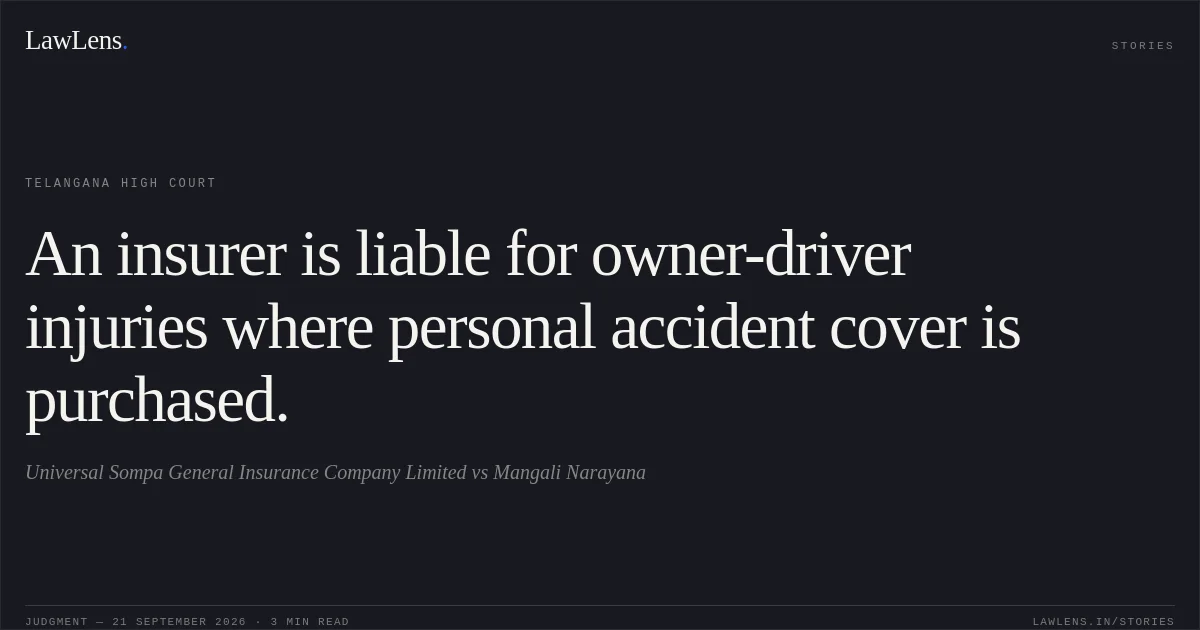
Whether the owner-cum-driver of the insured auto was entitled to compensation under the personal accident coverage forming part of the insurance policy, despite not being a third party?
Source reference: para. 4Whether the Tribunal’s award of ₹86,000 with interest at 7.5% per annum was legally sustainable and required appellate interference?
Source reference: para. 5Law Applied
The Court applied Sections 166(1)(a) and 173 of the Motor Vehicles Act, 1988, governing claims for compensation and appeals against awards of Motor Accidents Claims Tribunals.
Source reference: paras. 1–2It distinguished ordinary third-party liability from a specific personal accident policy covering the owner-cum-driver. Where an additional premium is collected for personal accident coverage and the policy provides coverage for bodily injuries to the owner-cum-driver, the insurer is liable in accordance with that contractual coverage. The insurer must establish a fundamental breach or violation of the policy conditions to avoid liability.
Source reference: para. 4Compensation must be assessed on the basis of the medical and documentary evidence under appropriate heads such as pain and suffering, medical expenses, nourishment and transport, and loss of earnings.
Source reference: para. 5Reasoning
The Court rejected the Insurance Company’s contention that the claimant was barred from recovery merely because he was the owner-cum-driver and not a third party. Ex.B1/Ex.A4 showed that an additional premium of ₹100 had been paid for personal accident coverage of the owner-cum-driver up to ₹2,00,000. The insurer’s witness, RW.1, admitted both the collection of the additional premium and the existence of the personal accident coverage.
Source reference: para. 4Since the claimant sustained bodily injuries within the scope of that coverage, the Insurance Company was liable under the policy. The insurer also failed to prove any fundamental breach or violation of the policy terms.
Source reference: para. 4On quantum, the Court upheld the Tribunal’s assessment of ₹50,000 for pain and suffering, ₹24,000 towards medical expenses, ₹6,000 towards extra nourishment and transport, and ₹6,000 for loss of earnings, totalling ₹86,000.
Source reference: para. 5Holding
The High Court held that the claimant was entitled to recover compensation under the personal accident coverage applicable to the owner-cum-driver, notwithstanding that he was not a third party.
It further held that the compensation of ₹86,000 with interest at 7.5% per annum from the date of petition until realization was just, reasonable, and supported by the evidence.
Source reference: para. 5The appeal was dismissed, with no order as to costs, and pending miscellaneous petitions, if any, were closed.
Source reference: paras. 6–7Acts & Sections Cited
2 provisions across 1 statute referred to in this judgment. Each provision opens on LawLens.
Motor Vehicles Act, 19882
Original Court PDF
Universal Sompa General Insurance Company LimitedvsMangali Narayana
Click to open original judgment
Original judgment, available to read, download and summarize on LawLens.in