Facts
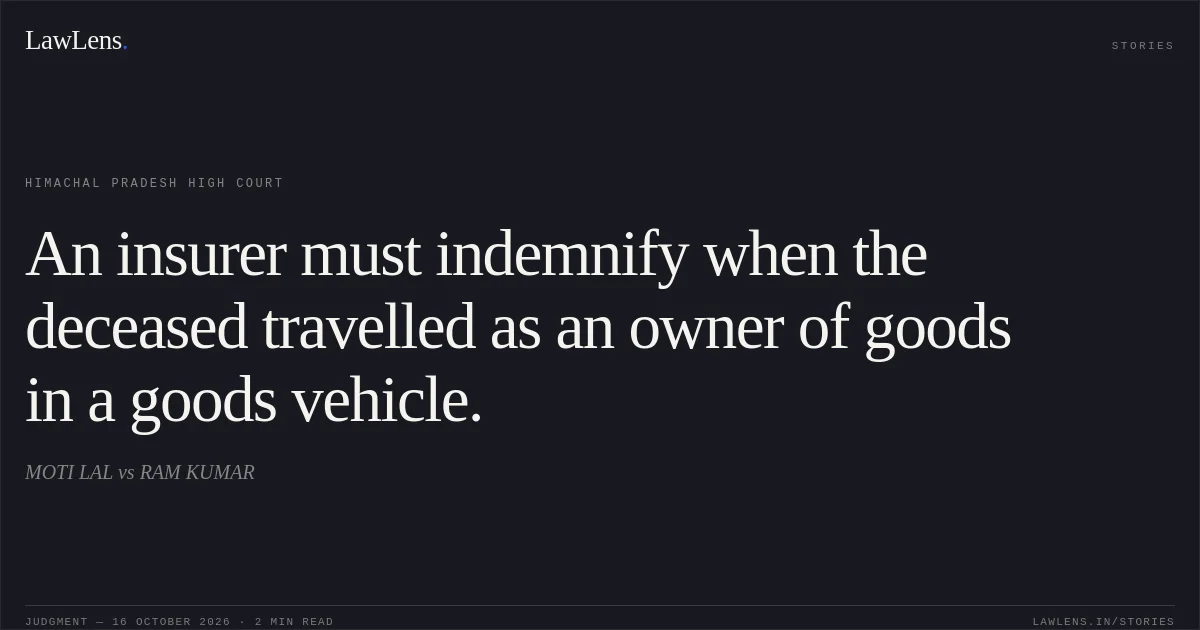
The claimants sought compensation under Section 166 of the Motor Vehicles Act for the death of Noryum Mani in an accident involving a light commercial vehicle owned by Moti Lal and insured by respondent No. 3.
Source reference: para. 4.1–4.3They alleged that she and Ram Pati had hired the vehicle to transport flower pots and plants.
Source reference: para. 4.1–4.3The Tribunal awarded Rs. 12,16,400 with 7.5% annual interest, but placed liability on the owner, finding the deceased was a gratuitous passenger because the FIR did not mention the hiring or goods.
Source reference: para. 2, 27The owner appealed, disputing that finding and seeking to shift liability to the insurer; the claimants also sought enhancement.
Source reference: para. 9–14Issues
Whether the deceased was travelling as an owner of goods, rather than as a gratuitous passenger, so that the insurer was liable to indemnify the owner.
Source reference: para. 27–36Whether the Tribunal’s award represented just compensation and, if not, what amount was payable.
Source reference: para. 37–48Law Applied
Under Sections 166 and 173 of the Motor Vehicles Act, a claim for compensation may be adjudicated by the Tribunal and its award appealed to the High Court.
Source reference: no citationThe insurer bears the burden of proving a fundamental breach of the policy conditions.
Source reference: para. 28In assessing evidence, sworn testimony before the Tribunal may be preferred to inconsistent FIR contents where the evidence supports that conclusion; the Court relied on National Insurance Co. Ltd. v. Chamundeshwari (2021) 18 SCC 596.
Source reference: para. 30–32Compensation is to be just: National Insurance Co. Ltd. v. Pranay Sethi (2017) 16 SCC 680 governs future prospects and conventional heads; Sarla Verma v. Delhi Transport Corporation (2009) 6 SCC 121 governs the multiplier and personal-expense deduction; and Magma General Insurance Co. Ltd. v. Nanu Ram (2018) 18 SCC 130 recognises spousal and parental consortium.
Source reference: para. 40, 43–46Reasoning
Ram Pati, who survived the accident and testified that she and the deceased hired the vehicle, loaded the flower pots and plants, and agreed to a fare of Rs. 1,500, was an eyewitness and was cross-examined by the insurer.
Source reference: para. 22–23, 28The Court considered her sworn evidence alongside the omission in the FIR, reasoning that the FIR was not sworn testimony and that its omission was not decisive in the circumstances.
Source reference: para. 29–32The owner’s pleading had also admitted that the vehicle was hired to carry the goods, and the Court found the claimants had established that the women travelled as owners of goods.
Source reference: para. 33–36On quantum, it applied 40% future prospects to the deceased’s monthly contribution of Rs. 8,000, deducted one-third for personal expenses, and applied a multiplier of 17; it then added compensation for consortium, loss of estate and funeral expenses.
Source reference: para. 39–47Holding
The Court allowed the owner’s appeal, held the insurer liable to indemnify him, and enhanced compensation from Rs. 12,16,400 to Rs. 16,33,268, with 7.5% annual interest from the date the claim petition was filed until deposit.
It apportioned 40% to petitioner No. 1 and 60% to the minor petitioner No. 2, directing that the minor’s share be invested in a fixed deposit until majority.
Source reference: para. 51–52Acts & Sections Cited
5 provisions across 3 statutes referred to in this judgment. Each provision opens on LawLens.
Motor Vehicles Act, 19882
Indian Penal Code, 18602
Code of Criminal Procedure, 19731
Original Court PDF
MOTI LALvsRAM KUMAR
Click to open original judgment
Original judgment, available to read, download and summarize on LawLens.in