Facts
Ankit Mahajan died in a car accident on 22 July 2011.
Source reference: para. 2The car had been sold and temporarily registered on 10 June 2011, but its temporary registration expired on 9 July 2011.
Source reference: para. 12, 15Although the vehicle’s documents and fee were submitted to the registering authority on 19 July 2011, it had not been registered when the accident occurred.
Source reference: para. 2, 12, 15His mother, Santosh Kumari, obtained an award of ₹72,67,700 against the insurer.
Source reference: para. 1, 8, 10, 16The insurer appealed, arguing that the vehicle’s use without registration breached the insurance policy; the mother cross-objected, seeking enhancement for future prospects.
Source reference: para. 1, 8, 10, 16Issues
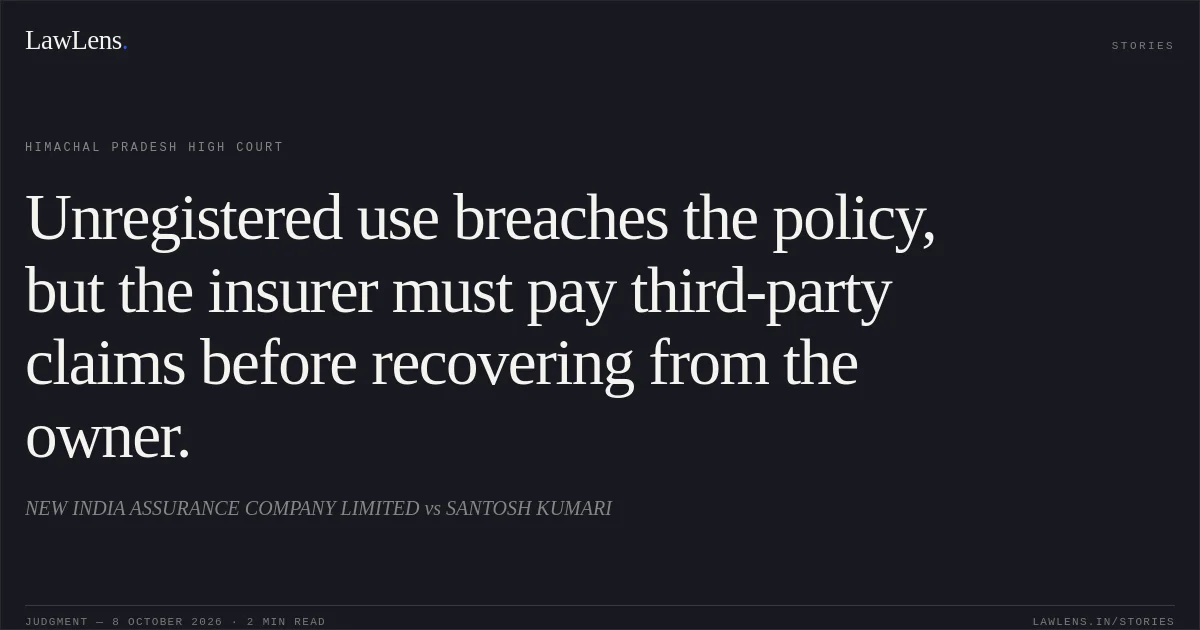
Whether the vehicle’s use on a public road without a valid registration certificate constituted a fundamental breach of the insurance policy, and whether the insurer could avoid liability to the third-party claimant.
Source reference: para. 14–15, 23–27Whether the compensation required enhancement to account for future prospects and the applicable conventional heads.
Source reference: para. 16–22Law Applied
Section 39 of the Motor Vehicles Act, 1988 prohibits driving or permitting a vehicle to be driven in a public place unless it is registered; Section 192 provides the penalty for contravention.
Source reference: para. 14Under Narinder Singh v. New India Assurance Co. Ltd., (2014) 9 SCC 302, use of a vehicle without registration is a fundamental breach of the policy.
Source reference: para. 14However, the pay-and-recover principle recognised in National Insurance Co. Ltd. v. Swaran Singh, (2004) 3 SCC 297, and applied in Lehru, Kusum Lata and Amrit Paul Singh, permits an insurer required to satisfy a third-party award to recover the amount from the insured in appropriate cases.
Source reference: para. 23–26Under National Insurance Co. Ltd. v. Pranay Sethi, (2017) 16 SCC 680, 40% is added for future prospects where a deceased below 40 was self-employed or on a fixed salary; a bachelor’s personal expenses are deducted at 50%, and the applicable multiplier is used.
Source reference: para. 17–19Magma General Insurance Co. Ltd. v. Nanu Ram, (2018) 18 SCC 130, recognises filial consortium, while Sunita v. United India Insurance Co. Ltd. supports periodic enhancement of conventional heads.
Source reference: para. 20–22Reasoning
The temporary registration had expired before the accident, and the owner had not established that a permanent registration certificate or extension had been obtained.
Source reference: para. 12–15The subsequent submission of documents and fee did not itself authorise the vehicle’s use on the road; the court therefore found a fundamental breach and held that the insurer could recover the compensation from the owner.
Source reference: para. 12–15, 27On the cross-objection, the deceased’s established annual income after tax was ₹8,46,200. Adding 40% for future prospects, deducting 50% for personal expenses and applying multiplier 17 produced loss of dependency of ₹1,00,69,780.
Source reference: para. 18–22The court also awarded ₹19,965 each for funeral expenses and loss of estate, and ₹53,240 for filial consortium.
Source reference: para. 18–22Holding
The appeal and cross-objections were partly allowed. Compensation was enhanced to ₹1,01,62,950.
The insurer was directed to pay the award to the claimant in the first instance, with the right to recover the amount from the vehicle’s owner in accordance with law.
Source reference: para. 27The remaining terms of the Tribunal’s award, including interest, were left unchanged.
Source reference: para. 27Acts & Sections Cited
7 provisions across 1 statute referred to in this judgment. Each provision opens on LawLens.
Motor Vehicles Act, 19887
Original Court PDF
NEW INDIA ASSURANCE COMPANY LIMITEDvsSANTOSH KUMARI
Click to open original judgment
Original judgment, available to read, download and summarize on LawLens.in