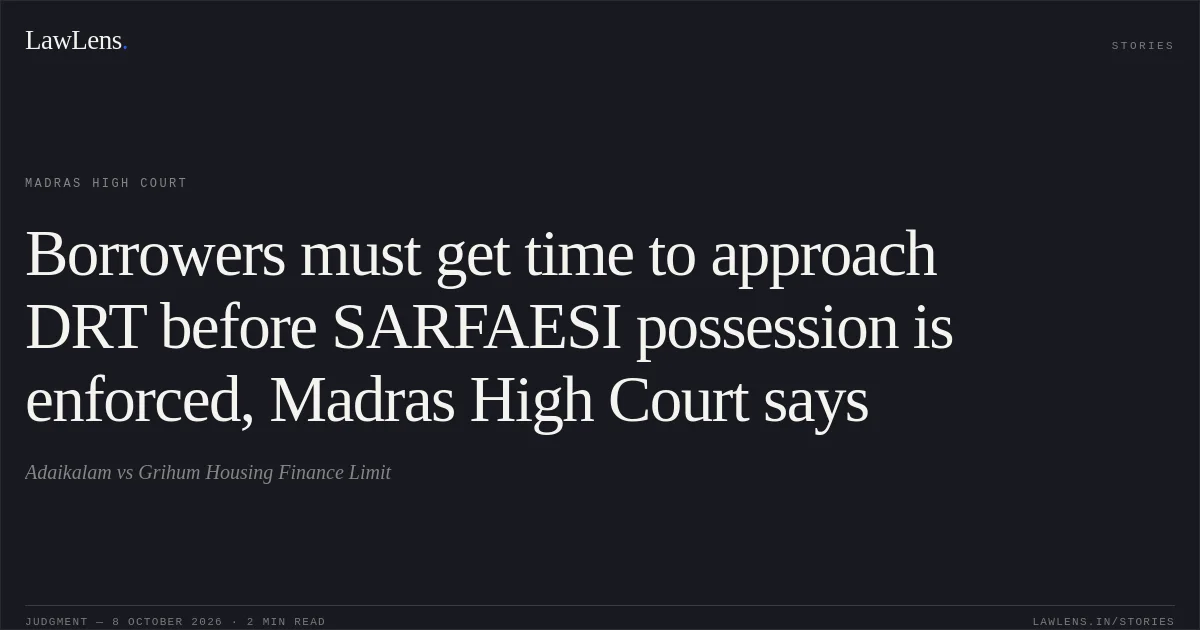
Facts
The petitioners had borrowed from the respondent, and their loan account was classified as a non-performing asset. The respondent initiated proceedings under the SARFAESI Act and obtained an order under Section 14 from the Chief Judicial Magistrate, Pudukkottai, on 18 September 2026. An Advocate-Commissioner was appointed, and possession was scheduled for 9 October 2026.
Source reference: para. 2, p. 2The petitioners sought a pause in possession proceedings to pursue a remedy under Section 17 before the DRT, Madurai. They stated that their Section 17 application had been filed in full shape.
Source reference: para. 6, p. 5Issues
Whether an order under Section 14 of the SARFAESI Act may be enforced before the expiry of the 45-day period available to challenge the relevant measure under Section 17
Source reference: para. 4, p. 3Whether possession proceedings should be kept on hold where the borrowers have approached, or are taking steps to approach, the DRT under Section 17
Source reference: paras. 5–6, pp. 4–5Law Applied
Section 13(4) of the SARFAESI Act authorises a secured creditor to take possession of secured assets; an order under Section 14 assists in implementing that measure and is ministerial in nature, involving no adjudication or hearing of the borrower.
Source reference: paras. 4–5, pp. 3–4Under Section 17, a borrower or other aggrieved person may apply to the DRT within 45 days of the measure, and the Tribunal may grant interim relief and order restitution.
Source reference: paras. 3–4, pp. 2–3The Court held that, when the secured creditor is put on notice that the Section 14 order is being challenged before the jurisdictional DRT, its enforcement should be held in abeyance for 45 days, giving the borrower an opportunity to seek interim relief; the borrower must act with vigilance, consistently with the object of the SARFAESI Act.
Source reference: para. 5, p. 4The Court also drew an analogy with Order 21 Rule 26 of the Code of Civil Procedure and referred to Article 8 of the Universal Declaration of Human Rights on the right to an effective remedy.
Source reference: para. 5, p. 4Reasoning
Because a Section 14 order is ministerial and does not itself provide an opportunity for adjudication, immediate enforcement could deprive a borrower or third party of a meaningful chance to obtain DRT review; later restitution might be inadequate or illusory.
Source reference: paras. 4–5, pp. 3–4The Court therefore considered a temporary pause necessary to preserve the statutory remedy, while requiring the borrower to approach the DRT promptly and leaving the Tribunal to decide interim relief.
Source reference: para. 5, p. 4In this case, the petitioners represented that their Section 17 application had been filed, so the Court directed the Tribunal to number it if the papers were in order and decide the interim application by 30 October 2026.
Source reference: para. 6, p. 5Holding
The writ petition was disposed of with a direction to keep the impugned Section 14 order on hold until the DRT decided the petitioners’ interim application, no later than 30 October 2026.
The order would thereafter abide by the Tribunal’s decision. The Tribunal was directed to number the Section 17 application immediately if the papers were in order; no costs were awarded.
Source reference: paras. 6–7, p. 5Acts & Sections Cited
3 provisions across 1 statute referred to in this judgment. Each provision opens on LawLens.
Securitisation and Reconstruction of Financial Assets and Enforcement of Security Interest Act, 20023
Original Court PDF
AdaikalamvsGrihum Housing Finance Limit
Click to open original judgment
Original judgment, available to read, download and summarize on LawLens.in
![Gujarat High Court awards ₹1.5 lakh for loss of marital life after road-accident injuries left claimant impotent. SHIVAJIRAO RAMDAS SONAVNE vs GURUMEJSING AJITSING JAAT [DELETED]. Gujarat High Court. LawLens](/stories/thumbnails/gujarat-high-court-awards-1-5-lakh-for-loss-of-marital-life-after-road-accident-injuries-l-624a03209b7a43bdb849566e39b4c367.webp)