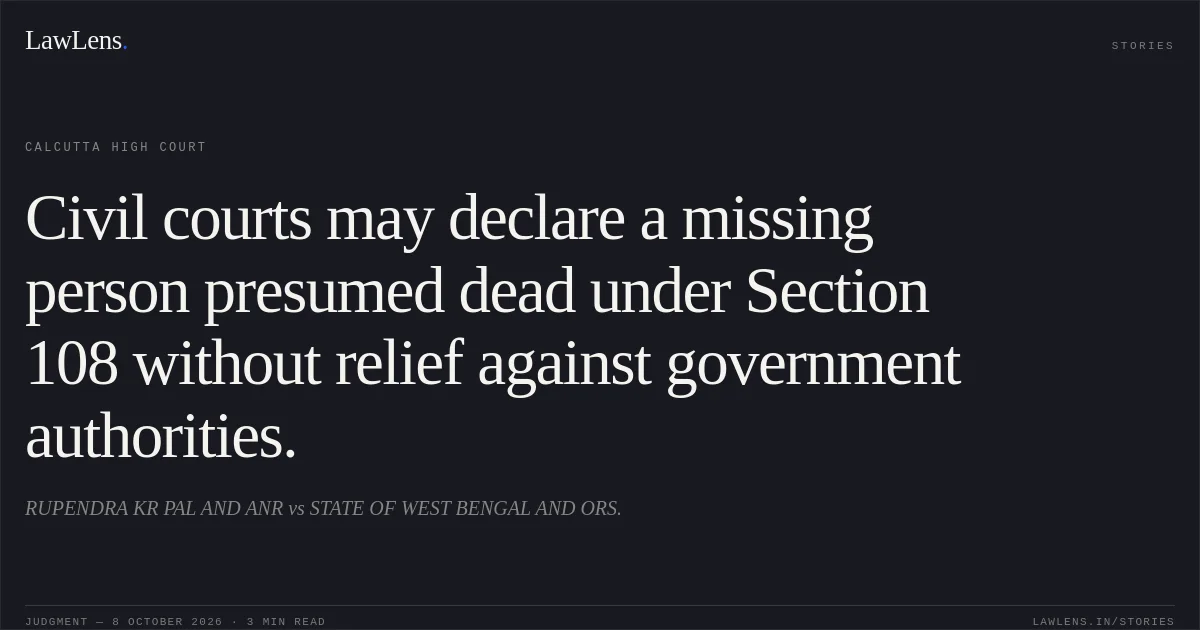
Facts
Satyendra Kumar Pal reportedly disappeared on 10 July 2007, aged 44.
Source reference: p. 2His brother lodged a missing-person report the following day; searches and a newspaper notice did not establish his whereabouts.
Source reference: p. 2–5The plaintiffs, claiming to be his legal heirs, sought a declaration of civil death under Section 108 of the Indian Evidence Act, 1872.
Source reference: p. 2–5The trial court dismissed the suit for want of cause of action, and the first appellate court affirmed that decision.
Source reference: p. 2–5In the second appeal, the High Court noted that an application for leave under Section 80(2) CPC was on the trial court record but had not been addressed; the police authorities also remained unable to provide Satyendra’s whereabouts.
Source reference: p. 7–8, 17–18Issues
Whether the courts below overlooked the plaintiffs’ pending application for leave under Section 80(2) CPC when dismissing the suit
Source reference: p. 4–5Whether the courts below erred in finding no cause of action against the authorities in a suit seeking a declaration of civil death
Source reference: p. 5Whether notice under Section 80 CPC was necessary where the plaintiffs sought no direction or other relief against the defendants
Source reference: p. 5Law Applied
Section 80(1) CPC ordinarily requires prior notice before suing the Government or a public officer, while Section 80(2) permits suit without notice with the court’s leave for urgent or immediate relief.
Source reference: p. 8–10The court relied on authorities recognising that an objection to non-service may be treated as waived in appropriate circumstances, including where it was not pursued or the State participated without raising it.
Source reference: p. 12–15Sections 107 and 108 of the Indian Evidence Act govern the burden of proving life or death: where a person has not been heard of for seven years by those who would naturally have heard from him, the burden shifts to the person asserting that he is alive; the presumption concerns death, not its date or circumstances.
Source reference: p. 15–16, 18–20A civil court may grant a declaration of civil death in its plenary jurisdiction under Section 9 CPC, without Section 34 of the Specific Relief Act being an obstacle.
Source reference: p. 19–20Reasoning
The High Court found that the Section 80(2) application was in the record but had been overlooked by both courts below.
Source reference: p. 7–8It further held that notice was unnecessary in the circumstances: no direction or relief was sought against the Government authorities, the police defendant did not raise non-service as an objection, and no issue on notice had been framed.
Source reference: p. 7–8, 14–15The authorities’ participation and failure to pursue the objection supported treating notice as waived.
Source reference: p. 14–15On the merits, Satyendra had been missing for more than seven years, and the police could not furnish his whereabouts despite being given an opportunity to do so in the second appeal.
Source reference: p. 16–17Applying Section 108, the court held that the statutory presumption of death arose and that the civil court could grant the requested declaration.
Source reference: p. 16–17, 20Holding
The High Court answered all three questions in favour of the appellants, allowed the second appeal, and set aside the judgments of the trial court and first appellate court.
It declared Satyendra Kumar Pal civilly dead under Section 108 of the Indian Evidence Act, 1872, and directed that a decree be drawn up.
Source reference: p. 20Acts & Sections Cited
3 provisions across 2 statutes referred to in this judgment. Each provision opens on LawLens.
Code of Civil Procedure, 19082
Specific Relief Act, 19631
Original Court PDF
RUPENDRA KR PAL AND ANRvsSTATE OF WEST BENGAL AND ORS.
Click to open original judgment
Original judgment, available to read, download and summarize on LawLens.in
![Gujarat High Court awards ₹1.5 lakh for loss of marital life after road-accident injuries left claimant impotent. SHIVAJIRAO RAMDAS SONAVNE vs GURUMEJSING AJITSING JAAT [DELETED]. Gujarat High Court. LawLens](/stories/thumbnails/gujarat-high-court-awards-1-5-lakh-for-loss-of-marital-life-after-road-accident-injuries-l-624a03209b7a43bdb849566e39b4c367.webp)