01Facts
On 1.11.2007, the appellant, a legal practitioner riding his motorcycle on Canal West Road, was allegedly hit by a TATA 407 (WB-25A/0354) and sustained multiple fractures, including a left humerus fracture.
¶ 3He was treated at R.G. Kar Medical College and Hospital and New Life Nursing Home, admitted from 1.11.2007 to 11.11.2007.
¶ 7–8He was readmitted to Apollo Hospital from 3.7.2008 to 9.7.2008 for implant removal and fixation.
¶ 15He claimed ₹15,00,000 as compensation, including 40% permanent disability and loss of income.
¶ 1, 3The Tribunal awarded ₹2,73,099.28 (₹1,73,099.28 for medical expenses and ₹1,00,000 as a consolidated, ad hoc sum for profession-related loss and treatment-period deprivation), with interest at 6% from 16.4.2009.
¶ 1, 7The Tribunal declined to award disability compensation and pain and suffering damages.
¶ 4The insurer contested the accident, the vehicle's involvement, income, and disability, and relied on the claimant's failure to produce a licence and the five-year delay in issuing the disability certificate.
¶ 5The Tribunal's disability evidence came from PW-3, Dr. P.K. Mondal, who assessed 40% whole-body disability on 11.5.2012.
¶ 8, 13The claimant's income evidence consisted of income tax returns filed in 2009, two years after the accident.
¶ 14, 22The appellant sought enhancement.
¶ 2–402Issues
i.1. Whether the Tribunal was right in not computing compensation for loss of future earning capacity arising from the permanent disability.
¶ 7 · p. 6ii.2. Whether the Tribunal was right in not awarding compensation for pain and suffering.
¶ 7 · p. 6iii.3. Whether the Tribunal's ad hoc award, unconnected to the prescribed guidelines, was sustainable.
¶ 19 · p. 1903Law Applied
The standard of proof in MACT proceedings is one of preponderance of probabilities, not proof beyond reasonable doubt, per Manju v. Avinash Singh, 2026 SCC OnLine SC 1310.
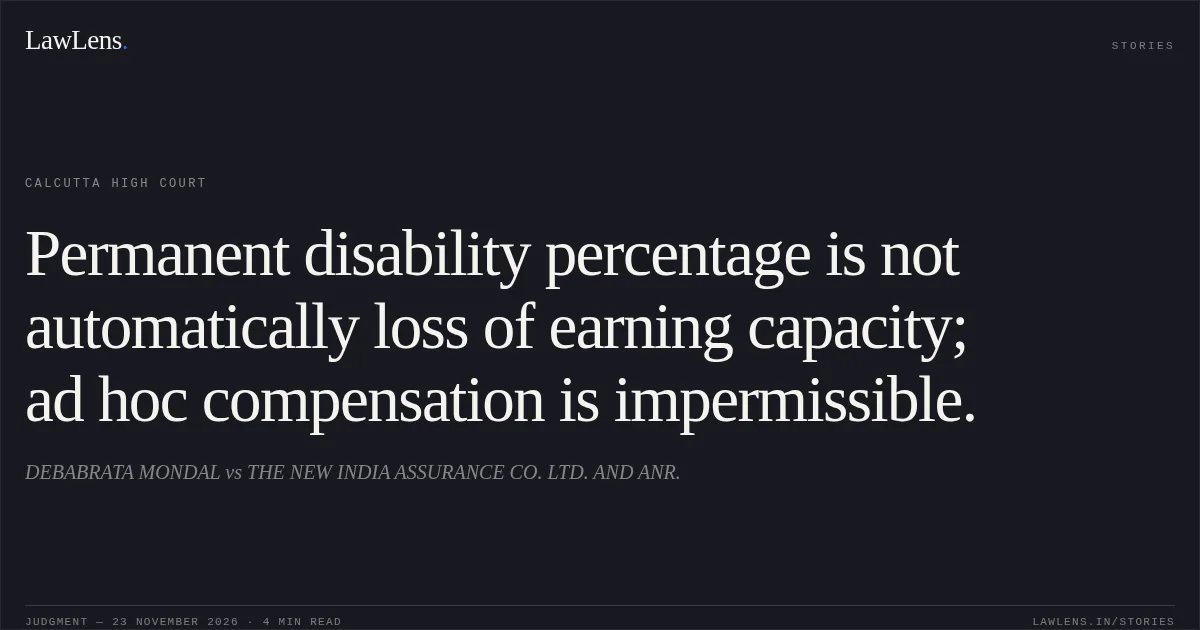
¶ 9 · p. 8Rajkumar v. Ajay Kumar, 2010 INSC 703, requires the Tribunal first to determine whether a permanent disability exists and its extent, then assess its effect on earning capacity by a three-step inquiry, and not to equate whole-body disability mechanically with loss of earning capacity.
¶ 9, 10, 13, 17 · pp. 8–12, 18Under Rajkumar, disability certificates must be supported by evidence from the treating or assessing doctor, and a Tribunal may constitute a Medical Board if unsatisfied.
¶ 10 · pp. 10–12Md. Sabeer v. UP SRTC, (2023) 20 SCC 774, holds that loss of earning capacity must be quantified in money by applying the multiplier method.
¶ 9 · pp. 8–9Talalkena Gowdra Parameshwarappa v. Branch Manager, New India Assurance Co. Ltd., (2023) 1 TAC 108 (SC), where a comparable lower-limb fracture disability was reassessed and the whole-body disability was reduced from 54% to 30%, is applied to reassess disability.
¶ 10–11, 16, 21Compensation must be computed under the prescribed guidelines and not as an ad hoc sum.
¶ 19The insurer's reliance on Parminder Singh v. Honey Goyal, Manu/SC/0356/2025, is noted, though the judgment does not extract its ratio.
¶ 1804Reasoning
The accident and the fracture were established through the hospital papers, discharge certificate, and the Apollo admission record, and were not displaced by cross-examination.
¶ 7–8, 15Because the accident was accepted and the insurer did not appeal, the Tribunal was bound to compute compensation under the prescribed guidelines rather than award an ad hoc sum.
¶ 19On disability, the Court found the 40% assessment excessive given the medical record, which showed an old healed humerus fracture with implant removal and no other fracture elsewhere, and applied the Talalkena reduction to fix disability at 20%.
¶ 8, 13, 21Income was not proved by 2007 documents, so the Court fixed it at ₹10,000 per month, based on the claimant's profession and the 2009 income tax return.
¶ 22Loss of future earning capacity was computed as 20% of ₹10,000 × 12 × 15 = ₹3,60,000.
¶ 23Loss of income during treatment was computed as ₹10,000 × 12 = ₹1,20,000, and pain and suffering was enhanced to ₹2,00,000 for two surgeries, implant removal, and prolonged hospitalisation.
¶ 20, 23The Court also awarded ₹25,000 for loss of amenities and ₹50,000 for future medical expenses.
¶ 23The Court rejected the claimant's claimed 40% disability and ₹15,00,000 total claim, and declined to accept the claimed waist and right-hand injuries, which the medical papers did not support.
¶ 7, 20–2105Holding
The Tribunal erred in not assessing future earning capacity, pain and suffering, and other heads under the prescribed guidelines.
¶ 19–20Permanent disability is fixed at 20% and monthly income at ₹10,000, and total compensation is recomputed at ₹9,28,099.
¶ 21–23The appeal is allowed in part. The award is modified and enhanced to ₹9,28,099, with the rest of the award unchanged. The Insurance Company is directed to pay within two months from the date of the order, by direct transfer to the appellant's bank account, and the appellant must furnish bank details forthwith. Urgent certified copies are to be supplied subject to formalities.
¶ 24, 28Original Court PDF
DEBABRATA MONDALvsTHE NEW INDIA ASSURANCE CO. LTD. AND ANR.
Click to open original judgment
Original judgment, available to read, download and summarize on LawLens.in