01Facts
The petitioner, a defendant in a partition suit concerning two flats, pleaded that the properties were mortgaged and that he had paid sums to banks to prevent their sale in recovery proceedings.
¶ 6–11The Trial Court passed a preliminary decree declaring the parties’ shares; on appeal, the decree was modified to cover both flats, with questions concerning the mortgage and payments left for the final-decree stage.
¶ 6–11After a partition commissioner was appointed, the petitioner applied under Section 151 CPC for adjudication of his alleged mortgage-related payments and other expenses.
¶ 2(f)–(l), 16The Trial Court dismissed the application, reasoning that related claims were pending before the High Court and that the petitioner had not raised the issue in the appeal.
¶ 2(f)–(l), 16The petitioner challenged that order under Article 227.
¶ 102Issues
i.1. Whether the Trial Court erred in declining to adjudicate, at the final-decree stage, the mortgage-payment questions expressly reserved by the preliminary decree.
¶ 6–7, 16–19ii.2. Whether the petitioner’s claims for property tax, electricity and maintenance expenses could also be considered in that enquiry, despite their absence from his pleadings and their exclusion from the questions reserved by the preliminary decree.
¶ 12–15, 2903Law Applied
Article 227 of the Constitution permits supervisory intervention where a subordinate court fails to exercise jurisdiction vested in it, or exercises jurisdiction in a manner not permitted by law resulting in failure of justice.
¶ 28Section 151 CPC recognises the court’s inherent powers, but the enquiry at the final-decree stage remains bounded by the matters left open by the preliminary decree.
¶ 12, 15, 29Under the Transfer of Property Act, 1882, full payment of the mortgage debt is required for subrogation under Section 92; nevertheless, a co-sharer who proves payment towards a common mortgage debt may be entitled to proportionate contribution and equitable adjustment, even if the debt was not fully discharged.
¶ 20, 25A court deciding partition must adjust equities so that other co-sharers do not obtain their shares free of a burden discharged on their behalf.
¶ 20–23Evidence on a matter not pleaded cannot ordinarily be relied upon to grant relief.
¶ 13–14Provisions in the judgment · 4 · Linked ones open on LawLens
Code of Civil Procedure, 1908 Section 151Section 23
Transfer of Property Act, 1882 Section 92Section 95
04Reasoning
The preliminary decree had expressly deferred questions concerning the mortgage, the purpose of the mortgage, and any payment towards its liquidation; those matters therefore remained for determination before the final decree.
¶ 6–11The petitioner’s mortgage-payment claim was distinct from the overlapping expenses claims in other proceedings, so the Trial Court was wrong to treat prior proceedings or the absence of an appeal-stage claim as barring its consideration.
¶ 16–19Whether the mortgage debt had been discharged, and whether the petitioner made the asserted payments, remained disputed questions for the Trial Court.
¶ 19–21Even if the payments did not satisfy the entire debt and therefore did not attract subrogation under Section 92, proven payments could still warrant proportionate contribution and equitable adjustment in partition.
¶ 19–21By contrast, the tax, electricity and maintenance claims were not pleaded in the written statements and were outside the matters reserved by the preliminary decree; they could not be added to the final-decree enquiry.
¶ 12–1505Holding
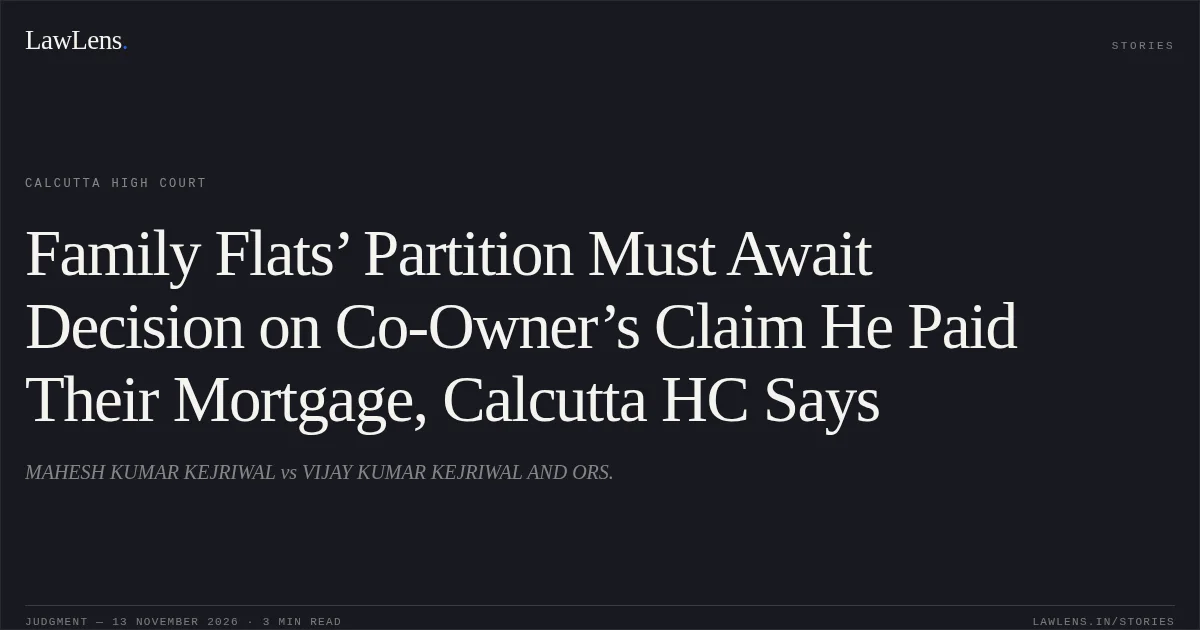
The High Court allowed the revision, set aside the Trial Court’s order and remanded the matter for decision only on the mortgage-debt payment questions reserved by the preliminary decree.
¶ 29–31It directed the Trial Court to decide those questions in accordance with law within one month of communication of the judgment and then proceed to pass an appropriate final decree.
¶ 29–31The Court expressed no view on the merits of the parties’ competing claims and excluded the maintenance, property-tax and electricity-expense claims from the remand.
¶ 29–31Original Court PDF
MAHESH KUMAR KEJRIWALvsVIJAY KUMAR KEJRIWAL AND ORS.
Click to open original judgment
Original judgment, available to read, download and summarize on LawLens.in