01Facts
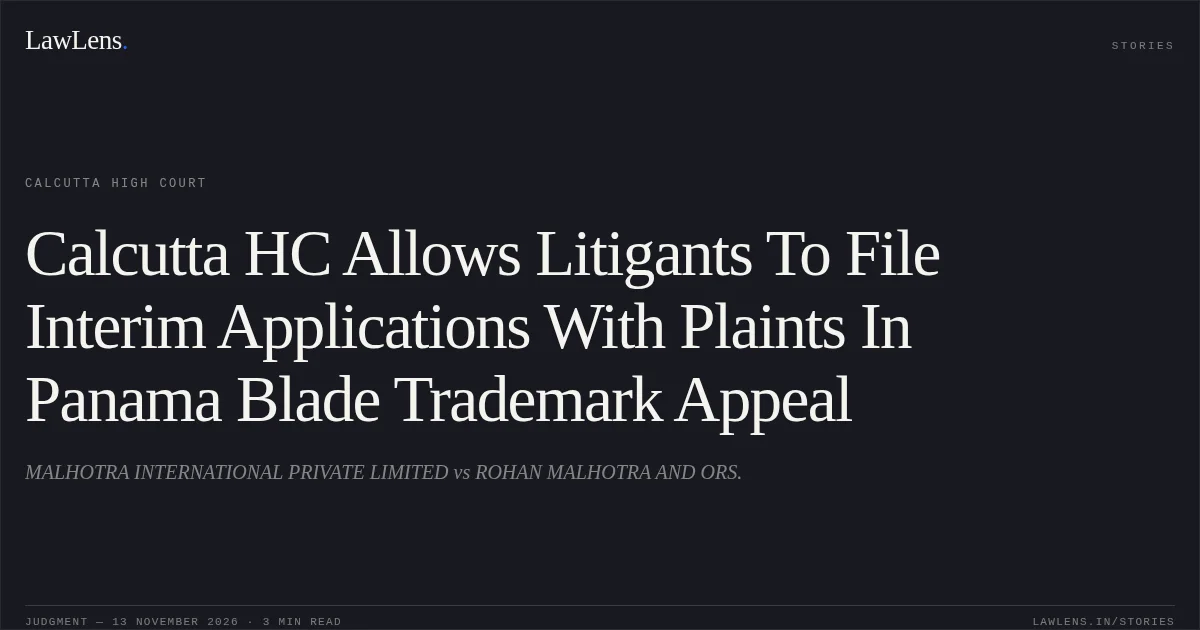
The appellant filed a commercial suit alleging infringement and passing off of its registered “PANAMA” trademark in relation to shaving blades. It claimed use of the mark since 1951 and alleged that it discovered the respondents’ competing products in the market in the second week of September 2026; the respondents asserted that they had been selling products under the mark since January 2026.
pp. 10, 15–16The suit was filed on 9 October 2026, and the appellant sought urgent interim relief without pre-institution mediation under Section 12A of the Commercial Courts Act, 2015.
pp. 10–11The Single Judge declined to dispense with mediation, directed return of the plaint and did not consider the appellant’s requests for leave under Clause 14 of the Letters Patent and Order II Rule 2 CPC. The appeal also raised the effect of an Office Order restricting the filing of interlocutory applications before presentation or admission of a plaint.
pp. 2, 6–902Issues
i.1. Whether the plaint and supporting materials disclosed a genuine need for urgent interim relief sufficient to dispense with pre-institution mediation under Section 12A of the Commercial Courts Act, 2015.
pp. 11–13ii.2. Whether the Office Order dated 20 January 2026 could restrict a litigant from filing an interim application simultaneously with the plaint.
pp. 6–10iii.3. Whether, following admission of the plaint, the appellant should receive leave under Clause 14 of the Letters Patent and Order II Rule 2 CPC.
pp. 2, 17–1803Law Applied
Section 12A of the Commercial Courts Act, 2015 makes pre-institution mediation mandatory, except where the suit genuinely contemplates urgent interim relief.
pp. 10–13Applying Patil Automation Private Limited v. Rakheja Engineers Private Limited, Yamini Manohar v. T.K.D. Keerthi, Dhanbad Fuels Private Limited v. Union of India and Novenco Building and Industry A/S v. Xero Energy Engineering Solutions Private Limited, the Court stated that urgency is assessed from the standpoint of the plaintiff by reading the plaint and supporting documents as a whole; the court must guard against a merely pro forma urgency plea, but the eventual refusal of interim relief does not itself defeat dispensation.
pp. 10–13For continuing intellectual-property infringement, urgency must be assessed in light of ongoing injury and the public interest in preventing deception; delay alone does not negate urgency.
pp. 15–17The Court also held that a litigant may file an interim application together with the plaint, subject to any just objections being placed before the court.
pp. 9–10Provisions in the judgment · 3 · Linked ones open on LawLens
Commercial Courts Act, 2015 Section 2Section 7
Code of Civil Procedure, 1908 Section 80
04Reasoning
The plaint alleged continuing infringement and passing off, supported by the appellant’s claim to longstanding use and registration of “PANAMA” and its account of discovering the respondents’ products in September 2026. Read from the appellant’s standpoint, those pleadings and documents disclosed a genuine need to seek urgent protection against ongoing injury and possible consumer deception; the dispute over whether the respondents had entered the market earlier was a factual issue for determination in the injunction proceedings, not a reason to refuse Section 12A dispensation at this stage.
pp. 15–17The Court therefore found that mediation would not be required before the suit proceeded.
pp. 15–17Separately, the Office Order’s restriction on simultaneous filing could impede access to urgent interim relief and was contrary to the consensus at the Bar; the Department could accept simultaneous filings while placing any just objections before the court.
pp. 8–1005Holding
The appeal was allowed and the impugned order set aside. The appellant was granted leave to proceed without pre-institution mediation under Section 12A; the plaint was admitted subject to scrutiny, retaining the initial suit number.
p. 17The Court set aside the relevant restriction in the Office Order and directed the Department to permit interim applications to be filed with the plaint.
pp. 9–10The respondents were directed to show cause why leave under Clause 14 of the Letters Patent should not be granted, and leave under Order II Rule 2 CPC was granted. The Court expressed no view on the merits of the injunction claim, leaving the parties’ contentions open.
p. 18Original Court PDF
MALHOTRA INTERNATIONAL PRIVATE LIMITEDvsROHAN MALHOTRA AND ORS.
Click to open original judgment
Original judgment, available to read, download and summarize on LawLens.in