01Facts
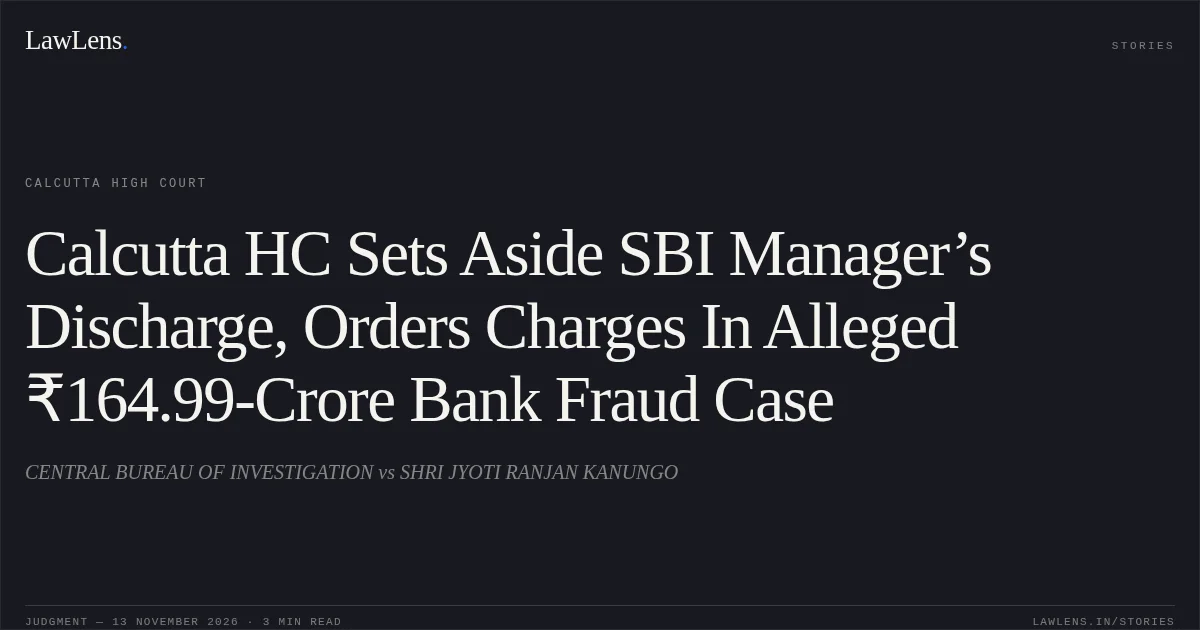
The CBI challenged an order discharging Shri Jyoti Ranjan Kanungo (A-3), an SBI Chief Manager and Relationship Manager, under Section 239 CrPC in a prosecution arising from alleged fraud involving SBI credit facilities to Shree Mahalaxmi Corporation Pvt. Ltd. and associated entities
¶ 1–5The charge sheet alleged that A-3 facilitated the scheme through, among other acts, unauthorized fund transfers and account creation, failure to reduce drawing powers, and inaccurate irregularity reports
¶ 5, 28The trial court discharged him, relying on matters including the separate CMP monitoring cell, departmental proceedings, senior officers’ countersignatures, and the asserted absence of criminal intent or personal enrichment
¶ 6The CBI sought revisional interference with that order
¶ 102Issues
i.Whether the trial court impermissibly conducted a “mini-trial” when considering discharge under Section 239 CrPC.
¶ 17(i)ii.Whether the prosecution materials, taken at face value, disclosed a prima facie case or strong and grave suspicion of conspiracy and abuse of official position against A-3.
¶ 17(ii)iii.Whether the discharge order was perverse and required revisional interference.
¶ 17(iii)03Law Applied
Section 239 CrPC permits discharge only where the court considers the charge groundless; at this stage, the court may sift the prosecution material to determine whether the alleged offence’s ingredients are disclosed, but must not decide whether the evidence will secure a conviction.
¶ 18–19, 22State of Tamil Nadu v. N. Suresh Rajan, (2014) 11 SCC 709, and Sajjan Kumar v. CBI, (2010) 9 SCC 368, establish that a charge may be framed where the material, taken at face value, gives rise to grave suspicion, while barring a roving inquiry or mini-trial.
¶ 22–23Captain Manjit Singh Virdi v. Hussain Mohammad Shattaf, (2023) 7 SCC 633, similarly cautions against evaluating the defence version at the discharge stage.
¶ 24The Court also applied Section 13(1)(d) read with Section 13(2) of the Prevention of Corruption Act, 1988, holding that personal enrichment is not invariably necessary where abuse of official position allegedly secures a pecuniary advantage for another.
¶ 33–34Under Sections 397 and 401 CrPC, revisional interference is available to correct patent legal error, perversity, or jurisdictional failure; Munna Devi v. State of Rajasthan, (2001) 9 SCC 631, and State of Rajasthan v. Fatehkaran Mehdu, (2017) 3 SCC 198, informed that principle.
¶ 36, 39–40Provisions in the judgment · 14 · Linked ones open on LawLens
Code of Criminal Procedure, 1973 Section 173Section 227Section 228Section 239Section 240Section 397Section 401Section 482
Indian Penal Code, 1860 Section 420Section 468Section 471
Prevention of Corruption Act, 1988 Section 13
Bharatiya Nagarik Suraksha Sanhita, 2023 Section 438Section 442
04Reasoning
The Court held that the trial court went beyond the Section 239 inquiry by accepting defence explanations and relying on departmental proceedings and other material to assess the merits of the prosecution case.
¶ 20–26The alleged unauthorized account, unbacked transfers, and signed reports concealing outstandings, considered at face value, raised grave suspicion of active facilitation rather than merely administrative negligence.
¶ 27–35The absence of evidence of direct personal gain did not, at this stage, negate the allegation that A-3’s official position was abused to confer pecuniary advantage on another.
¶ 32–35The trial court’s approach therefore involved a misapplication of the discharge standard and warranted revision.
¶ 41–4305Holding
The Court answered all three issues in favour of the CBI, allowed the revision, and set aside the discharge order.
¶ 26, 35, 43, 49(a)–(b)It remanded the case for restoration against A-3 and directed the trial court, upon submission of the prosecution sanction order if required, to proceed in accordance with law to frame appropriate charges and conduct the trial jointly with the co-accused.
¶ 49(c)–(d)Original Court PDF
CENTRAL BUREAU OF INVESTIGATIONvsSHRI JYOTI RANJAN KANUNGO
Click to open original judgment
Original judgment, available to read, download and summarize on LawLens.in