01Facts
The dispute concerned land at Mouza Dulliya, Howrah.
¶ 2–6Petitioners 3 and 4 claimed ownership of portions gifted to them by Petitioner 1, and had obtained conversion and building-plan approvals.
¶ 2–6They also obtained an interim injunction in Title Suit No. 150 of 2023 restraining interference with their construction.
¶ 2–6Separately, an earlier suit concerning an asserted ancestral share in the land included Petitioners 1 and 2 and was subject to a 2015 status quo order; Petitioners 3–5 were not parties to that suit.
¶ 2–6Opposite Party No. 2, acting as power-of-attorney holder for plaintiffs in the earlier suit, complained to police that the petitioners had violated the status quo order.
¶ 7–8, 15Police registered an FIR under Section 188 IPC, and the Magistrate took cognizance on the police report.
¶ 7–8, 15The petitioners sought quashing under Section 482 CrPC.
¶ 102Issues
i.1. Whether an FIR under Section 188 IPC initiated on a private person’s complaint, and cognizance taken on a police report, were maintainable in light of Section 195(1)(a) CrPC.
¶ 14ii.2. Whether alleged disobedience of a civil court’s interim status quo or injunction order in a private property dispute could constitute an offence under Section 188 IPC, or whether the remedy lay under Order XXXIX Rule 2A CPC.
¶ 14iii.3. Whether continuation of the criminal proceedings amounted to an abuse of process warranting quashing under Section 482 CrPC.
¶ 1403Law Applied
Section 195(1)(a)(i) CrPC bars a court from taking cognizance of an offence under Sections 172–188 IPC except on a written complaint by the public servant concerned or an administratively superior public servant; the judgment treated this requirement as mandatory and jurisdictional.
¶ 16–20Relying on C. Muniappan v. State of Tamil Nadu, (2010) 9 SCC 567, and State of U.P. v. Mata Bhikh, (1994) 4 SCC 95, the Court stated that prosecution under Section 188 IPC cannot proceed on a private complaint followed by a police report, absent the prescribed public-servant complaint.
¶ 18–19The Court construed Section 188 IPC as addressing disobedience of orders promulgated by public servants in their public capacity, and identified Order XXXIX Rule 2A CPC as the statutory mechanism for breach of civil injunction orders.
¶ 21–25Under State of Haryana v. Bhajan Lal, 1992 Supp (1) SCC 335, proceedings may be quashed where a legal bar prevents their institution or continuation, or where they constitute an abuse of process.
¶ 28Provisions in the judgment · 22 · Linked ones open on LawLens
Code of Civil Procedure, 1908 Section 151
Code of Criminal Procedure, 1973 Section 144Section 173Section 195Section 482
04Reasoning
The FIR arose from a private complaint, and no written complaint by a competent public servant was filed before the Magistrate.
¶ 15–20Cognizance on the police report therefore contravened Section 195(1)(a)(i) CrPC and was without jurisdiction.
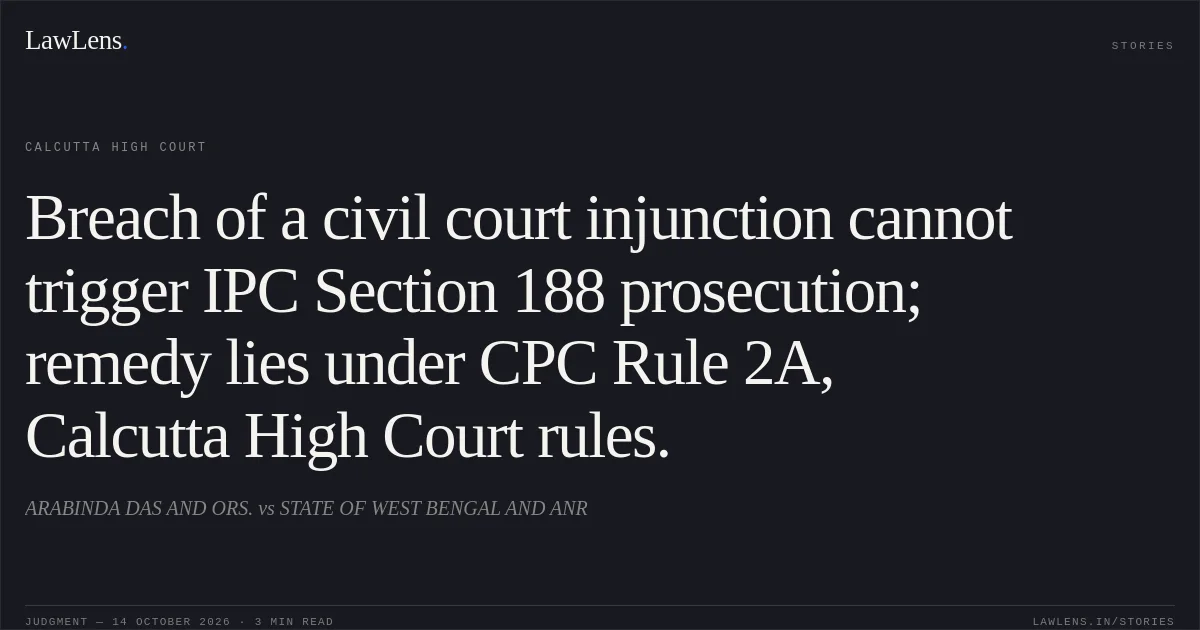
¶ 15–20The alleged disobedience concerned a civil court’s status quo order in a private property dispute; the Court held that such an allegation was not actionable under Section 188 IPC and that the complainant could pursue the remedy under Order XXXIX Rule 2A CPC.
¶ 21–25It further noted that Petitioners 3–5 were not parties to the earlier suit, while Petitioners 3 and 4 had a separate civil injunction protecting their construction.
¶ 26–27The Court concluded that continuing a prosecution barred at the cognizance stage would amount to abuse of process.
¶ 2905Holding
The Court answered all three issues in favour of the petitioners, allowed the revision, and quashed G.R. Case No. 5580 of 2023, the underlying Sankrail Police Station Case No. 850 of 2023, and the Magistrate’s order dated 20 December 2023.
¶ 30–32It clarified that the opposite party and the plaintiffs in the civil suit remained free to pursue an appropriate remedy under Order XXXIX Rule 2A CPC.
¶ 33Original Court PDF
ARABINDA DAS AND ORS.vsSTATE OF WEST BENGAL AND ANR
Click to open original judgment
Original judgment, available to read, download and summarize on LawLens.in