01Facts
The petitioner, a partner of M/s Meenakshi Fishing & Trading Company, sought quashing under s. 482 CrPC of G.R. Case No. 1139 of 2020, arising from Charge Sheet No. 105 of 2021 in Aberdeen P.S. Case No. 324 of 2020 under s. 420 IPC.
¶ 1 · pp. 1–2The complainant, M/s Shaurya Trade Impex Pvt. Ltd., alleged an outstanding business debt of Rs. 33,29,02,400. The petitioner issued cheques totalling Rs. 2,81,67,100 toward partial payment, all of which were dishonoured with the remark "Bank Account Closed".
¶ 2 · p. 3The complaint was lodged on 11.09.2020.
¶ 2 · p. 3On 06.10.2020 the parties executed a Settlement Agreement fixing the claim at Rs. 2,20,00,000, with para. 8 providing for withdrawal of criminal proceedings upon fulfilment of financial terms.
¶ 3 · p. 4The petitioner paid Rs. 1,25,00,000 by RTGS and issued two post-dated cheques for Rs. 50,00,000 (6.1.2021) and Rs. 45,00,000 (25.3.2021).
¶ 3 · p. 4On 27.07.2021 the complainant wrote to the SHO stating the dispute was settled in full and requesting closure.
¶ 4 · p. 4Investigation nonetheless continued and a charge sheet was filed on 31.10.2021.
¶ 4 · p. 4Both settlement cheques were later dishonoured with the remark "Account Closed," leading to further proceedings, including Aberdeen P.S. Case No. 252 of 2023 and s. 138 NI Act proceedings.
¶ 4 · pp. 4–5In the 2023 anticipatory bail cancellation proceedings, the complainant filed an affidavit noting the settlement of Rs. 2.2 crores.
¶ 4 · p. 5The petitioner contended that payments exceeded Rs. 2.2 crores through banking channels; the complainant contested full satisfaction.
¶ 5–6 · pp. 5–7Charges were scheduled for framing on 24.09.2026.
¶ 1 · p. 102Issues
i.1. Whether issuing cheques drawn on an already closed bank account, both in the original transaction and during the settlement, discloses a prima facie offence of cheating under s. 420 IPC, or merely a civil breach of contract.
¶ 7 · pp. 7–8ii.2. Whether the High Court should exercise its inherent powers under s. 482 CrPC to quash the criminal proceeding on the basis of the settlement agreement, the police closure letter and the subsequent bail affidavit, where the post-settlement cheques bounced from a closed account and full payment is contested.
¶ 7 · pp. 7–803Law Applied
Ss. 415 and 420 IPC require that cheating involves deception inducing delivery of property, coupled with dishonest intention existing at the time of inducement.
¶ 8 · p. 8Following Hridaya Ranjan Prasad Verma v. State of Bihar, (2000) 4 SCC 168, intention may be inferred from subsequent conduct, but a mere failure to perform a promise is a breach of contract unless dishonesty existed from the outset.
¶ 8 · p. 8Under State of Haryana v. Bhajan Lal, 1992 Supp (1) SCC 335, quashing under s. 482 CrPC is warranted only where uncontroverted allegations, taken at face value, disclose no offence, without a premature inquiry into disputed facts.
¶ 8 · p. 8 · ¶ 13 · p. 12Section 320(2) CrPC makes s. 420 IPC compoundable by the person cheated with the court's permission, and s. 482 CrPC preserves inherent power to prevent abuse of process.
¶ 10 · p. 10Under Gian Singh v. State of Punjab, (2012) 10 SCC 303, predominantly civil or commercial disputes may be quashed where the parties have amicably resolved the entire dispute and continuation would be oppressive.
¶ 10 · p. 10Under State of Madhya Pradesh v. Laxmi Narayan, (2019) 5 SCC 688, quashing depends on whether the dispute has truly been resolved in full, having regard to the stage of the case and the accused's conduct.
¶ 10 · pp. 10–11The Coordinate Bench decision in C.R.R. No. 31 of 2023 (decided 19.06.2024) holds that s. 482 CrPC cannot be used by an accused who defaults on post-settlement cheques, and that the High Court cannot conduct a mini-trial over contested payment records.
¶ 6, 11 · pp. 6–7, 11Provisions in the judgment · 5 · Linked ones open on LawLens
Code of Criminal Procedure, 1973 Section 320Section 482
Indian Penal Code, 1860 Section 415Section 420
Negotiable Instruments Act, 1881 Section 138
04Reasoning
The initial dishonour of all cheques for Rs. 2.81 crores with the remark "Account Closed" invited a strong inference that the petitioner never intended the instruments to be honoured when delivered, distinguishing a bona fide trader who later defaults from the present case.
¶ 9 · p. 9The post-settlement conduct, namely issuing settlement cheques that bounced from a closed account, reinforced that inference of dishonest intention at the time of inducement, taking the matter outside Hridaya Ranjan and Bhajan Lal and raising a triable issue.
¶ 9 · pp. 9–10Quashing on the strength of a compromise requires a genuine, complete and subsisting settlement.
¶ 10 · p. 10Although the petitioner relied on the settlement clause, the banking receipts, the July 2021 letter and the 2023 affidavit, the complainant disputed satisfaction because the settlement cheques were dishonoured.
¶ 11 · p. 11The July 2021 letter and the bail affidavit were predicated on the expectation that the settlement would be honoured, so they could not sustain quashing against the complainant's objection.
¶ 11 · pp. 11–12Resolving competing payment records would require a mini-trial impermissible under s. 482 CrPC.
¶ 11 · p. 11The offence is compoundable with the trial court's permission, so the petitioner retains a remedy before the trial court through banking proof of full payment, or through clearing the shortfall and securing the complainant's consent to a joint compounding application.
¶ 12 · p. 1205Holding
The first issue is answered in the affirmative: repeated cheques drawn on a closed account establish a prima facie case of cheating under s. 420 IPC requiring a regular trial.
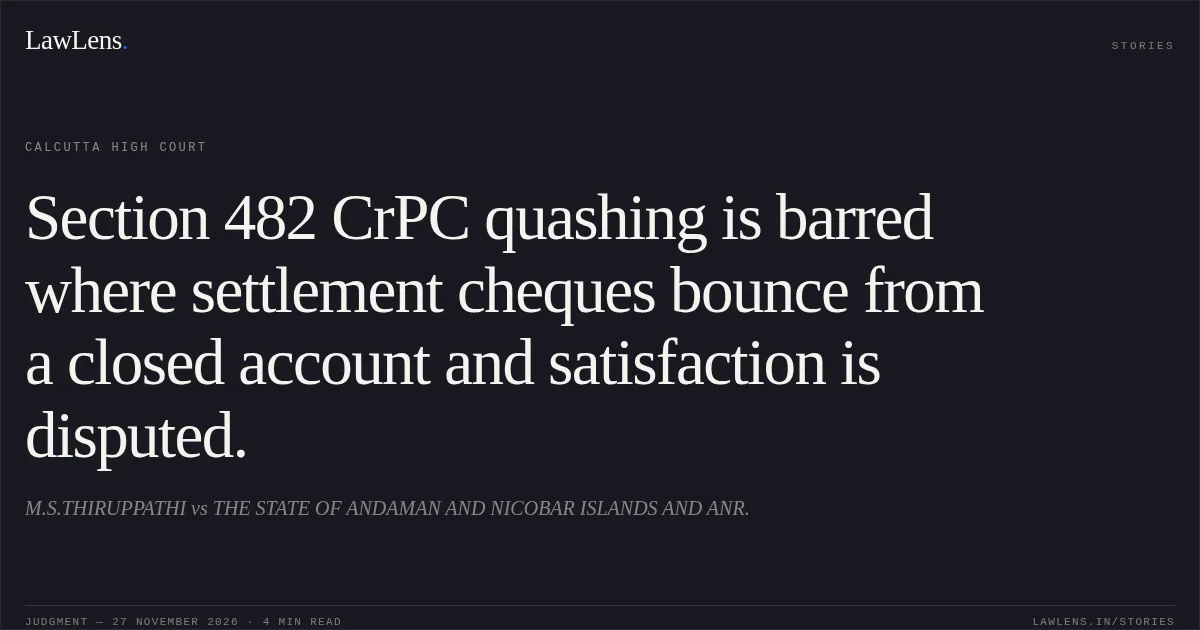
¶ 13(i) · p. 12The second issue is answered in the negative: where post-settlement cheques are dishonoured from a closed account and satisfaction is disputed, the High Court cannot conduct a mini-trial or quash G.R. Case No. 1139 of 2020 under s. 482 CrPC over the complainant's objection.
¶ 13(ii) · pp. 12–13The petition is dismissed and the prayer for quashing is refused.
¶ 14–15 · p. 13Interim orders stand vacated, with no order as to costs.
¶ 16 · p. 13The trial court may examine any banking records or entertain a joint compounding application under s. 320(2) CrPC.
¶ 12 · p. 12Original Court PDF
M.S.THIRUPPATHIvsTHE STATE OF ANDAMAN AND NICOBAR ISLANDS AND ANR.
Click to open original judgment
Original judgment, available to read, download and summarize on LawLens.in