Facts
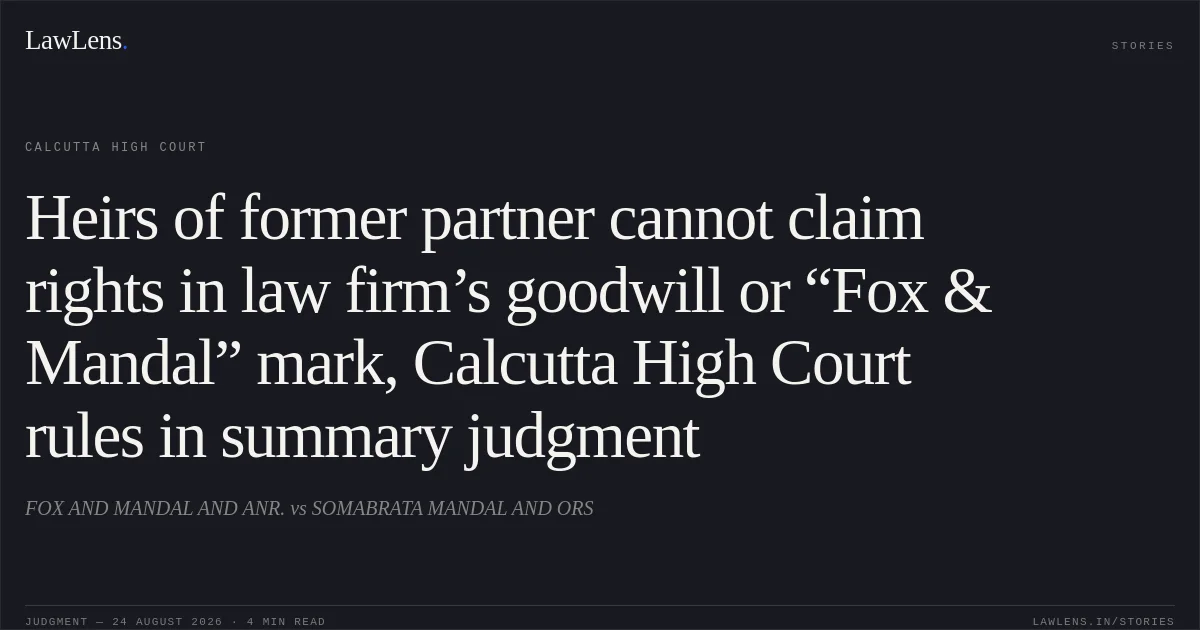
The plaintiff no. 1, a registered partnership firm constituted in 1896, has continuously provided legal services under the marks “Fox and Mandal”, “Fox & Mandal” and “F&M” and obtained trademark registrations, claiming user since 1 January 1896.
Source reference: para. 4Plaintiff no. 2 is a limited liability partnership subsequently established by the firm and its partners.
Source reference: para. 4Defendant no. 2 is a separate partnership firm formed in 1984 by, inter alia, certain then-partners of the plaintiff firm and operates in the same field of legal services; defendant no. 1 was never a partner or employee of the plaintiff firm.
Source reference: para. 6The plaintiffs alleged that the defendants, through publications, advertisements, websites and other materials, falsely represented an association with the plaintiff firm and claimed its legacy and history.
Source reference: paras. 7, 13–14Interim injunctions restraining such conduct were granted and subsequently confirmed in appellate proceedings.
Source reference: para. 8Despite service of the writ of summons, the defendants did not file a written statement.
Source reference: para. 3The plaintiffs accordingly sought summary judgment under Order XIII-A of the Code of Civil Procedure, 1908, in the passing-off suit.
Source reference: para. 2The defendants contended that defendant no. 1, as an heir of a former partner, possessed rights in the firm’s shared goodwill and that “Fox & Mandal” was a family mark; they also relied on prior registration, alleged acquiescence and the absence of proof of actual damage.
Source reference: para. 10Issues
1. Whether the plaintiffs established the essential elements of passing off—reputation or goodwill, misrepresentation creating a likelihood of confusion, and actual or likely damage—and were entitled to a permanent injunction.
Source reference: paras. 11–15, 24, 282. Whether the defendants could claim any right to use the marks or goodwill of the plaintiff firm as heirs of a former partner, joint proprietors, or members of a family entitled to use a “family mark”.
Source reference: paras. 16–213. Whether the defendants had any real prospect of successfully defending the suit, or whether any compelling reason required a regular trial under Order XIII-A CPC.
Source reference: paras. 28–314. Whether delay, acquiescence, third-party use, registration, or the plaintiffs’ failure to prove actual damage defeated the passing-off claim.
Source reference: paras. 19, 22, 24–25Law Applied
The Court applied Order XIII-A, particularly Rule 3, CPC, under which summary judgment may be granted where the defendant has no real prospect of successfully defending the claim and there is no other compelling reason for a trial.
Source reference: paras. 28–29In passing-off law, the “classic trinity” consists of the plaintiff’s reputation or goodwill, the defendant’s misrepresentation likely to deceive the public, and actual or likely damage to the plaintiff’s goodwill.
Source reference: paras. 11–12Misrepresentation need not be fraudulent; likelihood of confusion among actual or potential customers is sufficient, judged in light of the ordinary consumer’s imperfect recollection.
Source reference: para. 12A prior user has superior rights over a subsequent user, and registration is not decisive in a passing-off action: S. Syed Mohideen v. P. Sulochana Bai.
Source reference: paras. 15, 19Goodwill generated by a partnership is an asset of the partnership and does not belong individually to a partner or the partner’s heirs: Bhagwan Dass Khanna Jewellers v. Bhagwan Das Khanna Jewellers Pvt. Ltd. and Byford v. Oliver.
Source reference: para. 16Acquiescence requires positive conduct and cannot be inferred merely from silence or delay; likelihood of damage is sufficient, and proof of actual damage is unnecessary: Power Control Appliances v. Sumeet Machines, Ramdev Food Products v. Arvindbhai Rambhai Patel, Laxmikant V. Patel v. Chetanbhai Shah and Satyam Infoway Ltd. v. Siffynet Solutions.
Source reference: paras. 22, 24Use by third parties is generally not a defence, as the plaintiff is dominus litis and may choose whom to sue.
Source reference: para. 25Reasoning
The Court found that the plaintiff firm was the admitted prior and continuous user of the impugned marks since 1896, whereas the defendants were subsequent users claiming use only from 1986; the plaintiff’s reputation and goodwill were undisputed.
Source reference: para. 15The defendants’ publications, website content and historical claims were calculated to create the impression of an existing connection with the plaintiff firm, particularly because both parties operated in the same legal-services sector; this amounted to misrepresentation and created a likelihood of deception and damage.
Source reference: paras. 13–15, 27The Court rejected the “shared goodwill” and “family mark” defences because the marks and goodwill belonged to the partnership firm, not to any individual partner or heir, and defendant no. 1 had never been a partner or employee of the plaintiff firm.
Source reference: paras. 16, 18, 20–21Any monetary entitlement of defendant no. 1 as an heir had already been satisfied under a final decree in separate proceedings, leaving him without any proprietary interest in the firm or its marks.
Source reference: para. 17The alleged registration, no-objection certificate, delay, acquiescence and absence of actual damage did not defeat a passing-off action.
Source reference: paras. 19, 22, 24In the absence of a written statement, and since the defences were found to be sham, illusory and incapable of success, the Court held that there were no genuine triable issues or compelling reason for oral evidence.
Source reference: paras. 28–29Holding
The Court held that the plaintiffs established reputation, misrepresentation and likelihood of damage and that the defendants had no real prospect of successfully defending the passing-off claim.
GA No. 4 of 2023 was allowed, and a decree of perpetual injunction was granted restraining defendant nos. 1 and 2, their men, servants, agents, assigns and other partners from representing any association with the plaintiff firm or plaintiff no. 2, claiming the plaintiff’s 1896 legacy, passing off their firm or legal services as those of the plaintiffs, or using the marks “Fox & Mandal”, “Fox and Mandal” and “F&M”.
Source reference: para. 32IP-COM No. 6 of 2025 and all interlocutory applications were disposed of accordingly.
Source reference: para. 32The defendants’ post-judgment request for stay of the decree was rejected.
Source reference: para. 32; post-judgment orderOriginal Court PDF
FOX AND MANDAL AND ANR.vsSOMABRATA MANDAL AND ORS
Click to open original judgment
Original judgment, available to read, download and summarize on LawLens.in