Facts
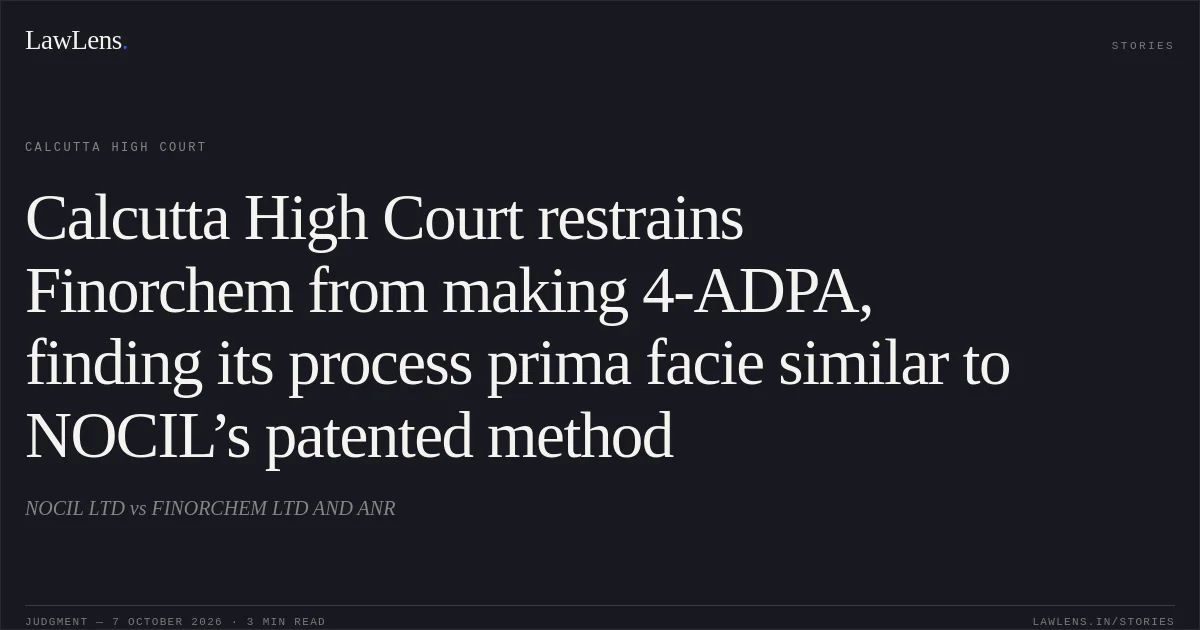
NOCIL held three Indian process patents relating to the manufacture of 4-ADPA.
Source reference: para. 1It alleged that Finorchem proposed to manufacture the same product using processes infringing those patents and had relied on an Environmental Impact and Risk Assessment (EIRA) report substantially reproducing NOCIL’s report.
Source reference: paras. 1–5, 7–9NOCIL also alleged that its former employee, defendant no. 2, who had worked on the 4-ADPA project and signed a non-disclosure agreement (NDA), had disclosed confidential information to Finorchem.
Source reference: paras. 1–5, 7–9Finorchem disputed infringement and challenged the patents’ validity; defendant no. 2 denied access to or disclosure of confidential information.
Source reference: paras. 1–5, 7–9NOCIL sought interim relief for patent infringement and breach of confidentiality.
Source reference: paras. 1–5, 7–9Issues
1. Whether NOCIL had established a sufficient prima facie case of infringement, and whether Finorchem had raised a credible challenge to the validity of the suit patents that would preclude interim relief.
Source reference: paras. 10–12, 19, 272. Whether the materials established a prima facie case that defendant no. 2 breached his confidentiality obligations and that Finorchem procured or misused NOCIL’s confidential information.
Source reference: paras. 24–25, 27Law Applied
Sections 12 and 13(4) of the Patents Act, 1970 mean that grant of a patent does not, by itself, establish its validity; nevertheless, grant and prolonged commercial exploitation may receive weight at the interim stage.
Source reference: paras. 10, 12Under Sections 64 and 107, a defendant may challenge validity in an infringement suit, but must raise a credible, prima facie sustainable challenge—not one that is fanciful or illusory—to resist interim protection.
Source reference: para. 11Section 104A may shift the burden of proving the process used where its conditions are met; the Court considered the identity of the product and the respondent’s evidence in applying that provision.
Source reference: para. 21Section 48(b) gives a process patentee the exclusive right to prevent unauthorised use of the patented process.
Source reference: para. 26For infringement, the Court compared the essential inventive features—the “pith and marrow”—of the patent claims with the challenged process, disregarding merely trifling variations.
Source reference: para. 19The Court also applied the principle that confidential information may remain protected even where some constituent elements are publicly available, and that an employee or former employee must not misuse an employer’s trade secrets or confidential information.
Source reference: paras. 24–25*Zee Telefilms Ltd. v. Sundial Communications Pvt. Ltd.*
Source reference: para. 25*John Richard Brady v. Chemical Process Equipments P. Ltd.* and *Hi-Tech Systems & Services Ltd. v. Suprabhat Ray*
Source reference: para. 24Reasoning
The Court gave weight to the patents’ examination, age, and commercial exploitation, while recognising that grant alone did not establish validity.
Source reference: paras. 10–12It found that Finorchem had not raised a credible validity challenge and that its changing descriptions of its process, proposed patent amendments, and the close correspondence between the parties’ EIRA reports supported NOCIL’s case.
Source reference: paras. 14–16, 20, 23Comparing the processes’ common steps and the uncontroverted expert evidence, the Court considered the alleged differences minor and the processes prima facie equivalent in their essential features.
Source reference: paras. 17–19As to confidentiality, the NDA expressly concerned the 4-ADPA project, and the available evidence of defendant no. 2’s project involvement, together with the circumstances of his engagement by Finorchem and the respondents’ conduct, supported a prima facie inference of breach and misuse.
Source reference: para. 24The Court therefore found a strong prima facie case, a balance of convenience in NOCIL’s favour, and a risk of irreparable injury.
Source reference: para. 27Holding
The Court held that NOCIL had established a strong prima facie case of patent infringement and breach of confidentiality, and that Finorchem had failed to raise a credible challenge to the validity of the suit patents.
It granted interim relief in terms of prayers (a) and (b) of the Notice of Motion and disposed of GA-COM 1 of 2024.
Source reference: para. 28Acts & Sections Cited
8 provisions across 1 statute referred to in this judgment. Each provision opens on LawLens.
Original Court PDF
NOCIL LTDvsFINORCHEM LTD AND ANR
Click to open original judgment
Original judgment, available to read, download and summarize on LawLens.in